Common Stock Investing Mistakes: 15 Errors Indian Investors Should Avoid
Understand common stock investing mistakes, from following market tips and chasing hot stocks to ignoring valuation, diversification, costs and risk. Learn practical ways to make more disciplined investment decisions in the Indian stock market.
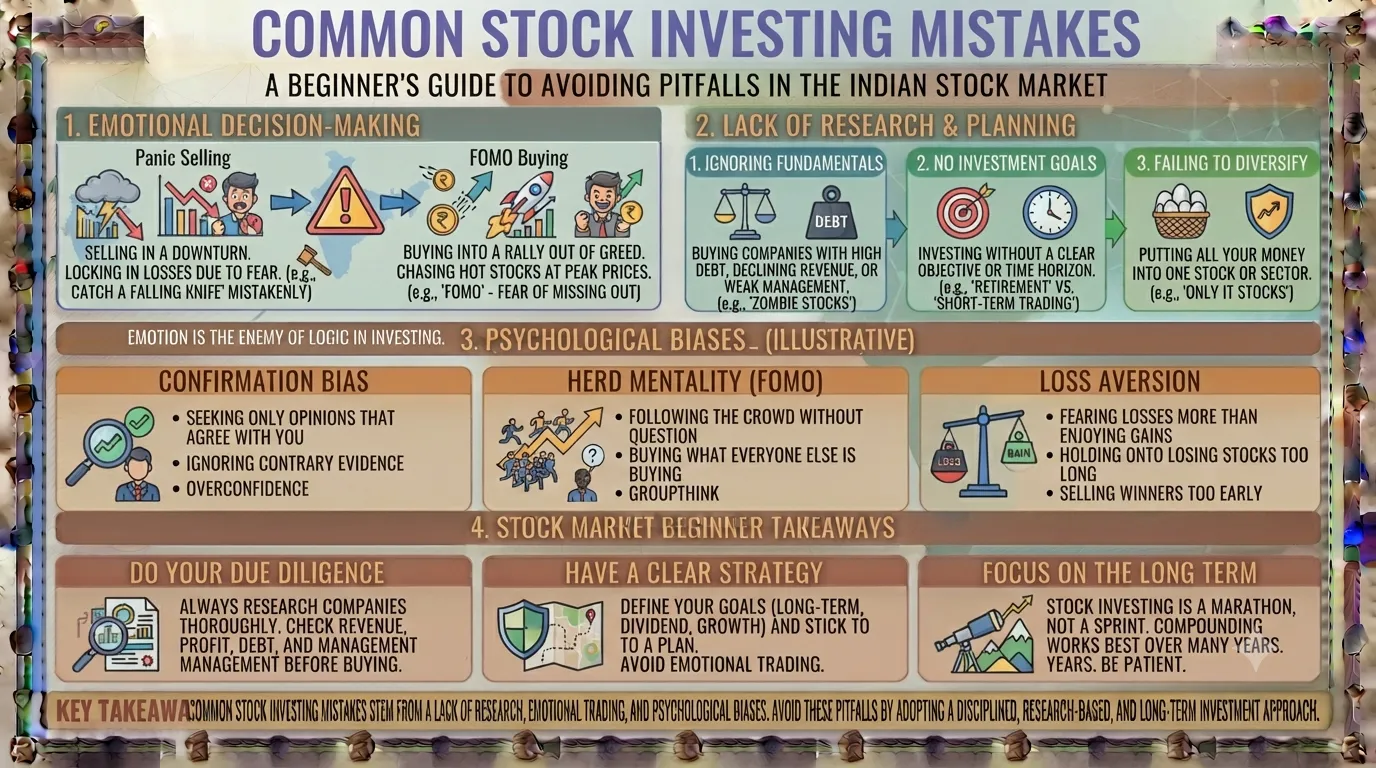
Common Stock Investing Mistakes: 15 Errors Indian Investors Should Avoid
Stock market investing can help investors participate in the growth of businesses, but buying shares without a clear process can expose capital to avoidable risks. Many costly mistakes do not come from a lack of market information. They come from acting on rumours, chasing stocks after sharp rallies, ignoring valuations, concentrating too much money in a few companies or allowing fear and excitement to control decisions.
Common stock investing mistakes include investing without financial goals, following unverified tips, confusing a low share price with a cheap valuation, ignoring company fundamentals, chasing past returns, panic-selling, holding deteriorating businesses, overtrading and neglecting transaction costs. Some investors also use borrowed money, misunderstand derivatives or invest money they may need in the near future.
These mistakes are not limited to beginners. Experienced investors can also fall into behavioural traps such as overconfidence, confirmation bias, loss aversion and herd behaviour. The practical solution is to follow a repeatable investment process: define the goal, understand the business, assess the price and risks, diversify appropriately, account for costs and review decisions using evidence rather than emotion.
Why Do Investors Make Stock Market Mistakes?
Investing decisions are influenced by both financial information and human behaviour. A rising share price can create excitement and fear of missing out. A falling share price can trigger panic or encourage an investor to hold a weak company simply to avoid accepting a loss.
Several behavioural patterns can influence decisions:
- Fear of missing out (FOMO): Buying because a stock is rising and other investors appear to be making money.
- Overconfidence: Assuming a few successful investments prove that future decisions will also be correct.
- Loss aversion: Feeling the pain of a loss so strongly that an investor refuses to reassess a poor investment.
- Confirmation bias: Looking only for information that supports an existing investment opinion.
- Anchoring: Treating the purchase price, previous high or a round number as more important than the company's current fundamentals.
- Herd behaviour: Copying the decisions of friends, social-media personalities or other investors without independent research.
These biases can lead to repeated mistakes even when relevant information is available. The SEBI investor education resources include material on overconfidence, herd mentality, loss aversion and impulsive decisions. The US Securities and Exchange Commission also summarises research on active trading, panic, noise trading and inadequate diversification in its investor behaviour resource.
15 Common Stock Investing Mistakes
1. Investing Without Clear Financial Goals
One of the most basic mistakes is buying stocks before deciding why the money is being invested and when it may be needed.
Money intended for a long-term retirement goal has a different time horizon from money required for a house deposit, education fees or another expense within a few years. Equity prices can decline sharply over short periods, and an investor may be forced to sell at an unfavourable time if the investment does not match the financial goal.
For example, suppose an investor plans to use ₹3 lakh for a major expense in 18 months. Investing the entire amount in individual shares creates the possibility that the market will be down when the money is required. A long-term investment strategy cannot remove this short-term timing risk.
How to avoid it:
- Write down the financial goal before choosing an investment.
- Identify when the money will be required.
- Separate short-term financial needs from long-term investment capital.
- Choose an asset allocation that reflects the goal, time horizon and ability to absorb losses.
- Maintain suitable emergency savings rather than relying on selling shares during a crisis.
SEBI's guide to factors to consider before investing highlights goals, investment horizon, risk appetite, liquidity, diversification and asset allocation as important considerations.
2. Following Stock Tips Without Independent Research
Buying a share because someone recommends it in a WhatsApp group, Telegram channel, online video or social-media post is a dangerous shortcut. The person sharing the recommendation may not understand the company's financial position, may have a different investment horizon or may have a financial interest in attracting buyers.
Some schemes deliberately create artificial excitement around a security. Operators may promote exaggerated claims, display misleading profit screenshots or encourage investors to buy a thinly traded share. They may then sell their own holdings while followers are left exposed to falling prices.
A stock tip is not a substitute for research. Even a recommendation that turns out to be profitable does not prove that the underlying analysis was sound.
How to avoid it:
- Treat recommendations as research leads, not instructions to buy.
- Read company announcements and financial statements.
- Understand how the business earns revenue and generates cash.
- Check whether the person providing regulated investment advice is appropriately registered with SEBI.
- Be suspicious of guaranteed returns, urgent payment requests and pressure to join private groups.
- Never transfer money to a personal account or install an unfamiliar trading application because of an unsolicited recommendation.
SEBI specifically warns investors not to rely on hot tips and advises them to deal with registered intermediaries. Read its Do's and Don'ts of investing in the securities market.
3. Chasing Stocks After a Sharp Price Rally
Investors often notice a stock only after it has risen substantially. News coverage, social-media discussions and visible gains can create the impression that the price will continue moving upward.
The mistake is assuming that a recent price increase automatically means more upside remains. A stock may have already incorporated optimistic expectations about future earnings. If actual results fail to match those expectations, its valuation may contract even when the company continues to grow.
Consider a hypothetical company whose share price rises from ₹200 to ₹400. An investor who notices the stock only after the rally may buy at ₹400 without checking whether earnings, cash flow and future prospects justify the higher price.
The investor is not necessarily wrong to buy after a rally. The mistake is buying without reassessing valuation, business performance and risk.
How to avoid it:
- Compare the current valuation with earnings, cash flow and realistic growth expectations.
- Check whether the rally is supported by business performance or mainly by market enthusiasm.
- Compare the company with suitable industry peers.
- Do not treat recent returns as a forecast of future returns.
- Be willing to miss an opportunity if the price no longer offers an acceptable risk-reward balance.
4. Confusing a Low Share Price With a Cheap Stock
A share trading at ₹20 is not automatically cheaper than a share trading at ₹2,000. The price of one share does not reveal the total value of the company or whether its shares are attractively valued relative to its earnings and assets.
Investors should distinguish between:
- Share price: The market price of one share.
- Market capitalisation: The market value of the company's outstanding equity shares.
- Valuation: An assessment of what the business or its equity may be worth based on financial performance and future expectations.
For example, consider two hypothetical companies:
| Particulars | Company A | Company B |
|---|---|---|
| Share price | ₹20 | ₹500 |
| Outstanding shares | 100 crore | 2 crore |
| Market capitalisation | ₹2,000 crore | ₹1,000 crore |
Company A has a lower share price but a higher market capitalisation. Neither figure establishes which company is a better investment. Investors must also examine profitability, debt, cash flow, growth prospects, governance and valuation.
How to avoid it: Compare companies using relevant financial measures such as price-to-earnings, price-to-book or enterprise value-to-EBITDA where appropriate. Understand the business before interpreting a low share price as an opportunity.
For a deeper explanation, read TradeSensi's guide to market capitalisation and company valuation.
5. Ignoring Company Fundamentals
Buying a share only because its chart looks strong or its price has been rising can lead investors to overlook the financial health of the business.
A company's fundamentals help explain whether its operations can support sustainable earnings and cash generation. Investors should examine more than the latest net profit figure.
Important areas to review include:
- Revenue growth and the source of that growth.
- Operating profit and profit margins.
- Net profit and the impact of exceptional items.
- Operating cash flow and free cash flow.
- Debt levels and interest obligations.
- Customer and supplier concentration.
- Competitive position and industry conditions.
- Management quality and corporate governance.
For example, a hypothetical company reports 20% revenue growth, but its receivables rise much faster and operating cash flow remains weak. This may indicate that reported sales are not converting into cash efficiently. The investor should investigate the reasons rather than treating revenue growth as sufficient evidence of business quality.
How to avoid it: Review annual reports, quarterly results, exchange disclosures and cash-flow statements. Compare performance over multiple periods and against relevant competitors. A single quarter rarely tells the complete story.
6. Ignoring Valuation and Paying Too Much
A strong company is not automatically a good investment at every price. If investors pay substantially more than a business's reasonable value, future returns may disappoint even if the company continues to grow.
Common valuation measures include:
- Price-to-Earnings (P/E): Compares share price with earnings per share.
- Price-to-Book (P/B): Compares market value with the company's book value per share.
- Enterprise Value to EBITDA (EV/EBITDA): Compares enterprise value with earnings before interest, taxes, depreciation and amortisation.
- Price-to-Sales (P/S): Compares market capitalisation with revenue, sometimes useful when earnings are temporarily low or negative.
No valuation ratio should be used in isolation. A bank, manufacturer, software company and capital-intensive utility may require different analytical approaches. Comparing a company with an unsuitable peer group can produce misleading conclusions.
How to avoid it: Use valuation measures appropriate to the industry, compare them with the company's own historical range and assess whether expected growth justifies the current price. Make assumptions explicit rather than treating an estimated fair value as certain.
7. Putting Too Much Money Into One Stock or Sector
Concentration risk develops when a large portion of an investor's capital depends on one company, industry or investment theme. A company-specific problem can then have a disproportionate effect on the entire portfolio.
For example, suppose an investor has a ₹5 lakh equity portfolio and invests ₹2 lakh in one company. If that stock declines by 40%, the loss on the position is ₹80,000. That represents 16% of the original portfolio value, before considering the performance of the other holdings.
Holding several companies does not automatically create diversification. Five banking stocks may still leave the investor heavily exposed to credit conditions, interest rates and financial-sector risks.
How to avoid it:
- Monitor the percentage of the portfolio held in each company.
- Identify overlapping sector and economic exposures.
- Consider diversification across suitable asset classes, not only across stock names.
- Set position limits that reflect your risk capacity and investment strategy.
- Review concentration after major price movements and portfolio changes.
Diversification can reduce the impact of poor performance in an individual holding, but it cannot eliminate broad market risk or guarantee a profit. SEBI explains this distinction in its investment risk-management guidance.
8. Panic-Selling During Normal Market Volatility
Stock prices do not move in a straight line. Even financially sound companies can experience temporary declines because of broader market corrections, changing expectations, interest-rate movements or short-term uncertainty.
Panic-selling occurs when investors exit positions primarily because prices are falling, without checking whether the original investment case has changed.
However, this does not mean investors should always hold a declining stock. A falling price may reflect genuine deterioration in earnings, debt, governance or business prospects. The correct response depends on the reason for the decline and the investment thesis.
How to avoid it:
- Define the reasons for buying before investing.
- Identify the business developments that would invalidate the investment thesis.
- Separate market-wide volatility from company-specific deterioration.
- Avoid making major decisions solely from headlines or intraday price movements.
- Reassess the investment using current evidence rather than hoping for recovery.
For background on market cycles, read TradeSensi's explanation of bull and bear markets.
9. Holding Deteriorating Companies Just to Avoid Booking a Loss
Some investors hold losing shares because they do not want to accept that their original decision may have been wrong. They wait for the share price to return to the purchase price, even when the business has weakened.
This behaviour is connected to loss aversion and anchoring. The purchase price is a historical transaction value; it does not determine what the company is worth today.
Consider a hypothetical investment of ₹1,00,000 that declines by 30% to ₹70,000. To recover the original investment value, the remaining ₹70,000 must rise by approximately 42.86%.
Recovery calculation:
Required gain = [(₹1,00,000 − ₹70,000) ÷ ₹70,000] × 100
Required gain = 42.86%
The calculation shows why large losses are difficult to recover from. It does not mean every declining stock should be sold. Investors should reassess the business, valuation, risk and original investment thesis.
How to avoid it: Ask whether you would buy the same company today at its current price, based on current information. If the business case has materially weakened, do not keep holding solely to avoid recognising a loss.
10. Selling Good Investments Too Early and Holding Weak Ones Too Long
Investors sometimes sell a profitable share as soon as it rises modestly because they fear losing the gain. At the same time, they hold a losing investment for years because they hope it will recover.
This is commonly associated with the disposition effect. It can create an unbalanced portfolio in which stronger investments are removed while weaker holdings remain.
There is no universal rule that winners should always be held or losers should always be sold. A profitable investment may become overvalued, while a declining company may still have a sound long-term business case. Decisions should depend on fundamentals, valuation, portfolio needs and the original investment strategy.
How to avoid it: Use consistent review criteria for both winning and losing positions. Record the reasons for selling, including changes in fundamentals, valuation, risk exposure or financial goals. Do not let the colour of the profit-and-loss figure make the decision for you.
11. Averaging Down Without Rechecking the Investment
Averaging down means buying additional shares after the price falls, reducing the average purchase price. It is not automatically wrong, but it becomes dangerous when investors add money simply because the stock is cheaper than before.
A lower price does not prove that a share is undervalued. The fall may reflect deteriorating earnings, rising debt, governance concerns, loss of market share or a permanent change in the business outlook.
Hypothetical example:
| Transaction | Amount |
|---|---|
| Buy 100 shares at ₹100 | ₹10,000 |
| Buy another 100 shares at ₹70 | ₹7,000 |
| Total investment | ₹17,000 |
| Total shares | 200 |
| New average purchase price | ₹85 |
| Value if price falls to ₹50 | ₹10,000 |
| Unrealised loss | ₹7,000 |
The average purchase price has fallen, but the investor has increased the amount exposed to the same business risk. Averaging down does not repair weak fundamentals.
How to avoid it: Reassess the company's financial statements, competitive position, valuation and risk before adding capital. Do not increase a position simply to make the displayed average price look better.
12. Ignoring Brokerage, Taxes and Other Investment Costs
Investors often focus on gross returns while overlooking the costs involved in buying, holding and selling securities. Brokerage, Securities Transaction Tax (STT), exchange transaction charges, GST, stamp duty, applicable depository charges and taxes can reduce the final amount retained.
The exact charges depend on the security, transaction type, broker, applicable rules and the investor's circumstances. Investors should use the current contract note and broker tariff rather than relying on an old online example.
Frequent buying and selling can make these costs more significant. A strategy that appears profitable before expenses may produce a much smaller net result after charges, taxes and execution differences.
How to avoid it:
- Review the broker's complete fee schedule.
- Read contract notes and transaction statements.
- Understand the tax treatment applicable to the investment and holding period.
- Compare returns after costs, not just headline price changes.
- Avoid unnecessary transactions that do not serve a clear investment purpose.
13. Borrowing Money or Using Leverage to Invest
Borrowing to invest can magnify losses because the investor remains responsible for repayment and interest even if the share price falls. Margin Trading Facility (MTF), loans against securities and other leveraged arrangements can create additional costs and forced-sale risks.
Hypothetical example: An investor contributes ₹1,00,000 and borrows another ₹1,00,000 to purchase shares worth ₹2,00,000. If the share value declines by 20%, the position falls to ₹1,60,000. The loss is ₹40,000, equal to 40% of the investor's original ₹1,00,000 contribution, before interest and charges.
If the broker requires additional margin and the investor cannot provide it, positions may be liquidated according to the applicable terms. A temporary market decline can therefore create a permanent loss for a leveraged investor.
How to avoid it: Do not borrow money simply to increase market exposure. Understand margin requirements, interest, collateral and liquidation conditions before using any leveraged facility. SEBI's investor guidance explicitly cautions against borrowing for securities-market investments.
14. Confusing Long-Term Investing With Short-Term Trading
Investing and trading are related but different activities. Investing generally involves owning a business or a diversified investment for a longer period, with decisions based on fundamentals, valuation and financial goals. Trading generally seeks to benefit from shorter-term price movements and requires a different process for entries, exits, position sizing and risk control.
A common mistake is to buy a stock for a short-term price move, watch it decline and then call it a long-term investment without reassessing the business. Changing the label does not change the underlying risk.
Another mistake is entering futures and options without understanding leverage, expiry, margin and contract obligations. Derivatives are not simply cheaper substitutes for buying shares.
How to avoid it:
- Decide whether the decision is an investment or a trade before entering.
- Use an appropriate research method for the chosen approach.
- Do not convert a failed trade into a long-term holding without a fresh investment analysis.
- Understand the product, costs, obligations and downside before using derivatives.
TradeSensi explains these differences in Investing vs Trading: Key Differences Every Indian Beginner Must Know and its guide to equity, futures and options.
15. Checking the Portfolio Too Often or Never Reviewing It
Two opposite behaviours can both be harmful. Checking share prices constantly may encourage impulsive decisions based on ordinary market fluctuations. Ignoring a portfolio completely can allow serious changes in a company's financial condition or the investor's own financial goals to go unnoticed.
A useful review process is not about reacting to every price movement. It is about checking whether the original investment reasons remain valid.
Investors should review:
- Company results and material exchange announcements.
- Changes in revenue, margins, debt and cash flow.
- Management and corporate-governance developments.
- Valuation changes relative to business performance.
- Portfolio concentration and asset allocation.
- Changes in financial goals, time horizon or risk capacity.
How to avoid it: Set a review schedule appropriate to the investment strategy and respond to material developments when they occur. A regular review is more useful than either constant price monitoring or complete neglect.
Other Important Mistakes Investors Should Watch For
The 15 mistakes above cover many recurring problems, but a few additional errors deserve attention.
Ignoring Corporate Governance and Promoter-Related Risks
Investors sometimes concentrate on earnings and share-price performance while overlooking related-party transactions, auditor qualifications, promoter share pledging, unexplained changes in management or delayed disclosures. These issues can affect the reliability of financial information and shareholder interests.
Review annual reports, stock-exchange disclosures and auditor observations. A single warning sign does not automatically prove misconduct, but unresolved governance concerns should not be ignored.
Assuming a Popular or Large Company Is Automatically Safe
Well-known companies and large-cap stocks can still be overvalued, financially stressed or exposed to industry disruption. Company size and brand recognition do not guarantee investment safety.
Investors should assess business quality, financial strength, valuation and portfolio suitability regardless of how familiar a company may be.
Ignoring Liquidity in Smaller Stocks
A stock may have a displayed market price but limited trading activity. A wide bid-ask spread or shallow market depth can make it difficult to sell a large position at a reasonable price, particularly during market stress.
Check trading volumes, available market depth and the frequency of price gaps. Do not assume that every listed share can be sold immediately at the last traded price.
Failing to Keep Investment Records
Without records, investors may forget why they purchased a stock, what risks they identified or what would make them reconsider the position. This makes it harder to distinguish a disciplined decision from an emotional reaction.
Maintain a simple investment journal with the purchase rationale, valuation assumptions, key risks, expected holding period and review conditions.
How to Avoid Common Stock Investing Mistakes: A Practical Checklist
Before purchasing a stock, use the following checklist. It is designed to make the decision process more consistent, not to guarantee that an investment will be profitable.
| Area | Questions to Ask Before Investing |
|---|---|
| Financial goal | Why am I investing, and when might I need this money? |
| Business understanding | Can I explain how the company earns revenue and generates cash? |
| Financial health | Are earnings, margins, debt and cash flow sustainable? |
| Valuation | Is the current price reasonable relative to the company's prospects? |
| Management | Are disclosures, governance and capital-allocation decisions credible? |
| Risk | What could make the investment lose value permanently? |
| Diversification | Will this purchase create excessive company or sector concentration? |
| Liquidity | Can I reasonably buy or sell the quantity I intend to hold? |
| Costs and taxes | Have I considered brokerage, statutory charges and applicable taxes? |
| Decision discipline | Am I acting on research or reacting to a tip, headline or price movement? |
A Simple Process for Reviewing an Existing Investment
Investors do not need to make a new decision every time a share price changes. A structured review can help determine whether the investment still makes sense.
- Revisit the original reason for buying: Check whether the business developments you expected have actually occurred.
- Review the latest financial information: Compare revenue, margins, earnings, debt and cash flow with earlier periods.
- Check for material changes: Look for new competition, regulatory developments, management changes, governance concerns or loss of major customers.
- Reassess valuation: Determine whether the current price still offers an acceptable relationship between business prospects and risk.
- Review portfolio exposure: Consider whether the position has become too large or overlaps with other holdings.
- Make a reasoned decision: Hold, reduce or exit based on the updated investment case and financial objectives—not simply because the position is showing a profit or loss.
- Record the decision: Note the evidence and reasoning so that future reviews can be more objective.
Frequently Asked Questions About Common Stock Investing Mistakes
1. What are the most common mistakes in stock market investing?
Common mistakes include following unverified tips, buying after a stock has already rallied, ignoring valuation and company fundamentals, concentrating too much money in a few shares, panic-selling, holding deteriorating businesses, overtrading and overlooking investment costs. Emotional biases can make these mistakes more frequent.
2. Why do beginners lose money in the stock market?
Beginners may lose money because they invest without understanding the business, take risks that do not match their financial goals, follow market rumours, chase popular stocks or underestimate volatility and costs. Losses can also occur because of genuine market and company risks, even when an investor follows a disciplined process.
3. Is buying a low-priced stock a good investment strategy?
Not by itself. A low share price does not establish that a company is undervalued. Investors should examine market capitalisation, earnings, cash flow, debt, valuation, liquidity and business prospects before deciding whether a share is attractively priced.
4. Should investors average down when a stock falls?
Averaging down is not automatically wrong, but it should not be done simply to reduce the displayed average purchase price. Investors should first investigate why the share has fallen and whether the company's financial condition, valuation and investment case still justify adding capital.
5. Is it a mistake to sell a stock at a loss?
No. Selling at a loss can be reasonable when the investment thesis has deteriorated, the company faces material risks or the investment no longer fits the portfolio. The mistake is making the decision only to avoid recognising a loss or, conversely, selling purely because of temporary price volatility without reassessing the fundamentals.
6. How many stocks should a beginner hold?
There is no universally correct number. The appropriate portfolio size depends on the investor's capital, ability to research and monitor companies, diversification needs and risk capacity. Holding more stocks does not automatically create diversification if the companies have similar business and market exposures. A suitably diversified fund may be a simpler option for some beginners.
7. Is long-term investing free from stock market risk?
No. A longer investment horizon may give an investor more time to manage short-term volatility, but it does not remove market risk, business failure, poor governance, overvaluation or permanent capital loss. Long-term investors still need to evaluate the businesses and review whether their investments remain suitable.
8. How can investors avoid emotional decisions?
Investors can reduce emotional decision-making by defining financial goals, writing down the investment thesis, setting review criteria, avoiding unverified tips, limiting unnecessary price checking and reviewing decisions against financial evidence. A written process cannot eliminate bias, but it can make impulsive decisions easier to recognise.
Conclusion
Common stock investing mistakes often begin when investors replace research and planning with excitement, fear, convenience or the opinions of others. Chasing recent winners, confusing low share prices with low valuations, ignoring company fundamentals and concentrating too much capital can expose a portfolio to risks that could have been identified earlier.
A more disciplined approach starts with clear financial goals and an understanding of the business. Investors should examine financial statements, valuation, management quality, liquidity, diversification and transaction costs. They should also recognise behavioural biases, distinguish investing from trading and review holdings when meaningful information changes.
There is no method that can eliminate all investment mistakes or guarantee positive returns. The objective is to make decisions using reliable information, understand the possible downside and avoid repeating errors that undermine long-term financial goals.
Disclaimer: This article is for educational and informational purposes only. It is not investment advice or a recommendation to buy, sell or hold any security. Equity investments are subject to market risks, including the possible loss of capital. All company and portfolio examples in this article are hypothetical and are provided for explanation only. Readers should conduct independent research and consider consulting a SEBI-registered investment adviser before making investment decisions.