What Are Equity, Futures and Options? Key Differences Explained
Learn how equity shares, futures and options work, how they differ, and what Indian investors should know about ownership, leverage, premiums, obligations and trading risks.
What Are Equity, Futures and Options? Key Differences Explained
Imagine you want to benefit from a rise in the price of a company such as Reliance Industries. You could purchase its shares and become a part-owner of the business. You could also trade a futures contract linked to its share price, or buy an options contract that gives you the right to buy or sell at a specified price.
All three approaches are connected to the stock market, but they are not the same. One represents ownership in a company. The other two are derivative contracts whose values depend on an underlying share or market index. They also differ considerably in how much capital is required, what obligations are created and how losses can arise.
For anyone learning the Indian stock market, understanding these differences is more useful than simply memorising the terms equity, futures and options.
What Are Equity, Futures and Options?
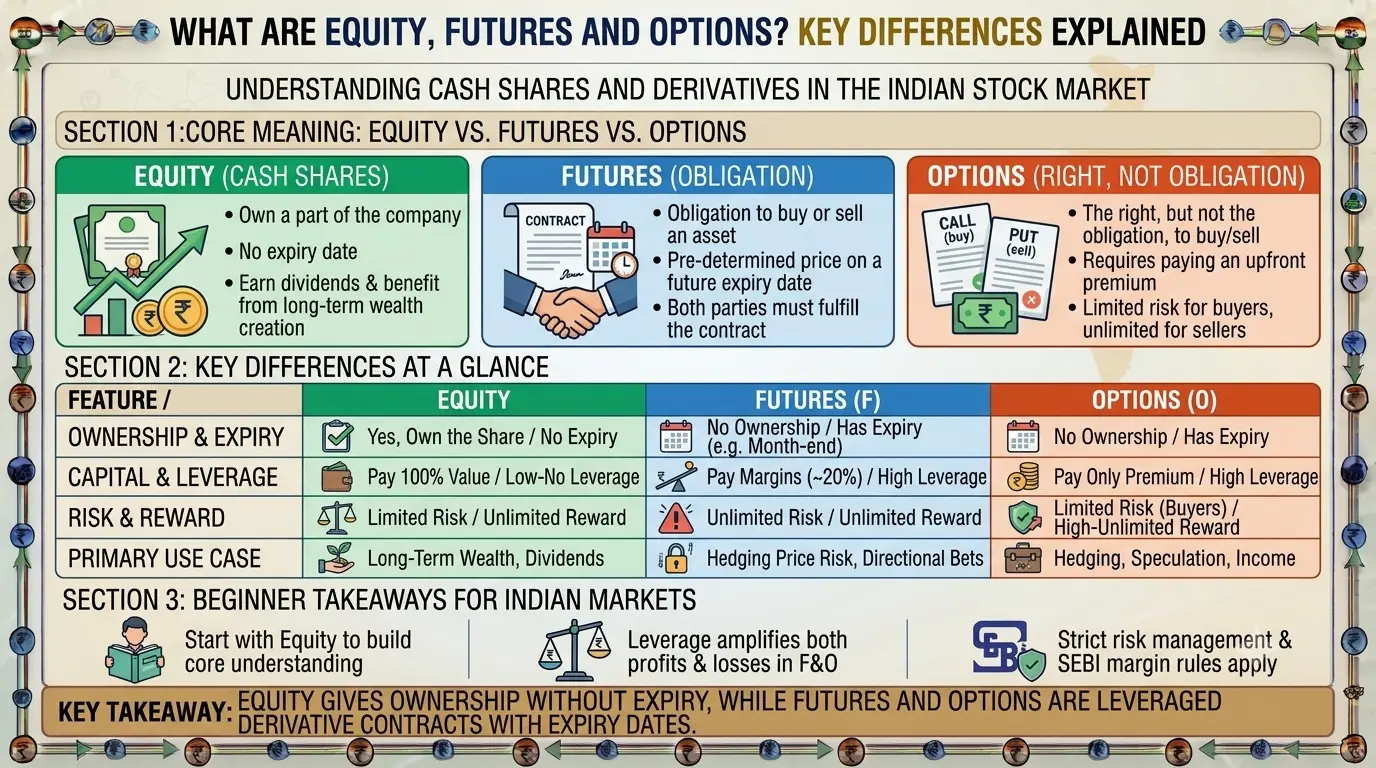
Equity represents ownership in a company through shares. Futures are standardised derivative contracts that create an obligation for both parties to buy or sell an underlying asset according to the contract terms. Options give the buyer the right, but not the obligation, to buy or sell an underlying asset at a specified price within the contract's permitted period.
Equity is commonly used for investing and trading in company ownership. Futures and options, together called F&O, are derivatives used for activities such as hedging, speculation and managing market exposure.
What Is Equity in the Stock Market?
Equity refers to an ownership interest in a company. When a company issues shares and an investor purchases them, the investor acquires a proportional ownership interest in that business.
For example, suppose you purchase 10 shares of a listed company at ₹500 each. Your investment is ₹5,000, excluding transaction charges and taxes. You now hold 10 shares of that company. If the share price rises to ₹600, the market value of your holding becomes ₹6,000. If it falls to ₹400, the holding becomes worth ₹4,000.
The change in market value is not necessarily a realised profit or loss. It becomes realised when you sell the shares, after accounting for applicable costs and taxes.
How Does Equity Investing Work?
- Open the required accounts: An investor generally needs a trading account with a broker and a Demat account to hold shares electronically.
- Select a listed company: Investors study the company's business, financial performance, valuation and risks before making a decision.
- Place a buy order: The order is routed through the broker to the relevant stock exchange, such as NSE or BSE.
- Shares are credited: After the applicable settlement process, purchased shares are credited to the investor's Demat account.
- Monitor the investment: The investor can hold the shares, receive eligible corporate benefits or sell them through the market.
How Can Equity Investors Earn Returns?
Equity investors may earn returns in two main ways:
- Capital appreciation: The share price increases and the investor sells at a higher price than the purchase price.
- Dividends: A company may distribute a portion of its profits or reserves to eligible shareholders, subject to its decisions and applicable rules.
Neither outcome is guaranteed. A company can perform poorly, its share price can decline, and it may decide not to distribute a dividend. Equity shareholders also face business, valuation, market and liquidity risks.
What Are Futures in the Stock Market?
A futures contract is a standardised agreement traded on an exchange to buy or sell an underlying asset at a predetermined price on a specified future date, according to the contract's terms.
In the Indian equity derivatives market, futures contracts can be linked to eligible individual shares or stock market indices. Their value changes as the underlying share or index moves, along with other pricing factors.
The important distinction is that a futures contract creates an obligation for both sides. The buyer and seller cannot treat the contract like an optional purchase once they have entered the position. They must close or settle it according to the exchange and contract rules.
How Does Futures Trading Work?
Consider a hypothetical stock futures contract with a contract quantity of 100 shares. Suppose its futures price is ₹1,000 per share. The notional contract value is:
100 × ₹1,000 = ₹1,00,000
This is the value represented by the contract. It does not mean that the trader necessarily pays ₹1,00,000 upfront. Futures positions generally require margin, which is a deposit collected to cover potential market risk. The applicable margin can change and should be checked with the broker and exchange.
Now suppose the futures price rises from ₹1,000 to ₹1,050. If the trader holds a long position of 100 units and closes it at that price, the illustrative gross gain is:
(₹1,050 − ₹1,000) × 100 = ₹5,000
If the futures price instead falls to ₹950, the illustrative gross loss is ₹5,000. Brokerage, taxes, exchange charges, applicable levies and other costs are not included in these calculations.
The example demonstrates why leverage matters. A relatively small movement in the underlying price can create a significant profit or loss compared with the margin deposited. Losses can exceed the initial margin.
Why Do Traders Use Futures?
- Hedging: An investor may use futures to offset some of the risk associated with an existing portfolio or exposure.
- Speculation: A trader may take a position based on an expectation that the underlying price will rise or fall.
- Arbitrage: Market participants may attempt to benefit from pricing differences between related instruments, subject to costs and execution risks.
Futures are not simply a cheaper way to buy shares. They are time-bound contracts with margin requirements, daily risk management and settlement obligations. Stock futures in India can involve physical settlement at expiry, while index derivatives are settled according to their applicable cash-settlement rules. Traders must check the current contract specifications rather than assume every derivative settles in the same way.
What Are Options in the Stock Market?
An options contract gives its buyer a right, but not an obligation, to buy or sell an underlying asset at a predetermined price, known as the strike price, within the contract's permitted period.
To obtain this right, the buyer pays an amount called the premium. The option seller, also called the writer, receives the premium but takes on the obligation to fulfil the contract according to its terms if assigned or exercised.
Options are commonly divided into two categories: call options and put options.
What Is a Call Option?
A call option gives the buyer the right to buy the underlying asset at the strike price. A trader may buy a call when expecting the underlying price to rise enough to make the option valuable.
Hypothetical example: A trader buys a call option with a strike price of ₹1,000 and pays a premium of ₹30 per share. At expiry, suppose the underlying share price is ₹1,100.
The option's intrinsic value at expiry is ₹100 per share (₹1,100 − ₹1,000). After subtracting the ₹30 premium, the illustrative net payoff before transaction costs is ₹70 per share.
If the share price finishes at or below ₹1,000, the call has no intrinsic value at expiry. The buyer may lose the premium paid, subject to the contract and applicable charges.
What Is a Put Option?
A put option gives the buyer the right to sell the underlying asset at the strike price. A trader may buy a put when expecting the underlying price to fall. Puts can also be used as part of a hedging strategy.
Hypothetical example: A trader buys a put option with a strike price of ₹1,000 and pays a premium of ₹25 per share. If the underlying share price falls to ₹900 at expiry, the option has an intrinsic value of ₹100 per share.
After subtracting the ₹25 premium, the illustrative net payoff is ₹75 per share before transaction costs. If the share price finishes at or above ₹1,000, the put has no intrinsic value at expiry and the buyer may lose the premium paid.
What Determines an Option's Premium?
An option premium is not determined only by whether a share is rising or falling. Several factors influence its price:
- Underlying price: The current price of the share or index compared with the strike price.
- Strike price: The price at which the option gives the right to buy or sell.
- Time to expiry: The time remaining before the contract expires. Other things being equal, less time generally means less time value.
- Implied volatility: The market's expectation of future price movement reflected in option prices. Higher implied volatility can increase premiums, all else being equal.
- Interest rates and dividends: These can also influence option pricing, depending on the underlying and contract.
An option can lose value even when the underlying share moves in the expected direction. The size of the move, the time remaining and changes in implied volatility all matter.
Equity vs Futures vs Options: Key Differences
| Feature | Equity | Futures | Options |
|---|---|---|---|
| What it represents | Ownership in a company | A contract to buy or sell an underlying asset | A right to buy or sell an underlying asset |
| Ownership of shares | Yes, when shares are purchased | No ownership merely from holding the contract | No ownership merely from buying the option |
| Obligation | Shareholder has ownership rights and responsibilities | Both sides have contractual obligations | Buyer has a right, not an obligation; seller has an obligation |
| Initial payment | Share purchase price | Margin as required | Buyer pays a premium |
| Expiry | No fixed expiry for ordinary shares | Has a contract expiry | Has a contract expiry |
| Potential loss | Share value can fall substantially | Can be substantial and may exceed margin | Buyer generally risks the premium; option sellers can face much larger losses |
| Common uses | Investing, ownership and trading | Hedging and speculation | Hedging, speculation and strategy construction |
The table describes the broad characteristics of these instruments. Actual settlement, margin, exercise and expiry conditions depend on the specific exchange-traded contract.
What Is the Difference Between Equity Trading and F&O Trading?
Equity trading involves buying or selling shares in the cash market. When an investor buys shares and holds them in a Demat account, the investor owns those shares. The holding does not normally expire simply because time has passed.
F&O trading involves derivative contracts. A futures or options position has a defined expiry and contract specifications. The trader's result depends on the contract's price, the underlying market, time remaining, volatility, margin and settlement rules.
For example, someone who buys 10 shares of a company can continue holding them after a market correction if the shares remain in their account. Someone holding a call option cannot simply wait indefinitely for the share price to recover. The option has an expiry date, and its time value can decline as that date approaches.
Why Do Investors and Traders Use Derivatives?
Derivatives are not designed only for short-term speculation. They also serve risk-management purposes.
Hedging an Existing Investment
Suppose an investor owns shares worth ₹2 lakh and is concerned about a possible short-term decline. A suitable put option may help offset some downside risk. However, the protection is not free: the investor pays a premium, and the hedge may not perfectly match the portfolio's movement.
Taking a View on Market Direction
A trader who expects a market index to rise may consider a futures position or a call option. Someone expecting a decline may consider a short futures position or a put option. These positions can create significant losses if the market moves unexpectedly.
Managing Exposure Without Buying the Underlying Shares
Derivatives can provide exposure to a share or index without purchasing the underlying shares in the cash market. That does not make them inherently safer or cheaper. The contract's leverage, margin, premium, liquidity and settlement requirements must all be considered.
Risks Beginners Should Understand Before Trading F&O
Futures and options can appear attractive because they offer exposure to large contract values without requiring the full notional amount upfront. That feature is also one of their biggest risks.
Leverage Can Magnify Losses
A futures trader may control a large notional position by depositing only a portion of its value as margin. If the market moves against the position, losses accumulate quickly. The trader may have to provide additional funds or close the position.
Options Can Expire Worthless
An option buyer can lose the entire premium if the option expires without value. Even if the underlying moves in the expected direction, the movement may not be large or quick enough to offset the premium and other costs.
Option Selling Has Different Risk
Buying an option and selling an option are not equivalent activities. An option buyer pays a premium for a right. An option seller receives the premium but accepts an obligation. Some uncovered option-selling positions can expose the seller to very large losses; a short call can have theoretically unlimited loss potential.
Transaction Costs Affect Results
Brokerage, exchange transaction charges, securities transaction tax, GST, stamp duty and other applicable costs can reduce trading results. Frequent trading can make these costs significant, even when individual trades appear small.
SEBI's Findings on Individual F&O Traders
SEBI's August 2026 study on individual traders in the equity derivatives segment is an important reality check. The study reported aggregate net losses of ₹91,685 crore for individual traders in FY26, compared with a revised ₹1.12 lakh crore in FY25. It also reported that options dominated individual participation: 99.3% of individuals traded options at least once in FY26, while 93% traded only options.
These figures describe aggregate market outcomes, not the result every individual trader will experience. They do, however, underline why beginners should not treat derivatives as an easy shortcut to making money.
Which Is Better: Equity, Futures or Options?
There is no universally better instrument. The appropriate choice depends on the person's objective, understanding, financial capacity and ability to manage risk.
- Equity: May be more suitable for someone who wants ownership in a company and is researching it for a longer-term investment horizon.
- Futures: May be used by experienced market participants who understand margin, leverage, contract expiry and settlement obligations.
- Options: May be used for defined-risk option buying, hedging or more complex strategies. Buyers and sellers face different risk profiles, and option pricing requires additional knowledge.
A beginner does not need to start with F&O to participate in the stock market. Learning how companies operate, how shares are valued and how portfolio risk works is a more useful foundation than entering leveraged contracts without understanding them.
Common Beginner Mistakes
- Assuming futures are the same as buying shares: A futures contract does not automatically make the trader a shareholder.
- Thinking an option buyer can never lose much: The loss may be limited to the premium for a long option position, but that premium can be lost in full.
- Ignoring expiry: Derivative contracts are time-bound. A view that eventually proves correct may still lose money if the timing is wrong.
- Confusing margin with maximum loss: Margin is a risk deposit, not a cap on the amount a futures trader can lose.
- Trading only because the entry amount looks small: A low upfront requirement does not mean the position carries low risk.
- Ignoring charges and settlement: Costs and contract-specific settlement rules can materially affect the final result.
How Should a Beginner Learn These Instruments?
- Understand the cash market first: Learn what shares, exchanges, brokers, Demat accounts and settlement mean.
- Study how prices move: Understand company fundamentals, market indices, volatility and basic risk management.
- Learn futures mechanics: Study contract value, lot size, margin, mark-to-market obligations, expiry and settlement.
- Learn options terminology: Understand calls, puts, strike prices, premiums, intrinsic value, time value and implied volatility.
- Practise calculations before risking money: Work through hypothetical profit-and-loss examples and include transaction costs.
- Read official contract information: Check current exchange specifications and broker risk disclosures before considering any derivative position.
Frequently Asked Questions
1. Are equity and futures the same?
No. Equity shares represent ownership in a company. Futures are derivative contracts that create an obligation to buy or sell an underlying asset according to specified terms. Holding a futures contract does not, by itself, make someone a shareholder.
2. What is the difference between futures and options?
A futures contract creates obligations for both parties. An options buyer pays a premium for the right, but not the obligation, to buy or sell the underlying asset. The option seller takes on the corresponding obligation.
3. Can beginners trade futures and options in India?
Access depends on the broker's onboarding and eligibility processes, but access does not mean a product is suitable for a beginner. F&O requires an understanding of leverage, margin, expiry, volatility and settlement. Beginners should learn the mechanics and risks before considering real trades.
4. Can an option buyer lose more than the premium?
For a standard long option position, the buyer's market loss is generally limited to the premium paid, plus applicable costs. This should not be confused with option selling, which has a different and potentially much larger risk profile.
5. Do futures and options have an expiry date?
Yes. Exchange-traded futures and options contracts have specified expiry dates. The available expiries and contract specifications depend on the underlying and exchange rules. Always check the current contract information.
6. Are futures more risky than equity shares?
Futures can create substantial leveraged exposure and losses may exceed the margin deposited. Equity shares can also lose significant value, but a fully paid shareholding does not have the same derivative margin and expiry structure as a futures position.
7. What are call and put options?
A call option gives its buyer the right to buy the underlying asset at the strike price. A put option gives its buyer the right to sell it at the strike price. Both require the buyer to pay a premium.
8. Which is better for long-term investing: equity or F&O?
Equity shares are the direct ownership instrument commonly used for long-term investing. Futures and options are time-bound derivatives generally used for hedging, trading or managing exposure. Their structure and risks make them different from simply holding shares over the long term.
Conclusion
Equity, futures and options are connected to the same financial markets, but they serve different purposes. Equity gives an investor ownership in a company. Futures create contractual obligations linked to an underlying asset. Options give the buyer a right in exchange for a premium, while placing an obligation on the seller.
The most important distinction is not which instrument can produce the largest return. It is understanding what you own or what you are contractually agreeing to, how much you can lose, and what happens when the contract expires.
For beginners, a sound understanding of equity markets is a sensible starting point. Futures and options should be approached only after learning their mechanics, pricing, costs and risks.
Disclaimer: This article is for educational and informational purposes only. It is not investment advice or a recommendation to buy or sell any security or derivative contract. Derivatives involve substantial risk and may not be suitable for every investor. Consult a SEBI-registered investment adviser where appropriate and review the latest exchange and broker disclosures before making financial decisions.