What Is Market Capitalization? Meaning, Formula, Types and Examples
Learn what market capitalization means, how to calculate it, how Indian stocks are classified as large-cap, mid-cap and small-cap, and why market cap is not the same as a company's value or investment quality.
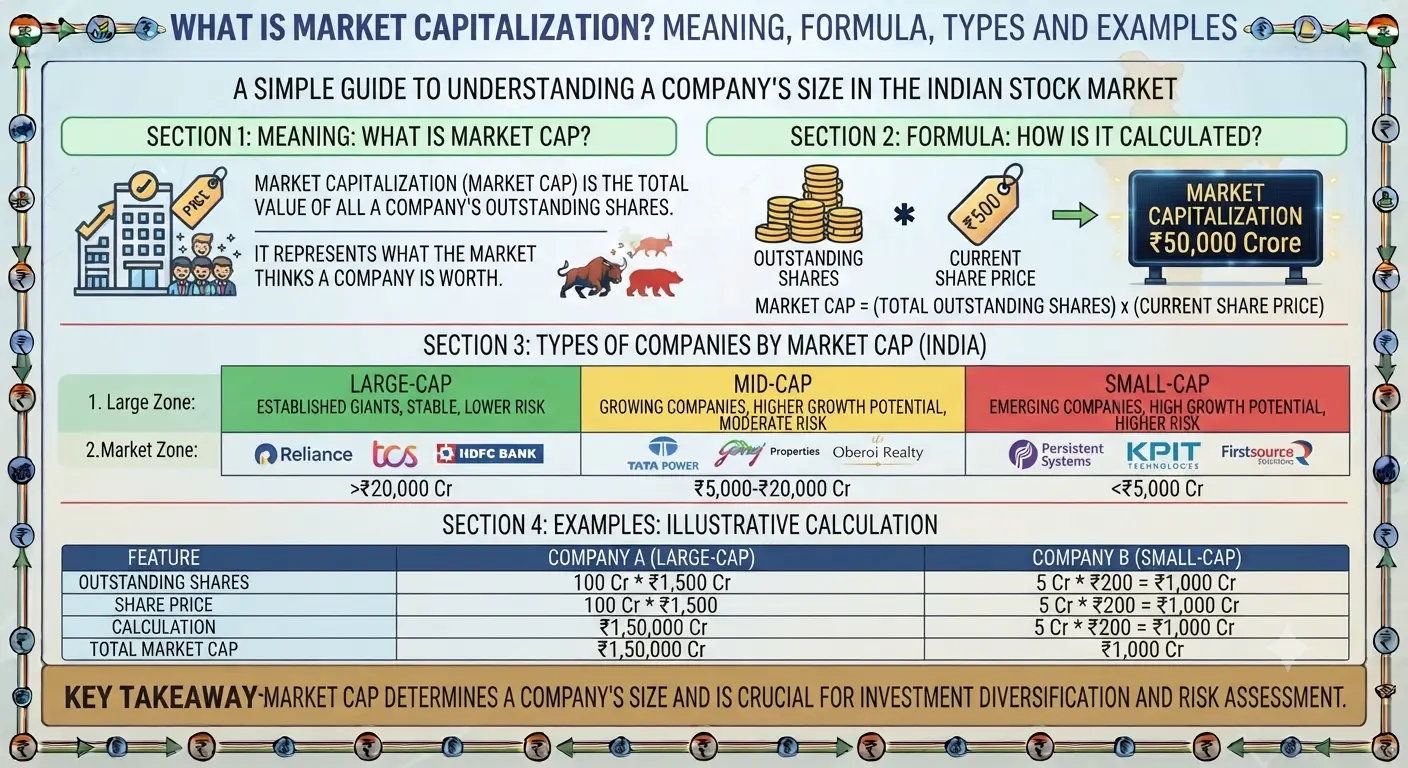
What Is Market Capitalization? Meaning, Formula, Types and Examples
Two companies can have very different share prices, yet the company with the cheaper-looking stock can be worth much more in the stock market. A share trading at ₹100 is not automatically a smaller business than one trading at ₹2,000. The missing piece is the number of shares each company has issued.
This is why investors look beyond the price displayed on a trading screen. They use a measure called market capitalization, commonly shortened to market cap, to understand the stock market value of a company's equity.
Market cap also explains familiar labels such as large-cap, mid-cap and small-cap. These categories are widely used when comparing Indian listed companies and understanding mutual fund investment categories. However, market capitalization does not tell you whether a company is profitable, financially healthy or attractively priced.
What Is Market Capitalization?
Market capitalization is the total market value of a company's outstanding equity shares at the current share price. It is calculated by multiplying the current market price of one share by the total number of outstanding shares. Investors use it to compare the relative size of listed companies.
For example, suppose a company has 10 crore outstanding shares and each share trades at ₹200. Its market capitalization is ₹2,000 crore. If the share price changes, the market cap changes too, assuming the number of shares remains the same.
The figure represents the market's current valuation of the company's equity. It is not the company's annual revenue, cash balance, total assets, or the amount of money sitting in its bank account.
How Is Market Capitalization Calculated?
The calculation is straightforward:
Market Capitalization = Current Share Price × Total Outstanding Shares
Both figures must refer to the same class of equity shares and the same point in time. Share prices move during market hours, so a company's market capitalization can change throughout the trading session.
A simple Indian stock market example
Imagine a fictional company called ABC Industries with the following details:
- Current share price: ₹250
- Total outstanding shares: 8 crore
Its market capitalization would be:
₹250 × 8 crore = ₹2,000 crore
Now imagine the share price rises to ₹275 while the number of outstanding shares stays at 8 crore.
₹275 × 8 crore = ₹2,200 crore
The company's market capitalization has increased by ₹200 crore, or 10%. The company has not necessarily sold more products, opened a new factory or received ₹200 crore in cash. The change comes from the higher market price assigned to its outstanding equity.
Why the number of shares matters
Consider two fictional companies:
| Particulars | Company A | Company B |
|---|---|---|
| Share price | ₹1,000 | ₹100 |
| Outstanding shares | 1 crore | 30 crore |
| Market capitalization | ₹1,000 crore | ₹3,000 crore |
Company A has a share price ten times higher than Company B. Yet Company B has three times the market capitalization. Its larger number of outstanding shares more than offsets its lower share price.
This is one of the most common mistakes beginners make: comparing companies by the price of one share. A share price on its own does not reveal the size of the business or whether the stock is expensive.
What Counts as Outstanding Shares?
Outstanding shares are the company's issued equity shares that are currently held by shareholders. These may be held by promoters, institutional investors, employees, retail investors and other shareholders.
For a basic market-cap calculation, use the total outstanding equity shares rather than only the shares actively traded on the exchange. That distinction matters because a significant portion of a company's shares may be held by promoters or long-term strategic investors.
The number of outstanding shares can change. A fresh issue of shares may increase it. A buyback may reduce the number of shares outstanding. A stock split or bonus issue can change the share count and per-share price without automatically changing the company's total market capitalization at the moment the adjustment takes effect.
What happens after a stock split?
Suppose a company has 1 crore shares trading at ₹500 each. Its market cap is ₹500 crore.
If it announces a 1:5 stock split, each old share becomes five shares. Assuming no market movement or other change, the share count becomes 5 crore and the theoretical share price becomes ₹100.
The calculation is now ₹100 × 5 crore = ₹500 crore. The number of shares has changed, but the company's market capitalization has not automatically increased fivefold. A split changes the units into which ownership is divided; it does not, by itself, create additional business value.
Full Market Cap vs Free-Float Market Cap
When researching Indian stocks, you may come across two related terms: full market capitalization and free-float market capitalization. They are not interchangeable.
Full market capitalization
Full market cap uses the company's total outstanding equity shares, multiplied by the current share price. It represents the market value of the company's entire outstanding equity.
Free-float market capitalization
Free-float market cap considers only the shares that are available for trading in the market, after excluding holdings that are not generally available to ordinary investors. Depending on the applicable methodology, these exclusions can include promoter or strategic holdings, certain government holdings and shares under lock-in.
Free-Float Market Cap = Share Price × Shares Considered Available for Public Trading
For example, assume a company has 10 crore outstanding shares trading at ₹100. Its full market capitalization is ₹1,000 crore. If only 4 crore shares are counted as free float under the relevant methodology, its free-float market cap is ₹400 crore.
The company has not become smaller. The two figures answer different questions: full market cap measures the value of all outstanding equity, while free-float market cap estimates the value of the portion considered available for public trading.
Why free float matters for Nifty 50
Market capitalization is also used in constructing stock market indices. However, an index may not give every company a weight based on its full market cap.
The Nifty 50 uses a free-float market-capitalization-weighted methodology. In broad terms, companies with larger free-float market capitalizations can receive larger weights in the index, subject to the index's eligibility and weighting rules. This is one reason a movement in a heavily weighted constituent can have a greater effect on the index than a similar percentage movement in a smaller constituent.
For the methodology, see Nifty Indices' explanation of index calculation and its Nifty 50 methodology document.
Large-Cap, Mid-Cap and Small-Cap Companies in India
Market capitalization is the basis for three widely used company-size categories in India: large-cap, mid-cap and small-cap. These labels help investors and mutual fund researchers compare companies by their relative market size.
For the investment universe of equity mutual fund schemes, SEBI's framework defines these categories by market-cap ranking. AMFI prepares and publishes the consolidated list using data from recognised stock exchanges, in accordance with the framework.
| Category | Market-cap ranking | What the label indicates |
|---|---|---|
| Large-cap | 1st to 100th | Companies ranked among the 100 largest by full market capitalization |
| Mid-cap | 101st to 250th | Companies ranked from 101st to 250th |
| Small-cap | 251st onwards | Companies ranked below the top 250 |
These are ranking-based categories, not permanent rupee-value bands. There is no single fixed market-cap figure that will always make a company large-cap or mid-cap. The rupee value at the boundary can change as listed companies' market values change.
AMFI publishes the relevant stock categorisation list periodically. Before relying on a company's current category, check the latest AMFI stock categorisation list rather than using an old article or an outdated rupee threshold.
What is a large-cap company?
A large-cap company ranks among the top 100 companies by full market capitalization under the applicable Indian mutual-fund categorisation framework. These businesses are often more established and widely followed, but that does not make every large-cap share low-risk or fairly valued.
What is a mid-cap company?
A mid-cap company ranks from 101st to 250th. It is smaller by market value than the top 100 companies, but it may already have an established business, a substantial customer base or a presence in a growing industry. Its future performance still depends on execution, competition, financial strength and the price investors pay for its shares.
What is a small-cap company?
A small-cap company ranks 251st or lower in the relevant list. Some small-cap businesses may be at an earlier stage of development or operate in specialised markets. Others may be mature businesses that are simply smaller in market value than the top 250 companies.
Smaller market capitalization can be associated with lower trading liquidity and sharper price movements, but this is not a rule that applies identically to every stock. Investors should examine the individual company's trading activity, financial position and business risks.
Does a Higher Market Cap Mean a Better Company?
No. Market cap tells you how much the market currently values a company's equity. It does not independently measure the quality of its management, the strength of its balance sheet, the reliability of its earnings or the attractiveness of its share price.
Imagine two companies. One has a market cap of ₹50,000 crore and another has a market cap of ₹5,000 crore. The larger company may have a wider business and greater market presence. But if its earnings are falling, debt is rising or its share price already reflects very optimistic expectations, its stock may still carry substantial risk.
The smaller company might have a strong balance sheet and a growing business. It could also be poorly managed, heavily indebted or facing serious competition. Market cap alone cannot settle the comparison.
Use it as a starting point for understanding company size, not as a final investment decision.
Market Capitalization vs Share Price vs Company Valuation
These terms are related, but they describe different things.
| Term | What it tells you | What it does not tell you by itself |
|---|---|---|
| Share price | The market price of one share | The overall size of the company |
| Market capitalization | The market value of all outstanding equity shares | Whether the stock is cheap, expensive or financially strong |
| Company valuation | An estimate of what a business or its equity may be worth, depending on the method used | A single universally agreed figure |
Investors may estimate a company's intrinsic value using methods such as discounted cash flow analysis or comparisons with similar businesses. These methods depend on assumptions about future cash flows, growth, risk and discount rates. Market cap, by contrast, is calculated from the traded share price and outstanding share count.
Market Capitalization vs Enterprise Value
Another term worth knowing is enterprise value (EV). Market capitalization measures the equity value of a company. Enterprise value attempts to reflect the value of the operating business available to all capital providers, taking debt and cash into account.
A simplified version of the calculation is:
Enterprise Value ≈ Market Capitalization + Total Debt − Cash and Cash Equivalents
More detailed calculations may also account for preferred shares, non-controlling interests and other items, depending on the company and the analyst's method.
Consider two fictional businesses with the same market cap of ₹10,000 crore. Company A has ₹1,000 crore of debt and ₹2,000 crore of cash. Company B has ₹5,000 crore of debt and ₹500 crore of cash.
Using the simplified formula:
- Company A: ₹10,000 crore + ₹1,000 crore − ₹2,000 crore = ₹9,000 crore.
- Company B: ₹10,000 crore + ₹5,000 crore − ₹500 crore = ₹14,500 crore.
The two companies have the same market capitalization, but their simplified enterprise values differ because their debt and cash positions are different. This is why analysts often use enterprise value alongside measures such as EV/EBITDA when comparing businesses with different capital structures.
Neither market cap nor enterprise value should be interpreted without understanding the company's business, accounting and financial position.
Why Does Market Capitalization Matter to Investors?
1. Comparing the size of companies
Market cap gives investors a common basis for comparing listed businesses. It avoids the misleading impression that a company with a high per-share price must be larger than one with a lower share price.
2. Understanding index composition
Many market indices use market-cap-based or free-float-market-cap-based weighting. A company's market value can therefore influence its representation in an index, depending on the index methodology.
3. Understanding mutual fund categories
Large-cap, mid-cap and small-cap fund categories are defined using the relevant market-cap rankings. Investors comparing these schemes should understand what the categories mean and read the scheme documents, rather than assuming that the label guarantees a particular return or risk level.
4. Building a more balanced research process
Market cap can help organise a stock watchlist or compare businesses of a similar size. An investor can then investigate profitability, cash flow, debt, valuation, corporate governance, industry conditions and liquidity.
It is a useful first filter. It is not a substitute for financial analysis.
What Can Cause a Company's Market Cap to Change?
There are two direct inputs in the basic formula: share price and outstanding shares. A change in either can alter market capitalization.
- Share-price movement: If the price rises or falls while the share count stays constant, market cap changes in the same direction.
- Fresh share issue: A company may issue additional equity shares. The share count increases, although the eventual market-cap effect also depends on the price and how investors assess the issue.
- Share buyback: A buyback can reduce the number of shares outstanding. Its effect on market cap depends on the transaction and the market price after it.
- Stock split or bonus issue: These corporate actions change the number of shares and the per-share price. They do not automatically create an equivalent increase in total market value.
Business developments can also influence market cap indirectly. Better earnings expectations, new orders, changing interest rates, regulation, competition or a shift in investor sentiment may affect the share price. The market cap then changes through the price component of the formula.
Common Market Capitalization Mistakes Beginners Should Avoid
Assuming a low-priced share is a small company
A ₹20 share can belong to a company with a larger market cap than a ₹2,000 share. Always consider the outstanding share count.
Assuming a large-cap stock is automatically safe
Large companies can lose market value, report weak results, face regulatory problems or become overvalued. Size does not remove business or market risk.
Assuming a small-cap stock must have greater growth potential
A smaller company may have room to expand, but it may also have limited financing options, concentrated customers, weaker liquidity or an unproven business model. Potential growth is not guaranteed growth.
Confusing market cap with revenue or profit
Market cap is based on the share price and share count. Revenue and profit come from the company's financial statements. A company can have high sales but a relatively low market cap, or a high market cap despite currently modest earnings.
Using outdated large-, mid- and small-cap lists
Company rankings can change. If you are checking a fund category or a stock's current classification, consult the latest AMFI list rather than relying on a static table from an old article.
How Should You Use Market Cap When Researching a Stock?
Use market capitalization as one part of a structured research process. It can help you understand a company's relative size, but the next questions should concern the business itself.
- Check the market cap: Note the company's current market value and whether the figure refers to full or free-float market capitalization.
- Confirm the share count: Check the latest company filings or reliable market-data source. Corporate actions can change the number of shares.
- Review the business: Understand what the company sells, who its customers are and how it earns money.
- Study financial performance: Examine revenue, operating profit, net profit, cash flow and debt over several reporting periods.
- Assess valuation: Compare relevant measures such as P/E, P/B or EV/EBITDA with the company's history and suitable peers. The right measure depends on the business.
- Check liquidity and risk: Review trading activity, ownership concentration, governance disclosures and sector-specific risks.
- Recheck current information: Market cap and category rankings change. Use current data before making a decision.
This approach prevents one number from dominating an investment decision. A company can be large but overvalued, small but financially sound, or somewhere in between. The details matter.
Frequently Asked Questions About Market Capitalization
1. What is market capitalization in simple words?
Market capitalization is the current stock market value of all a company's outstanding equity shares. You calculate it by multiplying the current share price by the total number of outstanding shares. It is commonly used to compare the relative size of listed companies.
2. What is the formula for market capitalization?
The formula is: Market Capitalization = Current Share Price × Total Outstanding Shares. For example, 5 crore outstanding shares at ₹100 each produce a market capitalization of ₹500 crore.
3. Who decides whether an Indian company is large-cap, mid-cap or small-cap?
SEBI's framework sets the ranking-based definitions for the investment universe of equity mutual fund schemes. AMFI prepares and publishes the consolidated stock list using market data from recognised exchanges. The top 100 companies are large-cap, ranks 101–250 are mid-cap, and rank 251 onwards are small-cap.
4. Is market capitalization the same as a company's net worth?
No. Market capitalization is the market value of outstanding equity shares. Net worth is an accounting measure based on assets and liabilities, usually represented by shareholders' equity on the balance sheet. The two figures are calculated differently and can be very different.
5. Can a company's market capitalization change every day?
Yes. If its share price changes, its market cap changes even if the number of outstanding shares stays the same. Share issues, buybacks and other corporate actions can also change the share count used in the calculation.
6. Is a higher market capitalization always better?
No. A higher market cap indicates a larger market value of equity, not necessarily better management, stronger finances or a cheaper stock. Investors should also examine earnings, debt, cash flow, valuation, governance and business risks.
7. What is the difference between market cap and free-float market cap?
Full market cap uses all outstanding equity shares. Free-float market cap uses only the portion considered available for public trading under the applicable methodology. Index providers may use free-float market cap to determine company weights in an index.
Conclusion
Market capitalization is one of the simplest ways to understand the relative size of a listed company. The calculation is straightforward, but its interpretation requires care. A company's share price alone does not reveal its size, and its market cap does not tell you whether the business is financially strong or the stock is attractively valued.
For Indian investors, the concept also helps explain large-cap, mid-cap and small-cap classifications, as well as the role of free-float market capitalization in indices such as the Nifty 50. Use the latest official classification list when category accuracy matters, and combine market cap with financial statements, valuation measures and an understanding of business risk.
Remember: market capitalization tells you how large the market currently values a company's equity. It does not, by itself, tell you what the company is truly worth or whether its shares are worth buying.
Disclaimer: This article is for financial education and general information only. It is not investment advice or a recommendation to buy, sell or hold any security. Market data and company classifications can change. Readers should verify current information from official sources and assess their own financial circumstances and risk tolerance before making investment decisions.