What Are Bull and Bear Markets? Meaning, Differences and Examples
Learn what bull and bear markets mean, what causes them, how to identify market trends using Nifty 50 and Sensex, and how investors can approach rising and falling markets.
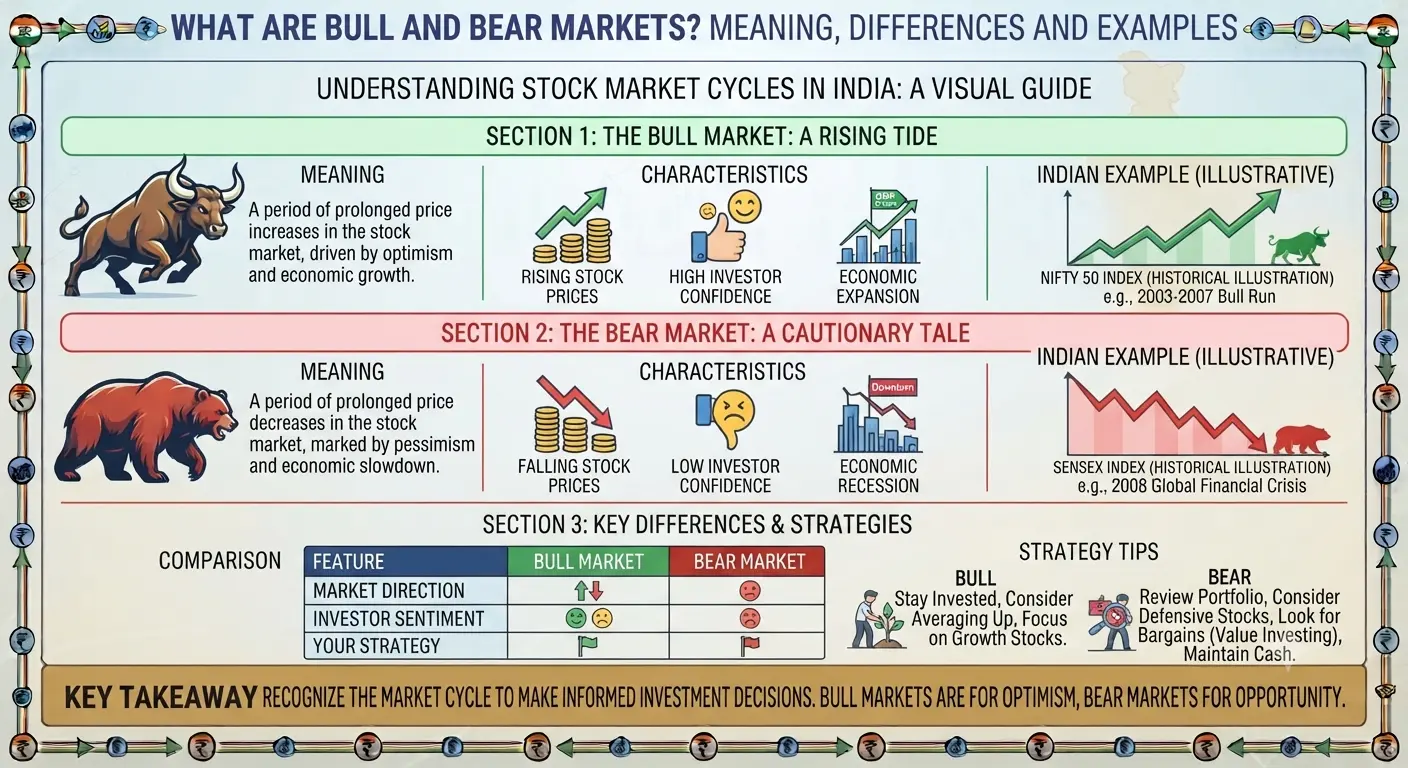
What Are Bull and Bear Markets? Meaning, Differences and Examples
Imagine you have invested in a few Indian companies. For several months, their share prices keep rising. Business news is positive, more people are discussing stocks, and the Nifty 50 is regularly moving higher. You may hear market participants say, “We are in a bull market.”
Now imagine the opposite. Company results disappoint, global markets become uncertain, investors start selling, and the Nifty and Sensex continue falling. The same people may describe the situation as a bear market.
These expressions are more than labels for green and red trading screens. They describe broader market conditions, changing expectations and investor behaviour. Knowing the difference helps beginners understand financial news, avoid confusing a temporary correction with a longer decline, and make more thoughtful investment decisions.
What Are Bull and Bear Markets?
A bull market is a sustained period in which stock prices generally move upward, supported by improving expectations, buying interest or confidence about future business and economic conditions. A bear market is a sustained period of falling stock prices, usually accompanied by weakening expectations, selling pressure and pessimism.
In common market terminology, a fall of around 20% or more from a recent peak is widely used as a bear-market threshold. A rise of around 20% from a recent low is sometimes used to identify a new bull-market phase. These are conventions, not universal legal definitions or guaranteed signals of a trend change.
In India, investors often study the Nifty 50 and BSE Sensex to understand the broad direction of the equity market. However, an index can rise even when several individual shares are falling, and it can decline while some sectors or companies continue performing well.
What Is a Bull Market?
A bull market describes a broad upward trend in share prices that continues over a meaningful period. It is usually associated with improving investor confidence, expectations of stronger corporate earnings, economic expansion or favourable financial conditions.
Consider a hypothetical example. The Nifty 50 is trading around 20,000. Over the following months, companies report stronger earnings, investors become more confident about future growth, and demand for shares increases. The index gradually moves towards 22,000 and then 24,000, despite occasional declines along the way.
That broader upward movement may be described as a bull-market phase. Notice that the index did not rise every day. A bull market can include losing sessions, weekly corrections and periods of sideways movement. The defining feature is the broader direction, not an uninterrupted rise.
Common characteristics of a bull market
- Rising market prices: Major indices and many shares show an upward trend over time.
- Improving earnings expectations: Investors expect companies to generate stronger revenue, profits or cash flows.
- Greater buying interest: More market participants may be willing to invest at prevailing prices.
- Positive sentiment: Investors generally become more optimistic about future market conditions.
- Sector participation: In a broad-based rally, multiple sectors may contribute to market gains, although participation can vary.
- Higher risk-taking: Some investors become more willing to buy growth-oriented or higher-risk shares.
These are common tendencies, not a checklist that every bull market must satisfy. A market can rise because a small group of large companies is performing strongly, even when many other shares are weak.
Why do bull markets happen?
Share prices reflect what investors expect from businesses in the future, not just what those businesses earned in the previous quarter. When expectations improve, investors may be willing to pay higher prices for future earnings.
Several developments can support an upward market trend:
- Strong corporate earnings: Better sales, profit margins and cash flows can improve expectations about a company's value.
- Economic growth: Higher consumption, business investment and industrial activity can support company revenues.
- Favourable interest-rate conditions: Lower borrowing costs can support businesses and influence how investors value future earnings. The relationship is not automatic; inflation and economic expectations also matter.
- Improving investor confidence: When uncertainty declines, investors may become more comfortable holding equities.
- Domestic and foreign investment flows: Increased demand from Indian and overseas investors can support share prices, although flows are only one part of the explanation.
- Positive global developments: Strong international markets, stable commodity prices or improving trade conditions may influence Indian market sentiment.
It is also possible for prices to rise ahead of actual improvements in company performance. Investors often buy based on what they expect to happen. If those expectations become too optimistic, valuations can become stretched and the market may become vulnerable to a correction.
What Is a Bear Market?
A bear market is a sustained period of declining share prices. It often develops when investors become less confident about future earnings, economic growth or the overall investment environment. Selling pressure can spread across sectors and push major indices lower.
For example, imagine the Nifty 50 falls from 25,000 to 20,000. The decline is 5,000 points, or 20% of the starting level. A fall of this size from a recent peak is commonly used as a bear-market threshold. The calculation alone, however, does not explain why the market fell or whether the decline will continue.
Bear markets can develop because of many different problems: a financial crisis, recession fears, geopolitical conflict, rising borrowing costs, weak company earnings, excessive valuations or a sudden loss of confidence. Sometimes several factors occur together.
Common characteristics of a bear market
- Falling prices: Major indices and many shares move lower over an extended period.
- Weak investor confidence: Market participants become more cautious about future returns.
- Lower earnings expectations: Investors may expect slower growth, weaker margins or falling profits.
- Increased uncertainty: Economic data, policy changes or global events can make future outcomes harder to assess.
- Volatile trading: Sharp declines and sudden recovery attempts can occur within the same broader downtrend.
- Defensive behaviour: Some investors reduce exposure to riskier assets or move towards investments they consider more stable.
A bear market does not mean that every listed company is performing badly. Some businesses may continue to grow, and certain sectors may even rise. The term describes the broader market environment or a particular index or asset class—not every security at the same time.
Why do bear markets happen?
Bear markets often begin when investors revise their expectations downwards. A company that was expected to grow quickly may report disappointing results. A central bank may keep interest rates higher than investors expected. A global crisis may create uncertainty about trade, energy prices or business investment.
These developments can influence share prices through several channels:
- Falling corporate profits: Lower sales, higher costs or weaker demand can reduce expected future earnings.
- High interest rates: Expensive borrowing can pressure businesses and households. Higher yields on relatively lower-risk instruments can also affect the attractiveness of equities.
- Economic slowdown: Weak consumption and investment can make investors cautious about future growth.
- Global uncertainty: Conflict, financial stress or international policy changes can trigger risk reduction across markets.
- Overvaluation: When share prices have risen far beyond what business performance can reasonably support, disappointing news can lead to a sharp repricing.
- Forced or panic selling: Investors facing losses, margin calls or liquidity needs may sell holdings, adding to downward pressure.
One important point: a falling market does not always mean the economy is already in recession. Share prices are forward-looking. Investors may start pricing in weaker conditions before those conditions become visible in official economic data.
Bull Market vs Bear Market: Key Differences
| Factor | Bull Market | Bear Market |
|---|---|---|
| Overall direction | Prices generally trend upward | Prices generally trend downward |
| Investor sentiment | More optimistic | More cautious or pessimistic |
| Buying and selling | Buying interest is often stronger | Selling pressure is often stronger |
| Business expectations | Expectations may improve | Expectations may weaken |
| Market headlines | Growth, earnings and new highs may dominate | Risk, falling earnings and uncertainty may dominate |
| Investor risk | Overconfidence and buying at excessive valuations | Panic selling and abandoning a suitable long-term plan |
| Potential opportunity | Participating in business and earnings growth | Evaluating quality businesses at more reasonable valuations |
The table describes typical tendencies, not fixed rules. A bull market can contain expensive and risky shares. A bear market can contain companies with weak balance sheets that remain unattractive even after their prices fall.
How to Calculate a Bull or Bear Market Decline
Percentage changes help investors compare market movements across different index levels. A 1,000-point fall has a different meaning when an index is at 10,000 than when it is at 50,000.
Calculating a market fall
Use this formula to calculate the percentage decline from a previous peak:
Percentage decline = [(Previous peak − Current level) ÷ Previous peak] × 100
Hypothetical example:
- Previous Nifty level: 25,000
- Current Nifty level: 20,000
- Point decline: 25,000 − 20,000 = 5,000
- Percentage decline: (5,000 ÷ 25,000) × 100 = 20%
The index has declined 20% from the selected peak. This is commonly used as a bear-market threshold, but investors should also examine the time period, trend structure and broader market context.
Calculating a market rise
To calculate a rise from a recent low:
Percentage rise = [(Current level − Previous low) ÷ Previous low] × 100
If an index rises from 20,000 to 24,000, the increase is 4,000 points. Dividing 4,000 by 20,000 gives a 20% rise.
This calculation describes the movement between two selected levels. It does not prove that a durable bull market has begun. A strong rally can occur inside a longer bear market.
Market Correction, Bear Market and Market Crash: What Is the Difference?
These terms are often used interchangeably in headlines, but they describe different things.
Market correction
A correction is commonly used to describe a decline of around 10% or more from a recent market high. It may occur during a longer bull market and does not automatically mean the market has entered a bear phase.
Bear market
A bear market generally refers to a more sustained decline. A fall of around 20% from a recent peak is a widely used convention, although market participants may consider trend duration and context as well.
Market crash
A crash usually describes a sudden and severe fall over a short period. It is a description of the speed and intensity of a decline, not a separate universal percentage-based classification. A crash can occur within a bear market, but not every bear market develops through a single dramatic crash.
Relief rally or bear-market rally
A relief rally is a sharp recovery after a period of selling. It may happen because investors believe the worst news has passed, short sellers close positions, or buyers see value at lower prices. However, a rally alone does not confirm that the broader downtrend has ended.
How Do Bull and Bear Markets Affect the Indian Stock Market?
Indian investors commonly follow the Nifty 50 and BSE Sensex to understand the direction of major listed companies. The Nifty 50 tracks a group of large and liquid companies listed on the NSE, while the Sensex tracks 30 major companies listed on the BSE.
Both indices are useful market indicators, but neither represents every listed company. A rise in a benchmark index may be driven by a relatively small number of heavyweight stocks. Meanwhile, mid-cap, small-cap or sector-specific shares may move in a different direction.
For example, imagine banking and information technology shares are rising while metal and real-estate shares are falling. The Nifty 50 may still finish higher if the gains in its larger constituents outweigh declines elsewhere. Calling the entire market broadly bullish without checking participation could therefore be misleading.
Why market breadth matters
Market breadth looks at how many shares are participating in a market move. One simple way to think about it is to compare the number of advancing shares with the number of declining shares.
If an index is rising and a large number of shares are also advancing, the rally may be broad-based. If the index is rising but most shares are falling, the advance may be concentrated in a smaller group of companies.
Beginners can use this distinction to avoid assuming that a green Nifty screen means every stock is doing well. It is also useful to compare sector indices, such as banking or information technology indices, with the broader benchmark.
How to Identify Whether the Market Is Bullish or Bearish
No single indicator can identify every market phase correctly. Investors and analysts usually combine price behaviour with company performance, economic information and market participation.
1. Study the broader index trend
Observe whether the Nifty 50 or Sensex is making progressively higher highs and higher lows, or lower highs and lower lows. This is a basic way to understand trend structure. A few positive or negative sessions are not enough to establish a long-term trend.
2. Check earnings and company fundamentals
Look at revenue growth, profit margins, debt, cash flow and management commentary. A rising share price without improving business performance may deserve closer valuation scrutiny. During a falling market, a company with resilient earnings may behave differently from one whose business is deteriorating.
3. Follow economic conditions
Inflation, interest rates, GDP growth, industrial activity, employment and consumption can influence market expectations. These indicators should be read together rather than treated as isolated buy or sell signals.
4. Observe market breadth and sector performance
Check whether gains or losses are spread across sectors and market capitalisation groups. A rally led by a handful of heavyweight shares is different from a broad advance involving many companies.
5. Understand volatility
Volatility measures how widely prices fluctuate. A market can be rising but volatile, or falling gradually with relatively smaller daily moves. High volatility indicates larger price swings; it does not independently tell you whether the market is bullish or bearish.
6. Treat investor flows as context, not a prediction
Domestic and foreign institutional investment activity can influence demand, but flows can change quickly. They should be considered alongside earnings, valuations, economic conditions and price trends.
What Should Investors Do in a Bull Market?
Rising markets can make investing feel easier. Portfolio values increase, positive stories become common and investors may begin to believe that recent returns will continue indefinitely. That is precisely when discipline matters.
- Review valuations: A good company can still be an expensive investment if its share price already reflects unrealistic expectations.
- Avoid fear of missing out: Do not buy a stock only because it has risen sharply or is being discussed widely.
- Maintain diversification: Avoid allowing one sector or a few popular shares to dominate your portfolio unintentionally.
- Review your asset allocation: Strong equity gains may cause your portfolio to move away from your intended risk level.
- Keep a long-term perspective: Short-term market strength does not remove the possibility of future declines.
A bull market is not a reason to stop researching businesses. In fact, buying decisions can become more difficult when prices are rising faster than underlying earnings.
What Should Investors Do in a Bear Market?
Falling markets test an investor's ability to separate temporary price pressure from permanent damage to a business. A lower share price may create an opportunity, but it may also reflect a genuine deterioration in the company's prospects.
- Revisit your investment reason: Check whether the original business case remains valid or whether important facts have changed.
- Examine financial strength: Review debt, cash flow, profitability and the company's ability to manage a difficult period.
- Avoid panic decisions: Selling solely because prices are falling can turn a temporary decline into a realised loss, although reducing exposure may be appropriate when the investment case or risk capacity has changed.
- Keep emergency money separate: Money needed for near-term expenses should not depend on an uncertain stock-market recovery.
- Invest according to a plan: Staggered investing may reduce the risk of committing all available capital at one price, but it cannot guarantee a profit or prevent losses.
- Do not assume every fallen share is cheap: A stock can keep declining if its business outlook continues to weaken.
Investors should also remember that market bottoms are usually clear only in hindsight. Trying to identify the exact lowest point can lead to repeated guesses and emotional decisions.
Why Recovering From a Market Fall Can Take Longer Than Expected
One of the most overlooked lessons in a bear market is that losses and gains are not symmetrical. If an investment falls by 20%, it does not need to rise by 20% to return to its original value.
Consider a hypothetical investment worth ₹1,00,000:
- After a 20% fall, its value becomes ₹80,000.
- To return from ₹80,000 to ₹1,00,000, it must gain ₹20,000.
- That ₹20,000 gain represents 25% of the reduced value of ₹80,000.
So a 20% loss requires a 25% gain to recover, before considering costs or taxes. The deeper the fall, the larger the percentage gain required to return to the starting point.
This is why investors should pay attention to downside risk, not just the return they hope to earn. Avoiding unnecessary concentration and matching investments to a suitable time horizon can matter as much as selecting assets with growth potential.
Common Mistakes Beginners Make
- Calling every fall a bear market: A few weak sessions or a short correction do not automatically establish a bear market.
- Assuming every rising market is safe: Bull markets can contain speculative excess, expensive valuations and sudden reversals.
- Confusing the index with the entire market: Nifty and Sensex do not show how every listed share is performing.
- Buying only because prices are rising: Recent performance does not guarantee future returns.
- Buying every stock after a fall: Lower prices do not automatically make a company financially healthy or attractively valued.
- Trying to predict the exact top or bottom: These turning points are difficult to identify in real time.
- Ignoring personal financial needs: An investor may be forced to sell at an unfavourable time if money needed for near-term expenses is exposed to market risk.
A Practical Checklist for Understanding Market Conditions
Before reacting to a strong rally or a sharp decline, ask a few questions:
- Is the movement visible across several weeks or months, or is it only a short-term move?
- Are Nifty 50 and Sensex moving in a similar direction?
- Are multiple sectors and shares participating?
- Are corporate earnings and economic expectations improving or weakening?
- Are valuations reasonable relative to business performance?
- Has the reason for holding a particular investment changed?
- Does the decision fit my financial goals, time horizon and ability to tolerate losses?
This checklist will not predict the next market move. Its purpose is to encourage a more complete assessment than simply reacting to a red or green index number.
Frequently Asked Questions
1. What is the main difference between a bull market and a bear market?
A bull market is a sustained period of generally rising share prices and improving market sentiment. A bear market is a sustained period of generally falling prices and weakening confidence. Both can include short-term movements in the opposite direction.
2. How much does the stock market need to fall to be called a bear market?
A decline of around 20% or more from a recent peak is a widely used convention for identifying a bear market. It is not a universal legal definition. Analysts may also consider the duration of the decline, price trends and broader market conditions.
3. Does a 10% fall mean the market has entered a bear market?
Not necessarily. A decline of around 10% is commonly described as a market correction. Corrections can occur during a longer bull market and do not automatically indicate a sustained bearish trend.
4. Can a bull market have falling days?
Yes. A bull market does not mean that prices rise every day. Short-term declines, profit-booking and corrections can occur while the broader market trend remains upward.
5. Can some stocks rise during a bear market?
Yes. Market conditions are not identical for every company or sector. A business with resilient earnings or favourable industry conditions may perform better than the broader market, even during a wider decline.
6. How can beginners identify a bull or bear market in India?
Beginners can study the broader trend in Nifty 50 and Sensex, check market breadth, compare sector performance and review corporate earnings and economic conditions. No single indicator can confirm every market phase with certainty.
7. Is a bear market a good time to invest?
A bear market can create opportunities when the prices of financially sound businesses become more reasonable. However, prices may fall further, and some companies may face lasting business problems. Investors should assess fundamentals, valuations, risk tolerance and time horizon rather than buying only because a share has declined.
8. How long do bull and bear markets last?
There is no fixed duration. Some market phases last months, while others continue for years. Their length depends on economic conditions, company earnings, valuations, investor expectations and unexpected events. Historical averages should not be treated as a forecast for the next cycle.
Conclusion: Understand the Trend, Not Just the Colour of the Market
Bull and bear markets are two broad phases of the stock-market cycle. A bull market reflects a sustained upward trend, while a bear market reflects a sustained decline. Both are influenced by company performance, economic conditions, valuations and investor expectations.
For Indian investors, following the Nifty 50 and Sensex can provide a useful starting point. But a benchmark index alone cannot explain what is happening across every sector or company. Market breadth, earnings, valuations and personal financial goals add important context.
The practical lesson is simple: do not confuse a short rally with a confirmed recovery, or a temporary correction with a lasting market collapse. Understand why prices are moving, check whether the underlying facts support the trend, and make decisions that fit your investment plan rather than the emotion of the moment.
Disclaimer: This article is for educational and informational purposes only. It does not constitute investment advice or a recommendation to buy or sell any security. Stock market investments are subject to market risks. Readers should conduct independent research or consult a SEBI-registered investment professional before making investment decisions.