How to Understand a Company's Cash Flow Statement: A Beginner's Guide
Learn how to read a company's cash flow statement, understand operating, investing and financing activities, and assess whether reported profits are supported by actual cash generation.
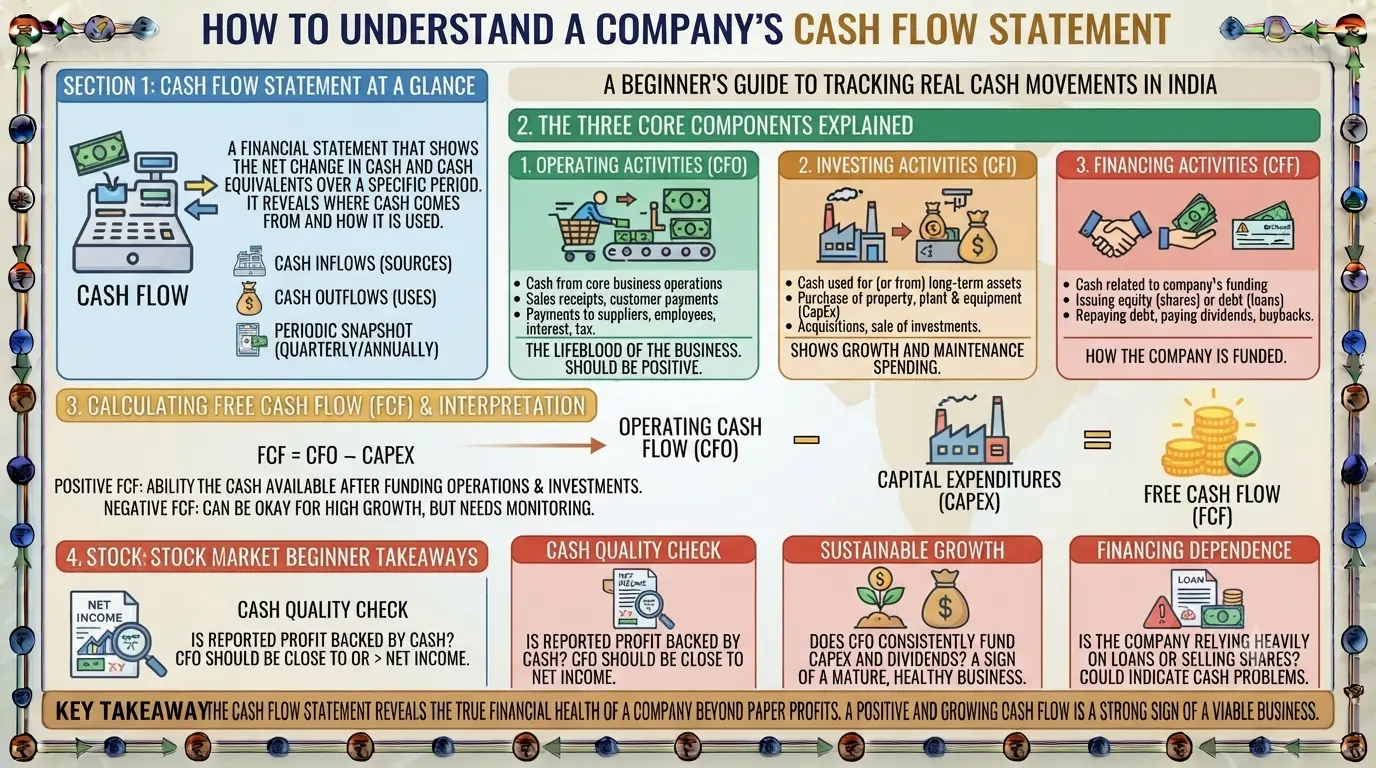
How to Understand a Company's Cash Flow Statement: A Beginner's Guide
A company can report rising revenue and strong net profit but still struggle to generate enough cash to pay suppliers, employees, lenders and other obligations. This is one reason investors should look beyond a company's Profit and Loss statement when evaluating its financial health.
A cash flow statement explains where a company's cash came from, where it was spent and how its cash and cash equivalents changed during a financial period. It separates cash movements into three categories: operating activities, investing activities and financing activities.
For Indian stock market investors, learning how to read this statement can help identify whether a business is generating cash from its core operations, investing in future growth, depending on borrowings or returning money to shareholders.
What Is a Cash Flow Statement?
A cash flow statement is a financial statement that records the inflows and outflows of cash and cash equivalents during a specific period, such as a quarter or financial year.
In simple terms, it explains how a company's opening cash balance changes into its closing cash balance. It shows cash generated from business operations, cash spent on assets and investments, and cash received from or paid to lenders and shareholders.
The statement is divided into three main sections:
- Cash flow from operating activities (CFO): Cash generated or used by the company's principal business operations.
- Cash flow from investing activities (CFI): Cash spent on or received from long-term assets and investments.
- Cash flow from financing activities (CFF): Cash received from or paid to lenders and shareholders.
The basic relationship is:
Net Change in Cash = Operating Cash Flow + Investing Cash Flow + Financing Cash Flow
The reconciliation may also include the effect of exchange-rate changes on cash and cash equivalents, where applicable.
Under Indian Accounting Standard (Ind AS) 7, the statement of cash flows is an integral part of financial statements and classifies cash flows into operating, investing and financing activities. It helps users evaluate a company's ability to generate cash and cash equivalents and its need to use those resources.
Why Is a Cash Flow Statement Important for Investors?
Profit is important, but a business also needs cash to operate. It must collect payments from customers, pay suppliers, meet salaries, service borrowings and fund investments.
A cash flow statement helps investors examine several important questions:
- Is the company generating cash from its main business?
- Are reported profits being converted into operating cash?
- Is the business spending cash to expand its operations?
- Is it relying heavily on new loans or share issues to fund itself?
- Can it repay debt and meet other financial commitments?
- Is it generating enough cash to support dividends or future investment?
- Why did its cash balance increase or decrease during the year?
These questions are particularly useful when a company's reported profit is increasing but its operating cash flow is weak or consistently negative.
The Three Main Sections of a Cash Flow Statement
1. Cash Flow from Operating Activities (CFO)
Operating cash flow represents cash generated or used by the company's principal revenue-producing activities. It generally includes cash collected from customers and cash paid to suppliers, employees and other operating expenses.
For a manufacturing company, operating activities may involve collecting payments for products, purchasing raw materials and paying factory employees. For an IT services company, they may include customer collections, employee payments and other operating costs.
Common operating cash inflows include:
- Cash received from customers.
- Cash received for services, fees or commissions.
- Other receipts classified as operating under the applicable accounting rules.
Common operating cash outflows include:
- Payments to suppliers.
- Payments to employees.
- Payments for routine operating expenses.
- Income taxes paid, unless the cash flow can be specifically identified with investing or financing activities.
Investors often focus on CFO because it indicates how much cash the business generates through its normal activities. However, one positive figure is not enough to establish that the business is financially strong. Working-capital movements, unusual receipts and payment timing can influence the result.
2. Cash Flow from Investing Activities (CFI)
Investing cash flow records cash spent on or received from the acquisition and disposal of long-term assets and certain investments.
Companies often use cash from investing activities to build capacity, purchase equipment, acquire businesses, develop facilities or invest in financial assets.
Common investing cash outflows include:
- Purchase of machinery and equipment.
- Construction or acquisition of buildings and facilities.
- Purchase of qualifying long-term investments.
- Acquisition of another business.
- Capitalised development expenditure where classified as investing under the applicable accounting rules.
Common investing cash inflows include:
- Sale of machinery, land or buildings.
- Sale or redemption of qualifying investments.
- Proceeds from disposal of a business or long-term asset.
- Repayment of loans given to other parties, where classified as investing.
Negative investing cash flow is not automatically a problem. A company may spend substantial cash to expand its manufacturing capacity or build new infrastructure. Such expenditure may support future growth, although the expected returns and funding requirements still need to be assessed.
On the other hand, repeatedly positive investing cash flow may sometimes result from selling assets or liquidating investments. Investors should identify the actual source of the inflow instead of assuming that a positive number always indicates strong performance.
3. Cash Flow from Financing Activities (CFF)
Financing cash flow shows how a company raises capital and returns money to lenders and shareholders. It provides information about changes in the company's borrowings and contributed equity.
Common financing cash inflows include:
- Money received from new loans or borrowings.
- Proceeds from issuing shares.
- Proceeds from issuing debentures or bonds.
Common financing cash outflows include:
- Repayment of loan principal.
- Repurchase or redemption of the company's own shares.
- Dividend payments to shareholders.
- Payments that reduce qualifying lease liabilities.
Positive financing cash flow may indicate that a company has raised debt or equity. This can support expansion, but investors should check whether the additional funding is being used productively and whether debt levels remain manageable.
Negative financing cash flow may reflect loan repayments, dividends or share buybacks. It can be consistent with a mature company returning capital to shareholders, but the company should still retain enough cash for operations and future investment.
Cash Flow Statement Format: A Simplified Example
The following is a hypothetical example of an Indian manufacturing company. All amounts are illustrative and are not taken from an actual listed company.
| Particulars | Amount (₹ crore) |
|---|---|
| A. Cash Flow from Operating Activities | |
| Profit Before Tax | 100 |
| Add: Depreciation and Amortisation | 20 |
| Add: Finance Costs | 10 |
| Less: Gain on Sale of Asset | (5) |
| Less: Increase in Trade Receivables | (15) |
| Less: Increase in Inventory | (10) |
| Add: Increase in Trade Payables | 8 |
| Add: Increase in Operating Provisions | 2 |
| Cash Generated from Operations | 110 |
| Income Taxes Paid | (25) |
| Net Cash from Operating Activities | 85 |
| B. Cash Flow from Investing Activities | |
| Purchase of Property, Plant and Equipment | (60) |
| Proceeds from Sale of Asset | 5 |
| Purchase of Investments | (10) |
| Net Cash Used in Investing Activities | (65) |
| C. Cash Flow from Financing Activities | |
| New Borrowings | 30 |
| Repayment of Borrowings | (20) |
| Interest Paid | (10) |
| Dividends Paid | (10) |
| Net Cash Used in Financing Activities | (10) |
| Net Increase in Cash and Cash Equivalents | 10 |
| Opening Cash and Cash Equivalents | 40 |
| Closing Cash and Cash Equivalents | 50 |
Note: This simplified illustration assumes a non-financial company applying an Ind AS 7 classification in which interest paid and dividends paid are shown under financing activities. Actual statements may include additional disclosures and reconciliation items, including exchange differences where applicable.
How to Interpret This Example
- Operating cash flow is ₹85 crore: The company generated positive cash from its operating activities after the illustrative tax payment.
- Investing cash flow is negative ₹65 crore: The company spent more cash on assets and investments than it received from disposals.
- Financing cash flow is negative ₹10 crore: New borrowings were partly offset by loan repayment, interest and dividend payments.
- Closing cash is ₹50 crore: Cash increased from ₹40 crore to ₹50 crore during the period.
The example illustrates how a company can generate operating cash, invest in assets, make financing payments and still increase its closing cash balance.
Direct Method vs Indirect Method of Cash Flow Statement
Under Ind AS 7, cash flows from operating activities can be reported using either the direct method or the indirect method. Both methods calculate the same net operating cash flow; they differ in how the operating section is presented.
Direct Method
The direct method reports major classes of actual operating cash receipts and payments. It focuses on cash collected from customers and cash paid to suppliers, employees and other parties.
A simplified direct-method presentation may look like this:
| Operating Cash Flow Item | Amount (₹ crore) |
|---|---|
| Cash Received from Customers | 500 |
| Cash Paid to Suppliers | (280) |
| Cash Paid to Employees | (70) |
| Other Operating Cash Payments | (40) |
| Income Taxes Paid | (25) |
| Net Cash from Operating Activities | 85 |
These figures are illustrative. The direct method makes the major cash receipts and payments easier to see.
Indirect Method
The indirect method starts with an accounting profit figure and adjusts it for non-cash items, working-capital movements and items whose cash effects belong in investing or financing activities.
For example:
- Depreciation is added back because it reduced accounting profit without creating a cash payment in the current period.
- An increase in trade receivables is generally deducted because some recognised sales have not yet been collected in cash.
- An increase in inventory is generally deducted because cash may have been used to purchase or produce stock that has not yet been sold.
- An increase in trade payables is generally added because the company has recognised costs but has not yet paid the corresponding suppliers.
- Gains on the sale of long-term assets are generally removed from the operating reconciliation because the disposal proceeds are reported under investing activities.
Companies may present the indirect reconciliation starting from profit before tax or another profit figure consistent with the applicable reporting format. Read the statement's headings and notes rather than assuming every company uses identical line items.
How Working Capital Changes Affect Operating Cash Flow
Working capital is one of the most important areas to understand when analysing operating cash flow. A company can report accounting profit while cash remains tied up in inventory or unpaid customer invoices.
Increase in Trade Receivables
Trade receivables represent amounts customers owe the company. When receivables increase, it may mean the company has recorded sales but has not yet collected all the related cash.
Under the indirect method, an increase in operating receivables is generally deducted when reconciling profit to operating cash flow.
Increase in Inventory
Inventory includes goods held for sale, raw materials and work-in-progress, depending on the business. An increase in inventory may indicate that the company has spent cash on stock that has not yet been converted into sales and collections.
Under the indirect method, an increase in operating inventory is generally deducted from the reconciliation.
Increase in Trade Payables
Trade payables represent amounts the company owes suppliers. An increase may mean the company has delayed payment for purchases or services received.
Under the indirect method, an increase in operating payables is generally added to the reconciliation because the company has not yet paid all the related amounts in cash.
However, an increase in payables is not automatically a positive sign. If the company is delaying supplier payments because of financial stress, the apparent improvement in operating cash flow may not be sustainable.
What Is Free Cash Flow (FCF)?
Free cash flow is a commonly used financial measure that estimates how much cash remains after a company funds its capital expenditure from operating cash flow.
A widely used simplified formula is:
Free Cash Flow = Cash Flow from Operating Activities − Capital Expenditure
Capital expenditure, often called CapEx, generally includes cash spent to acquire or improve property, plant and equipment and other qualifying long-term assets.
Using the hypothetical example:
- Operating cash flow = ₹85 crore.
- Capital expenditure = ₹60 crore.
- Free cash flow = ₹85 crore − ₹60 crore = ₹25 crore.
The company has ₹25 crore remaining after the assumed capital expenditure. This simplified measure does not automatically represent cash available for every purpose. It may not deduct dividends, debt principal repayments, acquisitions or other discretionary spending.
Some analysts use a different free cash flow definition, such as subtracting maintenance capital expenditure rather than total capital expenditure. Always check the formula before comparing FCF figures from different sources.
Important Cash Flow Ratios and Metrics for Investors
1. Operating Cash Flow to Net Profit Ratio
This ratio compares operating cash flow with net profit after tax.
Operating Cash Flow to Net Profit = Operating Cash Flow ÷ Net Profit After Tax
Using the hypothetical figures, assume the company reported PAT of ₹80 crore and operating cash flow of ₹85 crore.
Ratio = ₹85 crore ÷ ₹80 crore = 1.06 times.
This means operating cash flow was approximately 1.06 times the reported net profit for the period. It can be useful for examining cash conversion, but one year's ratio may be influenced by working-capital timing, tax payments and unusual items.
2. Operating Cash Flow Margin
This metric measures operating cash flow as a percentage of revenue.
Operating Cash Flow Margin = (Operating Cash Flow ÷ Revenue) × 100
If operating cash flow is ₹85 crore and revenue is ₹500 crore:
Operating cash flow margin = (₹85 crore ÷ ₹500 crore) × 100 = 17%.
The company generated ₹17 of operating cash for every ₹100 of revenue in this illustration.
3. Free Cash Flow
Free cash flow helps investors understand how much operating cash remains after capital expenditure. It can provide insight into a company's ability to fund expansion, reduce borrowings or return cash to shareholders.
However, positive FCF does not automatically mean a company is financially healthy. It may result from temporarily low capital expenditure, delayed supplier payments or the release of working capital.
4. Cash Flow to Debt
Analysts may compare operating cash flow with total debt to understand the scale of cash generation relative to borrowings.
Operating Cash Flow to Debt = Operating Cash Flow ÷ Total Debt
Use a consistent definition of debt and compare the result across multiple years and similar companies. This is an analytical measure, not a guarantee that all operating cash can be used for debt repayment.
How to Analyse a Company's Cash Flow Statement Step by Step
Investors can use the following process when reviewing a company's annual or quarterly financial statements.
- Start with operating cash flow: Check whether the core business is consistently generating cash.
- Compare CFO with net profit: Look for a sustained gap between accounting earnings and operating cash generation.
- Inspect working-capital changes: Examine receivables, inventory and payables to understand why operating cash flow increased or decreased.
- Review investing cash flow: Identify capital expenditure, acquisitions, investment purchases and asset disposals.
- Separate growth spending from asset sales: Negative investing cash flow may represent expansion, while positive investing cash flow may reflect asset disposals.
- Examine financing cash flow: Check whether the company is borrowing, repaying debt, issuing shares, paying dividends or buying back shares.
- Check opening and closing cash: Confirm how the company's cash and cash equivalents changed during the period.
- Compare at least three to five years where available: Multi-year trends can reveal patterns that a single reporting period may hide.
- Read the notes to accounts: Review material disclosures, cash-equivalent definitions, restricted balances and relevant accounting classifications.
- Compare all three financial statements: Connect cash flow with the P&L statement and balance sheet to understand the complete financial picture.
Positive and Negative Cash Flow: What Do They Mean?
Positive and negative cash flow should be interpreted according to the section in which they appear. A positive figure is not always good, and a negative figure is not always bad.
| Cash Flow Pattern | Possible Interpretation | What Investors Should Check |
|---|---|---|
| Positive operating cash flow | Core operations are generating cash | Consistency, working capital and profit conversion |
| Negative operating cash flow | Operations are consuming cash | Growth phase, collections, inventory and operating losses |
| Negative investing cash flow | Cash is being invested in assets or businesses | Purpose, expected returns and funding capacity |
| Positive investing cash flow | Cash is coming from disposals or investment recoveries | Whether asset sales are routine or a sign of financial pressure |
| Positive financing cash flow | Company is raising debt or equity | Debt burden, dilution and use of funds |
| Negative financing cash flow | Company is repaying debt or returning capital | Whether cash generation can support these payments |
Warning Signs to Look for in a Cash Flow Statement
Some cash flow patterns deserve additional investigation. They are not proof of fraud or financial distress on their own, but they can indicate areas that require closer analysis.
- Profit rises while operating cash flow repeatedly falls: Investigate receivables, inventory, revenue recognition and other working-capital movements.
- Operating cash flow remains negative for several years: Determine whether the business is in an intentional investment phase or struggling to collect cash from customers.
- Receivables grow much faster than revenue: Review customer collection periods and whether sales are being converted into cash.
- Inventory rises without corresponding sales growth: Check for slow-moving stock, demand weakness or production planning issues.
- Repeated borrowing funds routine operations: The business may not be generating enough cash internally to support its operating needs.
- Asset sales repeatedly support cash balances: Determine whether the company is selling productive assets to meet ongoing obligations.
- Large differences between reported cash and usable cash: Read disclosures for restricted balances, deposits, pledged cash or other limitations.
Difference Between Cash Flow Statement, P&L Statement and Balance Sheet
These three financial statements complement one another. Each provides a different view of the same business.
| Basis | Cash Flow Statement | P&L Statement | Balance Sheet |
|---|---|---|---|
| Main purpose | Shows cash movements | Shows financial performance | Shows financial position |
| Time coverage | A reporting period | A reporting period | A specific date |
| Main information | Operating, investing and financing cash flows | Revenue, expenses and profit | Assets, liabilities and equity |
| Key question | Where did cash come from and where did it go? | Did the company make a profit or loss? | What does the company own and owe? |
For a complete understanding of company financial statements, read our guides on understanding balance sheets and profit and loss statements after verifying that these pages are live and published.
Important Cash Flow Considerations for Indian Investors
Ind AS 7 and Cash Flow Classification
Ind AS 7 sets out the requirements for preparing and presenting a statement of cash flows for entities within its scope. It classifies cash movements into operating, investing and financing activities and provides guidance on the direct and indirect methods.
Classification of interest, dividends and income taxes requires particular care. Under Ind AS 7, interest and dividends are disclosed separately. For entities other than financial institutions, interest paid is generally classified as financing, interest and dividends received as investing, and dividends paid as financing. For financial institutions, interest paid and interest and dividends received are generally classified as operating. Income taxes are generally operating unless they can be specifically identified with investing or financing activities.
Always check the company's accounting policy and applicable reporting framework before comparing cash flow classifications between companies.
Cash Flow Analysis for Banks and Financial Institutions
Cash flow statements of banks and financial institutions need a different interpretation from those of manufacturing or service companies.
For a bank, accepting deposits and providing loans are central business activities. Ind AS 7 recognises that advances and loans made by financial institutions are usually operating activities because they relate to the institution's principal revenue-producing activities.
Investors should therefore avoid applying manufacturing-company cash flow assumptions mechanically to banks, NBFCs and other financial institutions. Their operating cash movements reflect the nature of financial intermediation and should be assessed with sector-specific measures and disclosures.
Standalone vs Consolidated Cash Flow Statements
Standalone cash flow statements report the cash movements of the individual company. Consolidated statements present the parent company and its subsidiaries as a group, subject to applicable consolidation requirements.
If a listed company operates through several subsidiaries, consolidated cash flow may provide a more complete view of the group's cash generation and use. Investors should compare like with like and avoid comparing one company's standalone statement with another company's consolidated statement without considering the difference.
Where to Find a Company's Cash Flow Statement in India
Investors can access cash flow statements through official company and stock exchange disclosures.
- Company annual reports: Review the audited financial statements and notes published by the company.
- NSE financial results: Use the NSE Financial Results page to locate listed-company financial filings.
- BSE website: Check the BSE website for company announcements and financial disclosures.
- Investor relations pages: Listed companies often publish annual reports, quarterly results, presentations and other financial information on their own websites.
When downloading a statement, confirm the financial year, reporting period, currency and unit of measurement. Also check whether the figures are standalone or consolidated and whether the report is audited or otherwise reviewed.
Common Mistakes Investors Make When Analysing Cash Flow
- Assuming positive cash flow means a healthy company: Cash may have increased because of new loans or asset sales rather than strong operations.
- Assuming negative investing cash flow is always bad: It may represent investment in productive assets and future capacity.
- Ignoring working-capital movements: Receivables, inventory and payables can materially affect operating cash flow.
- Confusing profit with cash: Accounting earnings and actual cash collection are different measures.
- Using only one year's data: A single reporting period may be affected by timing, seasonality or exceptional transactions.
- Ignoring financing activities: New borrowings can increase cash temporarily while increasing future repayment obligations.
- Treating free cash flow as a statutory figure: FCF is an analytical measure and its definition can differ across analysts and data providers.
- Comparing different industries without context: Capital-intensive companies, banks, retailers and IT services businesses have different cash flow patterns.
Frequently Asked Questions About Cash Flow Statements
1. What does a cash flow statement tell investors?
It shows how a company generated and used cash during a reporting period. Investors can examine operating cash generation, capital expenditure, borrowing, repayments and changes in cash balances.
2. What are the three main parts of a cash flow statement?
The three main parts are operating activities, investing activities and financing activities. They explain cash movements from business operations, asset and investment transactions, and funding transactions.
3. What is the difference between cash flow and profit?
Profit is calculated using accounting recognition rules and includes both cash and non-cash items. Cash flow records actual movements in cash and cash equivalents. A company can report profit without collecting all the related cash during the same period.
4. Is positive operating cash flow always good?
Not necessarily. Positive operating cash flow is generally useful, but it may be influenced by temporary working-capital changes, delayed supplier payments or other timing effects. Investors should examine multi-year trends and the underlying details.
5. Why can a profitable company have negative cash flow?
A profitable company may have negative operating cash flow if customers have not paid their invoices, inventory has increased, suppliers have been paid or other working-capital requirements have consumed cash. It may also have negative total cash flow because it is investing heavily in assets.
6. What is free cash flow in simple terms?
Free cash flow is commonly calculated as operating cash flow minus capital expenditure. It estimates the cash remaining after the company funds qualifying capital investments, although the exact definition can vary.
7. Where can I find the cash flow statement of an Indian listed company?
You can find it in the company's annual report, investor-relations website and relevant NSE or BSE financial filings. Check whether the statement is standalone or consolidated.
8. How many years of cash flow statements should investors compare?
Reviewing at least three to five years, where available, can help identify trends in operating cash generation, capital expenditure, debt and working capital. The appropriate period depends on the company's business cycle and reporting history.
Conclusion
A cash flow statement helps investors understand whether a company is generating cash from its core business, investing in future capacity and managing its funding requirements. The three sections—operating, investing and financing activities—explain how cash moves through the business during a reporting period.
When analysing a company, start with operating cash flow, compare it with reported profit, investigate working-capital movements and examine how capital expenditure and financing decisions affect the closing cash balance. Use multiple years of data rather than relying on a single figure.
Most importantly, read the cash flow statement alongside the Profit and Loss statement and balance sheet. Together, these documents provide a more complete view of a company's earnings, financial position and ability to generate cash.
Disclaimer: This article is for educational and informational purposes only. It does not constitute investment advice or a recommendation to buy or sell any security. Financial statements require context, and cash flow analysis alone cannot establish whether a stock is suitable for investment. Conduct independent research or consult a SEBI-registered investment adviser where appropriate.