Understanding Balance Sheets for Stock Market Beginners: Meaning, Components and Examples
Learn how to read and understand a company's balance sheet. Explore assets, liabilities, shareholders' equity, important financial ratios and warning signs with simple Indian examples.
Understanding Balance Sheets for Stock Market Beginners: Meaning, Components and Examples
When you research a company's shares, its share price is only one part of the picture. To understand the financial position behind that price, you need to know what the company owns, what it owes and how much value remains for its shareholders. A balance sheet helps answer these questions.
For stock market beginners, a balance sheet may initially look like a long list of accounting terms. However, its basic structure is straightforward. It presents a company's assets, liabilities and shareholders' equity on a particular date. By learning how these figures connect, you can begin to assess financial strength, debt levels, liquidity and potential warning signs.
This guide explains how to read a balance sheet, understand its major components, calculate useful ratios and examine a fictional Indian company using simple examples.
What Is a Balance Sheet?
A balance sheet is a financial statement that shows a company's financial position on a specific date. It reports the resources controlled by the business, its financial obligations and the residual interest belonging to shareholders.
Unlike an income statement, which reports performance over a period, a balance sheet is a snapshot. For example, a company's balance sheet dated 31 March 2026 shows its reported financial position as of that date. It does not, by itself, show every transaction that occurred during the year.
For investors, a balance sheet can help answer questions such as:
- Does the company have enough short-term resources to meet upcoming obligations?
- How much does it depend on borrowed money?
- Are its assets mainly cash, inventory, receivables or long-term investments?
- Has shareholders' equity strengthened or weakened over time?
- Are there unusual changes in debt, receivables or other balance-sheet items?
The Balance Sheet Equation
Every balance sheet follows a fundamental accounting equation:
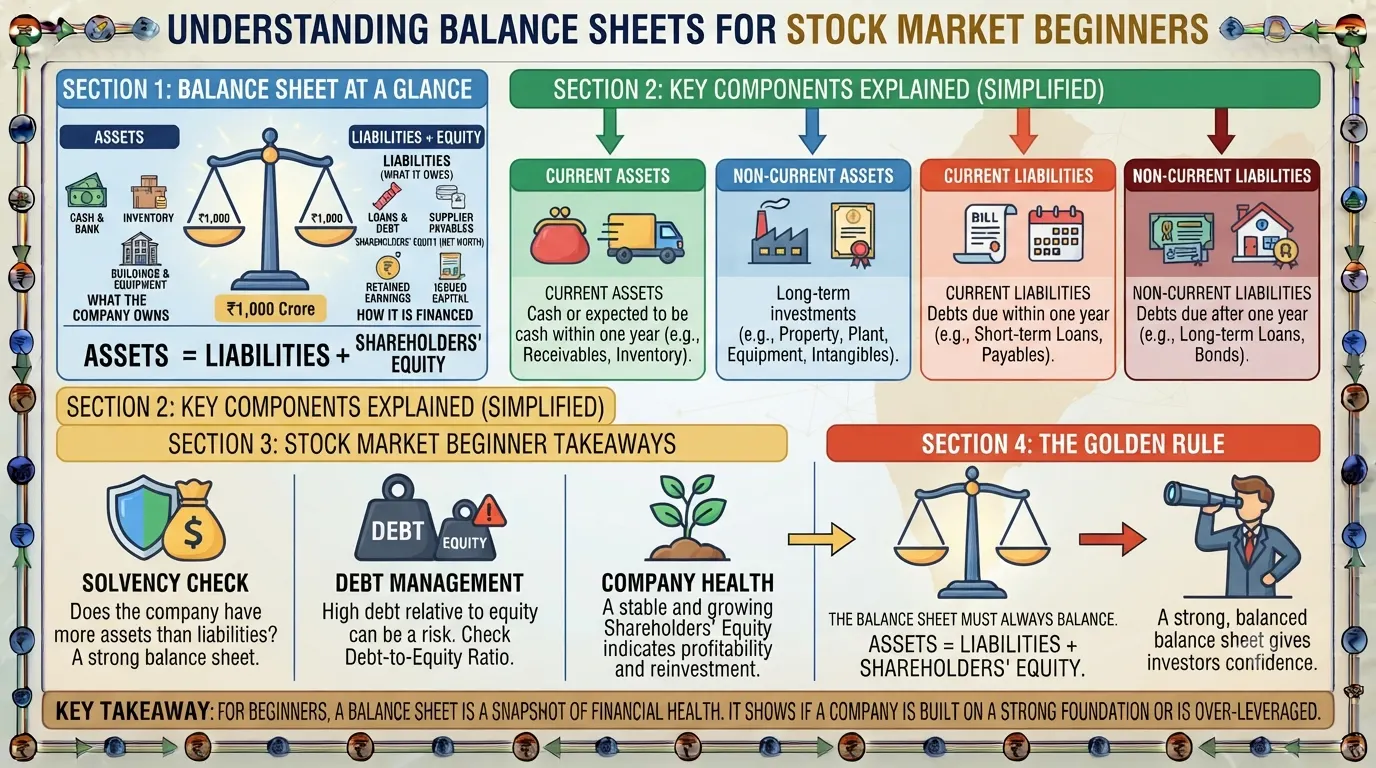
Assets = Liabilities + Shareholders' Equity
This equation means that a company's assets are financed through obligations to lenders and other parties, shareholders' funds, or a combination of both.
For example, suppose a company has assets worth ₹100 crore. It has liabilities of ₹40 crore and shareholders' equity of ₹60 crore.
₹100 crore = ₹40 crore + ₹60 crore
The two sides balance. If the company borrows ₹10 crore and keeps the money in its bank account, both its assets and liabilities increase by ₹10 crore. The accounting equation remains balanced.
What Are the Three Main Components of a Balance Sheet?
A balance sheet has three major components: assets, liabilities and shareholders' equity. Understanding each one is the starting point for analysing a company.
1. Assets: What the Company Owns or Controls
Assets are resources controlled by a company as a result of past events, from which future economic benefits are expected. They can include cash, inventory, property, machinery, investments, receivables and certain intangible resources.
Assets are generally classified into current and non-current categories.
Current Assets
Current assets are generally expected to be realised, sold or consumed during the company's normal operating cycle, or within the applicable current classification period. Common examples include:
- Cash and cash equivalents: Cash balances and qualifying short-term, highly liquid investments.
- Trade receivables: Money customers owe the company for goods or services supplied on credit.
- Inventory: Raw materials, work-in-progress and finished goods held for business operations.
- Short-term investments: Investments classified as current under the applicable accounting requirements.
- Other current assets: Items such as eligible advances, prepaid expenses and other short-term balances.
Investors should not assume that every current asset is immediately available as cash. Inventory may take time to sell, and receivables may not be collected on schedule.
Non-Current Assets
Non-current assets are resources that are not classified as current. They often support business operations over several years.
- Property, plant and equipment: Factories, buildings, machinery, vehicles and equipment.
- Intangible assets: Qualifying assets such as software, patents, licences and trademarks.
- Goodwill: An asset that can arise in a business combination when the consideration transferred exceeds the fair value of identifiable net assets acquired, subject to accounting rules.
- Long-term investments: Investments classified as non-current.
- Other non-current assets: Other qualifying long-term resources and balances.
For a manufacturing company, property and machinery may represent a large part of its assets. A technology or service company may have a different asset mix. Always interpret the composition in the context of the business model.
2. Liabilities: What the Company Owes
Liabilities are present obligations of a company that are expected to result in an outflow of economic resources when settled. They may arise from borrowing, purchases on credit, employee obligations, taxes or other business activities.
Liabilities are generally classified into current and non-current categories.
Current Liabilities
Current liabilities are obligations classified as current under the applicable accounting rules. They commonly include:
- Short-term borrowings: Loans and other borrowings classified as current.
- Trade payables: Amounts due to suppliers for goods or services purchased on credit.
- Current maturities of long-term debt: Portions of longer-term borrowings due within the relevant current period.
- Other current liabilities: Qualifying accrued expenses, statutory dues and other short-term obligations.
- Provisions: Amounts recognised for qualifying obligations where timing or amount is uncertain.
Non-Current Liabilities
Non-current liabilities are obligations that are not classified as current. Examples can include long-term borrowings, qualifying lease liabilities, deferred tax liabilities and long-term provisions.
High debt is not automatically a sign of a weak company. Borrowing may support expansion or investment. The important questions are whether the debt is manageable, whether cash flows can support repayment and whether the business earns an adequate return on the capital it uses.
3. Shareholders' Equity: The Residual Interest
Shareholders' equity represents the residual interest in the company's assets after deducting liabilities. It is also commonly described as the book equity or net worth shown in the financial statements.
Depending on the company's structure and reporting requirements, equity may include:
- Share capital: The recognised capital contributed through issued shares.
- Reserves and surplus: Accumulated balances and other reserves recognised under applicable accounting requirements.
- Other equity items: Items such as other comprehensive income balances and other recognised components.
Retained earnings are accumulated profits retained in the business after accounting for distributions and other relevant adjustments. They can support future investment, working capital or debt reduction.
However, a rising equity balance does not automatically prove that a business is performing well. Equity can also increase through new share issues, and it can be affected by accounting adjustments. Examine the reasons behind the movement.
How Is a Balance Sheet Presented in India?
Indian companies prepare financial statements under the applicable provisions of the Companies Act, 2013 and relevant accounting standards. Section 129 of the Act requires financial statements to give a true and fair view and follow the prescribed form, including the applicable Schedule III requirements.
A typical company balance sheet presents two broad sections:
- Equity and Liabilities: Shareholders' funds and the company's obligations.
- Assets: Current and non-current resources controlled by the company.
The detailed presentation depends on the company's applicable Schedule III division and accounting framework. Financial institutions and certain regulated entities can have different presentation requirements.
How to Read a Balance Sheet: A Practical Example
Consider ABC Manufacturing Ltd., a fictional Indian company. The following figures are hypothetical and are provided only to explain the accounting equation.
| Balance Sheet Item | Amount |
|---|---|
| Assets | |
| Cash and cash equivalents | ₹10 crore |
| Trade receivables | ₹15 crore |
| Inventory | ₹20 crore |
| Property, plant and equipment | ₹45 crore |
| Other assets | ₹10 crore |
| Total Assets | ₹100 crore |
| Liabilities and Equity | |
| Current liabilities | ₹15 crore |
| Long-term borrowings | ₹25 crore |
| Shareholders' equity | ₹60 crore |
| Total Liabilities and Equity | ₹100 crore |
The accounting equation is satisfied:
₹100 crore = ₹40 crore + ₹60 crore
Now look beyond the totals. The company has ₹10 crore in cash, ₹15 crore in receivables and ₹20 crore in inventory. It also has ₹25 crore in long-term borrowings. These figures raise further questions: how quickly are customers paying, how easily can inventory be sold, and can the company generate enough cash to service its debt?
The balance sheet gives you the starting information. The notes to accounts, income statement and cash flow statement help you investigate the answers.
Important Balance Sheet Ratios for Stock Market Beginners
Financial ratios help investors interpret balance-sheet figures. They are most useful when compared across several reporting periods and against companies with similar business models.
1. Current Ratio
The current ratio measures whether a company has enough current assets to cover its current liabilities.
Current Ratio = Current Assets ÷ Current Liabilities
Using the fictional ABC Manufacturing example, assume current assets are ₹45 crore and current liabilities are ₹15 crore.
Current ratio = ₹45 crore ÷ ₹15 crore = 3.0.
This means the company reports ₹3 of current assets for every ₹1 of current liabilities. It does not mean all those assets can immediately be converted into cash. A large inventory balance or overdue receivables may reduce the practical strength of this position.
2. Quick Ratio
The quick ratio provides a more conservative view of short-term liquidity by excluding inventory and, depending on the chosen definition, other less-liquid current assets.
Quick Ratio = (Current Assets − Inventory − Other Excluded Less-Liquid Items) ÷ Current Liabilities
For a simplified example, assume current assets of ₹45 crore, inventory of ₹20 crore, no other excluded items and current liabilities of ₹15 crore.
Quick ratio = (₹45 crore − ₹20 crore) ÷ ₹15 crore = 1.67.
This indicates ₹1.67 of quick assets for every ₹1 of current liabilities under the simplified calculation. The exact definition should be kept consistent when comparing companies.
3. Debt-to-Equity Ratio
The debt-to-equity ratio compares a company's borrowings with shareholders' equity.
Debt-to-Equity Ratio = Total Debt ÷ Shareholders' Equity
Suppose ABC Manufacturing has total debt of ₹25 crore and shareholders' equity of ₹60 crore.
Debt-to-equity ratio = ₹25 crore ÷ ₹60 crore = 0.42, approximately.
This indicates about ₹0.42 of debt for every ₹1 of shareholders' equity, based on the example's definition of debt. A ratio that is considered manageable in one industry may be unsuitable in another. Also check lease liabilities, repayment schedules and finance costs where relevant.
4. Debt-to-Assets Ratio
This ratio measures the proportion of assets financed by debt or by a defined category of total liabilities. Be precise about which definition is used.
Debt-to-Assets Ratio = Total Debt ÷ Total Assets
If total debt is ₹25 crore and total assets are ₹100 crore, the ratio is 25%. This means debt equals 25% of total assets under the stated definition. It does not mean that the company has only 25% total liabilities, because supplier dues and other obligations may also exist.
5. Book Value per Share
Book value per share estimates the accounting equity attributable to ordinary shareholders on a per-share basis.
Book Value per Share = Equity Attributable to Ordinary Shareholders ÷ Ordinary Shares Outstanding
For example, if relevant equity is ₹60 crore and the company has 6 crore ordinary shares outstanding, the book value per share is ₹10.
Book value is an accounting measure, not the same as the market price of a share. It may also be less informative for businesses whose value depends heavily on internally developed intellectual property, brands or other assets that are not fully reflected as recognised balance-sheet assets.
What Should Investors Check Before Trusting a Balance Sheet?
Reading the major headings is not enough. Investors should look at the quality, movement and context of the reported balances.
Check Whether Receivables Are Growing Too Quickly
Receivables represent money customers owe the company. If receivables increase much faster than revenue over several periods, investigate collection delays, customer concentration and the ageing of outstanding amounts.
Examine Inventory Trends
Rising inventory may be normal before a seasonal sales period or during expansion. However, if inventory keeps increasing while sales weaken, it may indicate slower movement, excess production or possible obsolescence. Compare inventory with sales, cost of goods sold and the company's operating cycle.
Review Borrowings and Repayment Obligations
Look beyond total debt. Review short-term and long-term borrowings, current maturities, interest costs, security provided and repayment schedules. A company may have manageable total debt but face short-term liquidity pressure if a large repayment is due soon.
Understand Goodwill and Intangible Assets
Large goodwill or intangible-asset balances may arise from acquisitions, licences, software and other transactions. Read the relevant accounting notes to understand how these assets were recognised and whether impairment risks exist.
Read Contingent Liabilities and Commitments
Contingent liabilities can relate to legal disputes, guarantees, tax matters or other uncertain obligations. They are not necessarily recognised as ordinary liabilities in the balance sheet. Review the notes to understand their nature, amount and uncertainty.
Check Promoter Shareholding and Related Disclosures
For Indian listed companies, examine exchange disclosures and the annual report for promoter shareholding, pledged shares, related-party transactions and other material ownership information. These are not substitutes for the balance sheet, but they add context to the company's financial risk.
Standalone vs Consolidated Balance Sheet: What Is the Difference?
A standalone balance sheet reports the financial position of the parent company as an individual legal entity. A consolidated balance sheet presents the parent company and its subsidiaries as a single economic group, subject to the applicable consolidation rules.
For investors evaluating a business group, consolidated statements are often important because subsidiaries may hold substantial assets, debt, revenue-generating operations or obligations.
For example, a parent company may show modest borrowings on its standalone balance sheet while one of its subsidiaries carries significant debt. Looking only at the parent company's standalone figures could therefore provide an incomplete view of group-level financial risk.
Always compare like with like. Do not compare a company's standalone balance sheet in one year with its consolidated balance sheet in another year.
Why Balance Sheet Analysis Is Different for Banks
Banks and other financial institutions have business models that differ from ordinary manufacturing or service companies. Deposits, loans, investments, provisions and regulatory capital are central to their operations.
For banks, investors commonly examine measures such as capital adequacy, gross and net non-performing assets, provision coverage, liquidity, deposit growth and credit growth, along with profitability and asset-quality disclosures.
Standard industrial-company ratios such as inventory turnover or debt-to-equity may not provide a meaningful comparison for a bank. Use sector-specific measures and the applicable regulatory disclosures when analysing financial institutions.
How to Find a Company's Balance Sheet in India
Investors can obtain balance-sheet information from original company and exchange disclosures. Useful starting points include:
- NSE corporate filings and financial results — search listed-company results and related disclosures.
- BSE financial results — access financial result filings for companies listed on BSE.
- Ministry of Corporate Affairs — consult the Companies Act and applicable company-law resources.
- Company investor relations website: Look for annual reports, quarterly financial results and investor presentations.
When downloading a report, confirm the company name, financial year, reporting date, currency, units and whether the statement is audited, standalone or consolidated. Also read the notes that accompany the financial statements.
Common Mistakes Beginners Make When Reading Balance Sheets
- Assuming high assets always mean a strong company: Assets may include slow-moving inventory, overdue receivables or assets that generate weak returns.
- Assuming low debt automatically means low risk: A company can have weak liquidity, poor cash generation or significant contingent liabilities even with modest borrowings.
- Using fixed ratio thresholds for every industry: Business models, operating cycles and capital structures differ.
- Ignoring the reporting date: A balance sheet is a snapshot and may not reflect major events that occurred after that date.
- Confusing book value with market value: Shareholders' equity is an accounting figure; market capitalisation is based on the market price and shares outstanding.
- Ignoring the notes to accounts: Important details about debt, receivables, provisions, commitments and related parties may be disclosed in the notes.
- Reading the balance sheet alone: The income statement and cash flow statement are needed to understand profitability and cash generation.
A Simple Balance Sheet Checklist for Stock Market Beginners
Use this checklist as a starting point when reviewing a listed company:
- Confirm the reporting date and whether the figures are standalone or consolidated.
- Check total assets and understand the major asset categories.
- Review cash, receivables and inventory separately.
- Examine short-term and long-term borrowings.
- Compare current assets with current liabilities.
- Review shareholders' equity and the movement in reserves.
- Calculate relevant liquidity and leverage ratios using consistent definitions.
- Compare the balance sheet with previous years and suitable industry peers.
- Read notes to accounts, contingent liabilities and auditor observations.
- Cross-check debt, profit and working-capital movements against the cash flow and income statements.
Frequently Asked Questions
1. What does a balance sheet tell investors?
A balance sheet shows a company's assets, liabilities and shareholders' equity on a particular date. It helps investors examine financial position, liquidity, debt and the composition of company resources.
2. What is the basic balance sheet formula?
The basic formula is Assets = Liabilities + Shareholders' Equity. It means that a company's resources are financed through obligations and shareholders' funds.
3. What are current assets and current liabilities?
Current assets are resources classified as current under the applicable accounting rules, such as cash, receivables and inventory. Current liabilities are obligations classified as current, such as trade payables, short-term borrowings and current maturities of long-term debt.
4. What is a good current ratio for a company?
There is no universal current-ratio level that is suitable for every company. The appropriate level depends on the industry, operating cycle, inventory quality, receivable collection and cash-flow position. Compare the ratio with the company's history and relevant peers.
5. Is a high debt-to-equity ratio always bad?
Not necessarily. Some businesses operate with more debt because of their capital requirements and predictable cash flows. However, high leverage can increase financial risk. Investors should examine interest costs, repayment schedules, cash generation and industry conditions.
6. What is the difference between a balance sheet and an income statement?
A balance sheet reports a company's financial position at a particular date. An income statement reports revenue, expenses and profit or loss over a period. Both are needed to understand a company's financial performance and position.
7. Should beginners read standalone or consolidated balance sheets?
Both can be useful, but consolidated statements are important when subsidiaries form a material part of the business. Standalone statements show the parent company's individual position. Compare the same reporting basis across periods.
8. Can a company have positive shareholders' equity and still face financial problems?
Yes. Positive equity does not guarantee adequate cash, timely debt repayment or profitable operations. A company may have valuable long-term assets but weak liquidity, overdue receivables or substantial upcoming obligations.
Conclusion
A balance sheet is an important starting point for understanding a company's financial position. It shows what the business controls, what it owes and the residual value attributable to shareholders. For stock market beginners, learning to read these three components can make company research more structured and meaningful.
Do not judge a company by one figure or ratio. Examine the quality of its assets, the size and maturity of its liabilities, changes in shareholders' equity and the relationship between current assets and current obligations. Compare several years of data and read the accompanying notes.
Most importantly, use the balance sheet together with the income statement, cash flow statement, annual report and relevant industry information. This broader view helps you ask better questions, although it cannot eliminate investment risk or predict future share prices.
Disclaimer: This article is for educational and informational purposes only. It is not investment advice or a recommendation to buy, sell or hold any security. Financial statements involve accounting estimates and assumptions, and reported figures may change through subsequent disclosures or restatements. Verify information from official company and exchange filings and consider your financial objectives and risk tolerance before making investment decisions.