What Is Return on Equity (ROE)? Formula, Meaning and Examples
Learn what Return on Equity (ROE) means, how to calculate it using average shareholders' equity, and how to analyse profitability, financial leverage and business performance in Indian stocks.
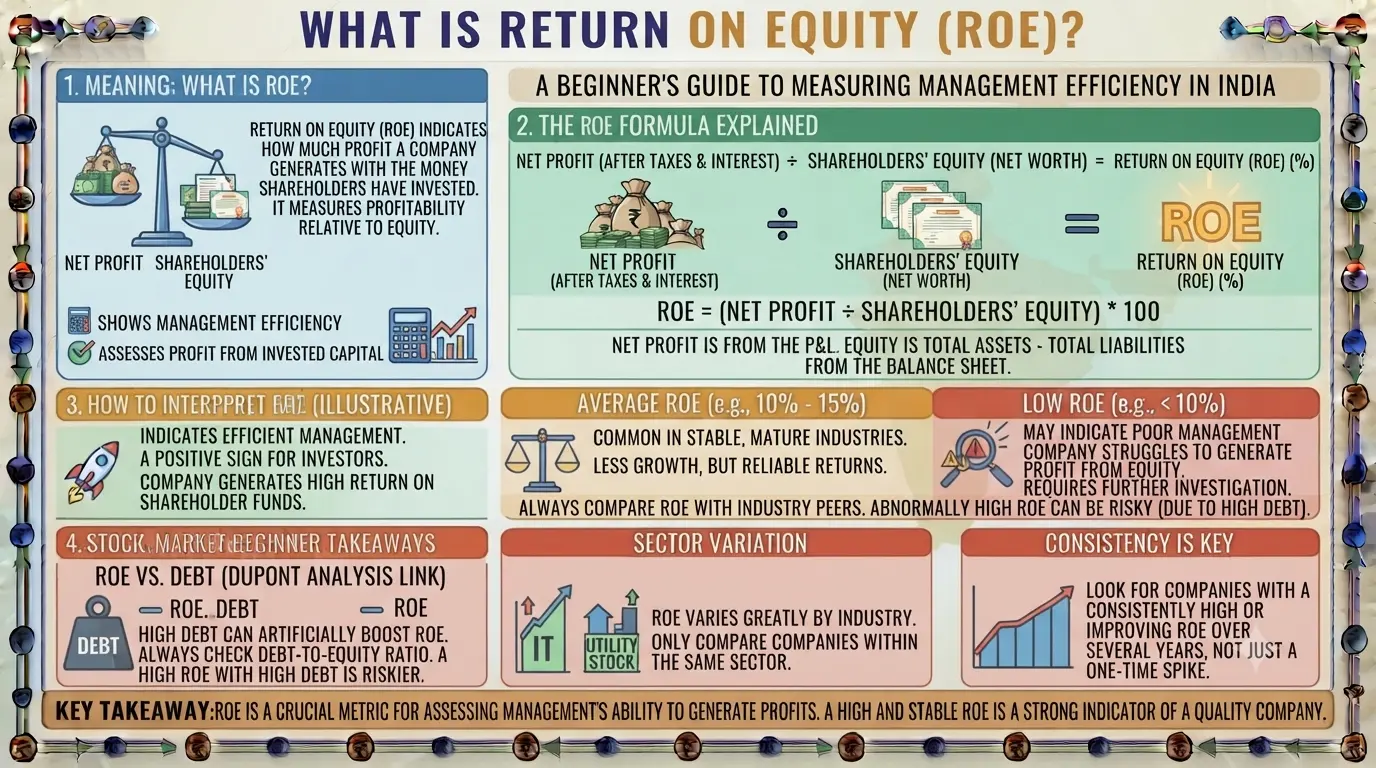
What Is Return on Equity (ROE)? Formula, Meaning and Examples
When analysing a listed company, investors need to understand not only how much profit it earns but also how efficiently it uses the capital invested by its shareholders. Return on Equity, commonly called ROE, is one of the financial ratios used to examine this relationship.
ROE measures the profit a company generates relative to its shareholders' equity. It helps investors assess how effectively management uses the owners' capital to generate earnings. However, a high ROE does not automatically mean that a company is financially strong or that its shares are attractively valued. Debt, buybacks, accumulated losses and one-time gains can all influence the ratio.
For Indian investors, understanding ROE is particularly useful when comparing companies within the same industry, studying long-term profitability and evaluating the quality of a business. This guide explains the ROE formula, a step-by-step calculation, the DuPont analysis method, its relationship with ROCE and ROA, and the warning signs investors should check before relying on the ratio.
What Is Return on Equity (ROE)?
Return on Equity (ROE) is a profitability ratio that measures how much profit a company generates in relation to the shareholders' equity invested in the business. It is generally expressed as a percentage.
In simple terms, ROE indicates how much net profit a company generates for every ₹100 of shareholders' equity.
For example, if a company has an ROE of 15%, it has generated ₹15 in annual profit for every ₹100 of average shareholders' equity during the period, based on the figures used in the calculation.
This does not mean that shareholders receive ₹15 as cash or a dividend. The profit may be retained in the business, reinvested, used to repay debt or distributed according to the company's dividend policy.
ROE is therefore an accounting profitability measure. It is not the same as an investor's personal return, which depends on the price paid for shares, dividends received and changes in market value.
What Is the ROE Formula?
The commonly used Return on Equity formula is:
ROE = (Net Income ÷ Average Shareholders' Equity) × 100
For a listed company, analysts generally use profit attributable to the ordinary equity shareholders of the parent company and the corresponding shareholders' equity attributable to those shareholders. The numerator and denominator should be consistent in scope.
Understanding the two components
1. Net income
Net income is the profit remaining after the company accounts for its expenses, finance costs and income tax for the relevant period. In an Indian company's financial statements, this is generally examined through the statement of profit and loss.
For consolidated analysis, investors should use profit attributable to the owners of the parent rather than automatically using total consolidated profit if part of that profit belongs to non-controlling interests. Where preference shares exist, the amount attributable to preference shareholders must also be considered when calculating the return attributable to ordinary equity holders.
2. Average shareholders' equity
Shareholders' equity represents the residual interest in the company's assets after deducting its liabilities. It includes items such as issued share capital and reserves, subject to the company's accounting presentation.
Average shareholders' equity is commonly calculated using the opening and closing equity balances:
Average Shareholders' Equity = (Opening Equity + Closing Equity) ÷ 2
Average equity is generally more suitable than using only closing equity because net income is earned throughout a financial period, while the balance sheet reports equity at a particular date.
If a company issues shares, completes a large buyback, records a major loss or distributes a substantial dividend during the year, the equity balance may change significantly. In such cases, the simple opening-and-closing average may not fully reflect the timing of those movements. Analysts may need more detailed interim or time-weighted equity information.
How to Calculate ROE: Step-by-Step Example
Consider ABC Industries, a hypothetical Indian company. The following figures are illustrative and do not represent the financial results of an actual listed company.
| Particulars | Amount |
|---|---|
| Profit attributable to ordinary shareholders | ₹150 crore |
| Opening shareholders' equity | ₹900 crore |
| Closing shareholders' equity | ₹1,100 crore |
Step 1: Calculate average shareholders' equity
Average Equity = (₹900 crore + ₹1,100 crore) ÷ 2
Average Equity = ₹1,000 crore
Step 2: Apply the ROE formula
ROE = (₹150 crore ÷ ₹1,000 crore) × 100
ROE = 15%
ABC Industries therefore has a hypothetical ROE of 15% for the period. In simple terms, it generated ₹15 of profit for every ₹100 of average shareholders' equity.
Why should investors use average equity?
Suppose the company used only its closing equity of ₹1,100 crore:
ROE = (₹150 crore ÷ ₹1,100 crore) × 100 = 13.64%
This differs from the 15% calculated using average equity. Neither calculation should be mixed with a different equity basis when comparing companies. For a full-year profitability analysis, average equity is generally the more representative starting point because the profit was earned over the year.
What Does a High or Low ROE Mean?
A high ROE indicates that a company is generating more accounting profit relative to its equity base. A low ROE indicates that it is generating less profit relative to that base.
However, the number should be interpreted in the context of the company's industry, historical performance, financing structure and earnings quality. There is no single ROE percentage that is suitable for every business.
What does a high ROE indicate?
A consistently high ROE may indicate that a company has strong profit margins, uses its assets efficiently, has a competitive business model or reinvests capital effectively.
For example, a hypothetical company with a stable 22% ROE over several years may deserve further research if its profits are recurring, its debt is manageable and its operating cash flow supports reported earnings.
But the same 22% ROE could be less reassuring if it is mainly caused by high borrowing, a sharply reduced equity base or a one-time accounting gain.
What does a low ROE indicate?
A low ROE may indicate weak profitability, underused assets, high operating costs or an equity base that has grown faster than earnings.
It may also be temporary. A company investing in a new factory, expanding its distribution network or entering a new market may have a larger equity base before the expected profits fully materialise.
Investors should therefore examine why ROE is low rather than assuming that management is necessarily performing poorly.
What is considered a good ROE?
A useful starting point is to compare a company's ROE with the historical range of the same company and with comparable businesses in the same industry.
For example, an asset-light software company and a capital-intensive steel manufacturer have different operating models, asset requirements and financing needs. Applying the same ROE threshold to both can lead to misleading conclusions.
Investors should also compare ROE with the company's cost of equity. A business creates economic value only when its returns on equity capital are sufficient relative to the risk-adjusted return required by shareholders. A high accounting ROE alone does not establish that this condition is met.
What Is the DuPont Analysis of ROE?
DuPont analysis breaks ROE into three components so investors can understand what is driving the ratio. Instead of looking only at the final percentage, it separates profitability, asset efficiency and financial leverage.
The three-step DuPont formula is:
ROE = Net Profit Margin × Asset Turnover × Equity Multiplier
Where:
- Net Profit Margin: Net Income ÷ Revenue
- Asset Turnover: Revenue ÷ Average Total Assets
- Equity Multiplier: Average Total Assets ÷ Average Shareholders' Equity
When the periods and accounting bases are consistent, multiplying these components reconstructs ROE.
1. Net profit margin
Net profit margin measures how much net income a company generates from its revenue.
Net Profit Margin = (Net Income ÷ Revenue) × 100
A higher margin may indicate stronger pricing power, better cost control or a favourable business mix. However, margins differ considerably across industries. A high-margin software company should not automatically be compared with a low-margin distributor using the same expectations.
2. Asset turnover
Asset turnover measures how efficiently a company uses its assets to generate revenue.
Asset Turnover = Revenue ÷ Average Total Assets
A higher asset turnover may indicate that the company generates more sales from its asset base. Retailers and distributors may have different turnover characteristics from utilities, infrastructure companies or heavy manufacturers.
3. Equity multiplier
The equity multiplier measures the relationship between a company's assets and shareholders' equity.
Equity Multiplier = Average Total Assets ÷ Average Shareholders' Equity
A higher equity multiplier generally indicates greater financial leverage, meaning a larger portion of assets is funded by liabilities rather than shareholders' equity. This can increase ROE, but it can also increase financial risk.
DuPont calculation example
Consider another hypothetical company with the following figures:
| Component | Illustrative value |
|---|---|
| Net profit margin | 10% |
| Asset turnover | 1.5 times |
| Equity multiplier | 2 times |
ROE = 10% × 1.5 × 2
ROE = 30%
The company has a hypothetical ROE of 30%. DuPont analysis shows that this result comes from a combination of its profit margin, asset turnover and financial leverage.
Now assume the company's equity multiplier rises from 2 to 3 while the other two components remain unchanged:
ROE = 10% × 1.5 × 3 = 45%
ROE has increased from 30% to 45%, even though the profit margin and asset turnover have not improved. The increase is driven by a higher equity multiplier. Investors should investigate the company's debt and financial risk before treating the higher ROE as an improvement in business quality.
ROE vs ROCE vs ROA: What Is the Difference?
ROE, Return on Capital Employed (ROCE) and Return on Assets (ROA) are profitability ratios, but they examine different aspects of a company's performance.
| Ratio | What it measures | Common formula |
|---|---|---|
| ROE | Profit generated relative to shareholders' equity | Net Income ÷ Average Shareholders' Equity |
| ROCE | Operating return generated from capital employed | EBIT ÷ Average Capital Employed |
| ROA | Profit generated relative to the asset base | Net Income ÷ Average Total Assets |
ROE vs ROCE
ROE focuses on the return generated for equity shareholders. ROCE examines the operating return generated from the capital employed in the business, including relevant debt and equity funding.
For non-financial companies with substantial borrowing, ROCE can help investors assess operating performance without focusing only on the equity-funded portion of the business.
For example, a manufacturing company may report a high ROE because it uses significant debt. If its ROCE is comparatively weak, investors should investigate whether the business is generating sufficient operating returns from its total capital base.
ROE vs ROA
ROA measures profitability relative to total assets, whereas ROE measures profitability relative to shareholders' equity.
Because assets are funded by both equity and liabilities, financial leverage can cause ROE to be substantially higher than ROA. Looking at both ratios can help investors understand whether a company's reported return is supported by asset productivity or a relatively small equity base.
Why Can a High ROE Be Misleading?
ROE is useful, but several factors can make the ratio look stronger than the underlying business performance. Investors should identify these factors before treating a high ROE as evidence of business quality.
1. High debt can increase ROE
When a company finances a larger portion of its assets through borrowing, shareholders' equity may represent a smaller share of the funding base. This can increase the equity multiplier and raise ROE.
Borrowing can support profitable expansion, but it also creates interest and repayment obligations. If sales weaken, borrowing costs rise or cash flows deteriorate, the company may face financial pressure.
Check the debt-to-equity ratio, interest coverage, debt maturity profile and operating cash flow alongside ROE.
2. A small equity base can inflate the ratio
A company that has accumulated losses, made substantial distributions or reduced its equity base may report a high ROE when profits recover. The denominator has become smaller, so even moderate earnings can produce a large percentage.
This does not automatically mean that the company has developed a superior business model. Investors should study the historical balance sheet and the reasons for the reduction in equity.
3. One-time gains can increase net income
A company may report a large gain from an asset sale, a settlement, a reversal of a provision or another non-recurring event. Such gains can raise net income and temporarily increase ROE.
Investors should distinguish recurring operating profit from unusual gains and consider whether the reported ROE is representative of normal business performance.
4. Share buybacks can change ROE
A share buyback reduces the company's equity when shares are repurchased and accounted for as a distribution to owners. If net income remains stable while the equity base declines, ROE may increase.
A buyback may be a sensible capital-allocation decision in some circumstances, but a higher ROE following a buyback does not by itself prove that operating efficiency has improved.
5. Cyclical earnings can distort a single-year figure
Companies in sectors such as metals, commodities and other cyclical industries can experience large changes in earnings as prices and demand move through economic cycles.
ROE may rise sharply during a strong period and fall during a downturn. Investors should examine several years of results and avoid treating a peak-cycle ROE as a permanent level of profitability.
6. Negative shareholders' equity makes interpretation difficult
Shareholders' equity can become negative when accumulated losses and other balance-sheet movements exceed the company's capital and reserves. In such cases, a conventional ROE calculation may produce a negative or otherwise misleading percentage.
Do not interpret an unusually high positive ROE calculated from a very small equity base as proof of exceptional efficiency. If equity is negative, the usual interpretation of ROE is generally not meaningful. Examine the balance sheet, accumulated losses, liabilities and cash flows instead.
How Should Investors Analyse ROE in Indian Companies?
Investors should use ROE as one part of a broader financial analysis. The following checks can help explain whether a company's ROE is sustainable and supported by its business performance.
1. Compare ROE over several years
Review the company's ROE over multiple financial years rather than relying on the latest annual result alone. A stable trend may be more informative than one unusually high figure.
Investigate sudden increases or declines by checking net income, equity movements, acquisitions, buybacks and changes in borrowing.
2. Compare with companies in the same industry
Compare companies with similar business models, capital requirements and financing structures. An asset-light IT services business, a steel producer and a bank should not be judged using identical ROE expectations.
3. Examine ROCE and ROA alongside ROE
For many non-financial businesses, ROCE provides useful context about returns generated from the total capital employed. ROA helps assess how effectively assets generate profits.
If ROE is high but ROCE is weak and borrowing is substantial, investigate whether leverage rather than operating strength is driving the result.
4. Check debt and interest obligations
Review borrowings, interest expenses, debt-to-equity and interest coverage. A company with a high ROE and manageable debt may have a different risk profile from one with a similar ROE but heavy borrowing and weak interest coverage.
5. Compare net profit with operating cash flow
Accounting profit does not always convert into cash during the same period. Compare profit with cash generated from operating activities and examine changes in receivables, inventory and working capital.
If earnings rise consistently while operating cash flow remains weak, investigate the reasons. It may reflect working-capital requirements, timing differences or other factors that deserve further review.
6. Identify exceptional items
Read the notes to accounts and management discussion to identify gains or expenses that may distort the reported result. A normalised or adjusted ROE can sometimes help with historical comparisons, but investors should understand every adjustment rather than accepting a company's adjusted figure without scrutiny.
7. Consider the company's cost of equity
ROE should also be considered relative to the return shareholders require for the risk of investing in the business. A company reporting a 12% ROE is not automatically creating economic value if its cost of equity is higher.
Estimating the cost of equity requires assumptions about risk and market conditions. It should not be treated as a fixed universal benchmark.
How Should ROE Be Interpreted for Banks and Financial Companies?
ROE is commonly used to analyse banks and financial institutions because shareholders' equity is an important measure of the capital that supports their operations and absorbs losses.
However, banks operate with a different balance-sheet structure from ordinary manufacturing or service businesses. Deposits and other financial liabilities are part of their core funding model. As a result, conventional debt comparisons used for non-financial companies may not be appropriate.
When analysing a bank's ROE, investors should also review:
- Return on Assets (ROA): Shows profit relative to the bank's asset base.
- Gross Non-Performing Assets (GNPA): Indicates the proportion of gross advances classified as non-performing.
- Net Non-Performing Assets (NNPA): Reflects non-performing advances after relevant provisions.
- Provisioning: Shows the amounts set aside against potential credit losses.
- Capital adequacy: Helps assess the bank's capital buffer relative to risk-weighted assets.
- Net interest margin (NIM): Helps evaluate the spread between interest earned and interest paid relative to relevant earning assets.
A bank's ROE should therefore be interpreted alongside asset quality, capital strength, profitability and credit-cycle conditions. Comparing a bank's ROE directly with that of an asset-light consumer company can lead to an incomplete conclusion.
Common Mistakes Investors Make When Using ROE
- Assuming a high ROE always means a good company: Debt, buybacks and a small equity base can inflate the ratio.
- Using only closing equity: Average equity is generally a better starting point for a full-period profitability calculation.
- Comparing unrelated industries: Different business models and capital structures produce different ROE patterns.
- Ignoring one-time gains: Exceptional income may make a single year's ROE look unusually strong.
- Ignoring debt: A high ROE does not reveal whether the company can comfortably meet its borrowing obligations.
- Ignoring cash flow: Reported profit should be examined alongside cash generated from operations.
- Confusing ROE with investor returns: ROE is a company-level accounting ratio, not the return earned by an individual shareholder.
- Ignoring negative equity: A conventional ROE percentage may not be meaningful when shareholders' equity is negative or extremely small.
A Practical ROE Analysis Checklist
Before relying on a company's ROE, investors can use this checklist:
- Confirm that net income and shareholders' equity refer to the same reporting scope.
- Use profit attributable to the relevant ordinary equity holders.
- Calculate average shareholders' equity using consistent opening and closing balances.
- Review the company's ROE trend across several years.
- Compare ROE with relevant industry peers.
- Use DuPont analysis to identify the effects of margin, asset turnover and leverage.
- Check debt, interest coverage and the company's ability to meet obligations.
- Compare reported earnings with operating cash flow.
- Identify buybacks, exceptional gains, accumulated losses and other equity movements.
- For banks, review asset quality and capital adequacy alongside ROE.
- Compare ROE with the company's cost of equity when assessing value creation.
- Use ROE with ROCE, ROA and valuation ratios rather than as a standalone investment signal.
For a wider framework covering earnings, debt, valuation and business growth, read our guide to five things to check before investing in stocks.
Frequently Asked Questions About Return on Equity
1. What does ROE mean in the stock market?
ROE stands for Return on Equity. It measures how much profit a company generates relative to its shareholders' equity. Investors use it to assess profitability and how efficiently the business uses equity capital.
2. How is ROE calculated?
ROE is generally calculated by dividing net income attributable to ordinary equity shareholders by average shareholders' equity and multiplying the result by 100. Average equity is commonly calculated as opening equity plus closing equity divided by two.
3. What is a good ROE for a company?
There is no universal good ROE for every company. Investors should compare a company's ROE with its own historical performance and similar businesses in the same sector. Debt, profit quality, asset requirements and cost of equity should also be considered.
4. Is a higher ROE always better?
No. A high ROE may reflect strong margins and efficient operations, but it can also result from high financial leverage, a reduced equity base, share buybacks or one-time gains. Investors should use DuPont analysis and review the balance sheet before drawing conclusions.
5. What is the difference between ROE and ROCE?
ROE measures net profit relative to shareholders' equity. ROCE measures operating profit relative to capital employed, which includes relevant debt and equity funding. ROCE is often useful when analysing capital-intensive non-financial businesses.
6. Why is average shareholders' equity used in the ROE formula?
Net income is generated over a period, whereas shareholders' equity is recorded at a specific date. Averaging opening and closing equity provides a more representative denominator for the period than using only the closing balance.
7. Can ROE be negative?
Yes. ROE can be negative when the company reports a loss while shareholders' equity is positive. If shareholders' equity itself is negative, the conventional ratio may become difficult to interpret and should not be treated as a normal profitability measure.
8. Why should investors check ROE and ROA together?
ROE measures profit relative to shareholders' equity, while ROA measures profit relative to total assets. Comparing them can help investors understand how financial leverage affects the reported return on equity.
Conclusion
Return on Equity is an important profitability ratio that helps investors understand how effectively a company generates profit from shareholders' equity. It can be useful for studying long-term performance, comparing similar businesses and examining the efficiency of management's use of capital.
However, ROE should never be interpreted in isolation. Financial leverage, buybacks, one-time gains, accumulated losses and changes in the equity base can all influence the ratio. A high percentage is not automatically evidence of a high-quality business.
A more disciplined approach is to examine average shareholders' equity, review several years of results, use DuPont analysis, check debt and cash flow, and compare ROE with ROCE or ROA where appropriate. For banks, asset quality and capital adequacy deserve particular attention.
Ultimately, ROE is most useful when it helps explain how a business earns its profits and whether those earnings are sustainable. It should support a wider analysis of financial strength, business quality and valuation—not replace it.
Disclaimer: This article is intended for educational and informational purposes only. It does not constitute investment advice or a recommendation to buy or sell any security. Stock market investments are subject to market risks. Readers should review official company disclosures and consult a SEBI-registered investment adviser where appropriate before making investment decisions.