What Is Nifty 50 and How Is It Calculated?
Learn what the Nifty 50 represents, how NSE calculates it using free-float market capitalisation, how stock weightage works, and why the index moves.
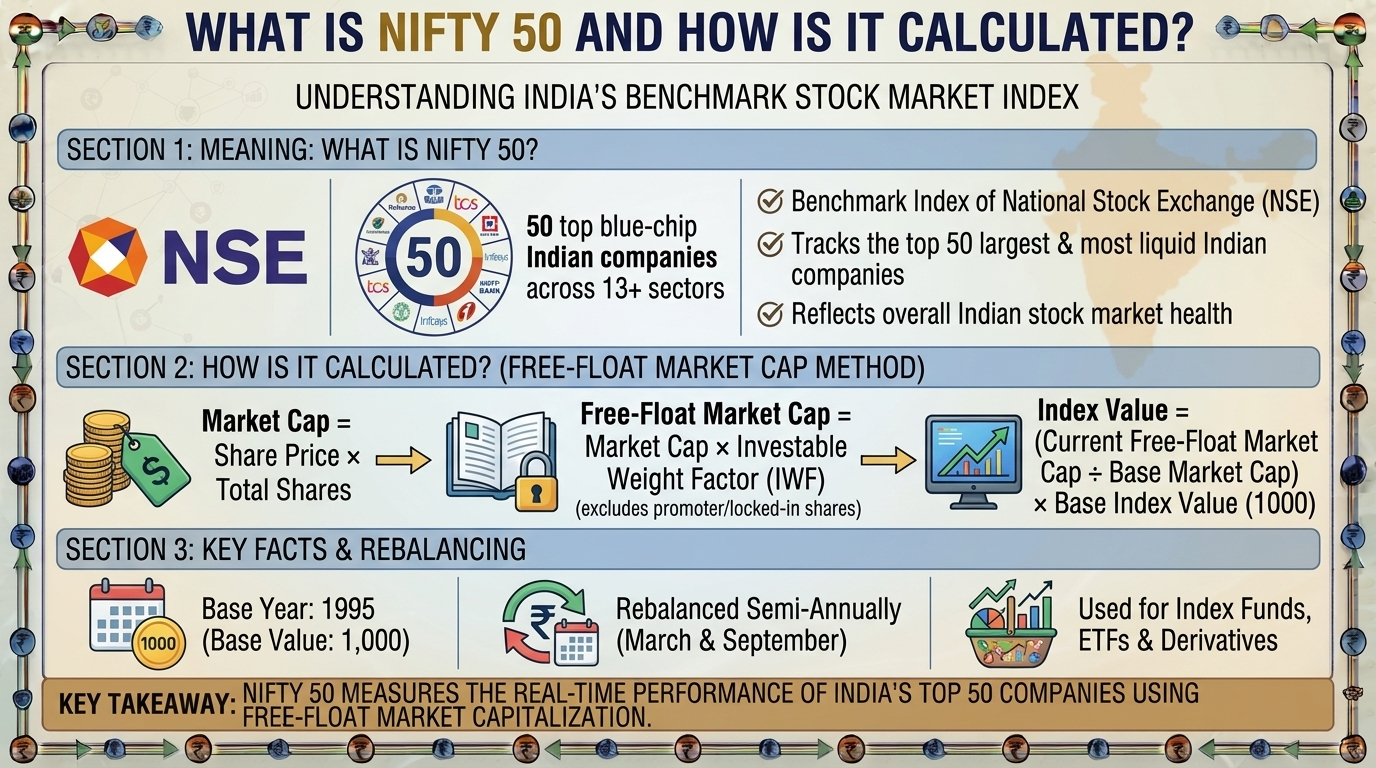
What Is Nifty 50 and How Is It Calculated?
When the Nifty 50 rises by 200 points, financial news channels often describe it as a positive day for the Indian stock market. But what does that number actually represent? Did all 50 companies gain value? Does every company contribute equally? And who decides which stocks belong in the index?
These questions matter because the Nifty 50 is more than a number displayed on a trading screen. It is one of the most widely followed indicators of the Indian equity market, used by investors, fund managers, analysts and traders to understand market performance.
The interesting part is that the Nifty 50 does not simply add the share prices of 50 companies and divide the result by 50. It uses a method called free-float market capitalisation weighting. That means companies with a larger market value of shares available for public trading generally have a greater influence on the index.
What Is Nifty 50?
The Nifty 50 is a benchmark stock market index that tracks the performance of 50 large and liquid companies listed on the National Stock Exchange of India (NSE). It is owned and managed by NSE Indices Limited and represents companies from important sectors of the Indian economy.
Think of it as a carefully constructed market basket. Instead of following every listed company individually, investors can use one index to observe how a selected group of major companies is performing.
For example, if the Nifty 50 rises during a trading session, it generally indicates that the combined weighted performance of its constituents has improved. It does not mean that every company in the index has increased in price.
The index is used as a benchmark for investment portfolios, index funds, exchange-traded funds (ETFs) and derivatives. It is also a common reference point when people discuss the direction of the Indian stock market.
Who Manages the Nifty 50?
The Nifty 50 is managed by NSE Indices Limited, a company within the National Stock Exchange group that specialises in developing and maintaining market indices.
The NSE is the stock exchange where the constituent shares are traded. NSE Indices is responsible for the index itself, including its methodology, constituent reviews and calculation framework.
This distinction is useful: the Nifty 50 is not a mutual fund, a company or a stock that investors can purchase directly. It is a measurement of the performance of a defined group of securities. Investors can obtain exposure to it through products such as Nifty 50 index funds and ETFs.
How Is Nifty 50 Calculated?
The Nifty 50 uses the free-float market capitalisation method. The calculation considers the market value of shares that are available for public trading, rather than treating every issued share as freely tradable.
In simplified form, the calculation can be understood as:
Index value = (Current free-float market capitalisation of the index ÷ Base free-float market capitalisation) × Base index value
The official calculation framework also accounts for index maintenance and corporate actions. The formula above is a simplified way to understand the relationship between the current market value of the constituents and the index's base reference.
Step 1: Calculate the market capitalisation of a company
Market capitalisation, often shortened to market cap, is the total market value of a company's issued shares.
Market capitalisation = Share price × Total number of outstanding shares
Suppose a hypothetical company has 100 crore outstanding shares and each share trades at ₹200.
- Outstanding shares: 100 crore
- Share price: ₹200
- Market capitalisation: 100 crore × ₹200 = ₹20,000 crore
The company has a market capitalisation of ₹20,000 crore. However, the Nifty 50 calculation does not necessarily use this entire amount.
Step 2: Understand free-float market capitalisation
Not every share issued by a company is normally available for public trading. Promoter holdings, certain strategic holdings and other restricted or non-public holdings may not form part of the freely tradable share count.
Free-float market capitalisation = Market capitalisation × Free-float factor
Imagine the hypothetical company has 100 crore shares, but only 60 crore are considered available for public trading. Its free-float factor is 60%.
- Total market capitalisation: ₹20,000 crore
- Free-float factor: 60%
- Free-float market capitalisation: ₹20,000 crore × 60% = ₹12,000 crore
The index uses the ₹12,000 crore free-float market capitalisation in this example, not the full ₹20,000 crore market capitalisation.
Step 3: Calculate the free-float market capitalisation of all 50 companies
The free-float market capitalisation of each constituent is calculated and combined. The resulting total represents the current free-float market value of the Nifty 50 portfolio.
Because companies have different market capitalisations and free-float factors, their contributions are not equal. A large company with a high free-float market value can influence the index more than a smaller constituent.
Step 4: Compare the current value with the base reference
The Nifty 50 uses 3 November 1995 as its base date and 1,000 as its base value. The original base capital was ₹2.06 trillion.
The base provides a reference point. As the combined free-float market value of the index constituents changes, the index level changes in relation to that reference. The operational calculation also uses index-maintenance adjustments so that events such as stock splits, rights issues and constituent changes do not create artificial jumps in the index.
The index has been calculated using free-float market capitalisation weighting since 26 June 2009.
Why Do Some Nifty 50 Companies Have More Weight?
Each company has a different weight in the index because its contribution is linked to its free-float market capitalisation.
Consider a simplified example with only two hypothetical companies:
| Company | Free-float market cap | Index weight |
|---|---|---|
| Company A | ₹80,000 crore | 80% |
| Company B | ₹20,000 crore | 20% |
| Total | ₹1,00,000 crore | 100% |
In this hypothetical portfolio, Company A has four times the weight of Company B. If both shares rise by 1%, Company A contributes more to the portfolio's movement because it has the larger weight.
This is why the Nifty 50 is not an equal-weight index. A company does not receive the same influence simply because it is one of the 50 constituents.
What Happens When Nifty 50 Stocks Rise or Fall?
The index responds to the weighted movement of its constituent shares. A price change in a heavily weighted company generally has a larger effect than the same percentage change in a company with a much smaller weight.
Continue with the two-company example above:
- Company A has an 80% weight and rises by 2%.
- Company B has a 20% weight and falls by 1%.
The simplified portfolio return is:
(80% × 2%) + (20% × -1%) = 1.4%
The portfolio rises by approximately 1.4%, even though one of the two companies has fallen. This is a simplified weighted-return illustration, not a live Nifty 50 calculation.
It explains an important market observation: the Nifty 50 can rise even when several individual stocks decline. The reverse is also possible. A few heavily weighted stocks can fall enough to pull the index down while many smaller constituents remain positive.
How Are Companies Selected for the Nifty 50?
A company does not enter the Nifty 50 simply because its share price has increased or it has become popular among retail investors. NSE Indices follows documented eligibility and review rules.
Under the March 2026 methodology, the eligible universe is drawn from Nifty 100 constituents that are available for trading in the NSE Futures and Options segment. The methodology also considers trading frequency, liquidity and free-float market capitalisation.
Some important requirements include:
- Trading frequency: The company's security should have a 100% trading frequency over the preceding six months.
- Liquidity: The security must satisfy the specified impact-cost requirement. Impact cost measures the price impact of executing a trade compared with an ideal market price.
- Free-float market capitalisation: The average free-float market capitalisation must meet the prescribed threshold relative to the smallest existing constituent.
- Eligible universe: The company must satisfy the rules for the eligible Nifty 100 and NSE F&O universe.
These conditions help the index represent large and actively traded companies rather than simply selecting stocks based on headline market capitalisation.
When Does the Nifty 50 Change Its Companies?
The Nifty 50 is reviewed twice a year. The scheduled reviews use six-month data ending in January and July, with any scheduled constituent replacements implemented from the last trading day of March and September.
Changes can also be considered outside the regular review cycle in specific circumstances, such as mergers, demergers, delisting, trading suspension or other events that affect a constituent's eligibility.
For investors, this means the list of 50 companies is not permanent. The index is designed to evolve as the market and company eligibility change.
Nifty 50 vs Sensex: What Is the Difference?
Both indices are used to understand the Indian equity market, but they track different groups of companies and are maintained by different index providers.
| Feature | Nifty 50 | Sensex |
|---|---|---|
| Exchange association | NSE | BSE |
| Number of constituents | 50 | 30 |
| Index manager | NSE Indices Limited | Asia Index Private Limited |
| Base value | 1,000 | 100 |
| Weighting approach | Free-float market capitalisation | Free-float market capitalisation |
The index levels should not be compared directly. A Nifty 50 reading of 25,000 is not evidence that it is more valuable or better performing than a Sensex reading of 80,000. Their base values, constituent groups and index histories differ.
Does Nifty 50 Include Dividends?
This is an important distinction that investors sometimes overlook.
The commonly quoted Nifty 50 is the price return index. It reflects changes in the share prices of its constituents, but it does not include ordinary dividends as reinvested returns.
NSE Indices also calculates a Nifty 50 Total Returns (TR) Index. This version accounts for dividends received from constituent companies by assuming that those dividends are reinvested in the index.
For example, suppose an index portfolio gains 8% from price movements and also receives dividends. The price return index reflects the price movement, while the total return index reflects both the price movement and the dividend reinvestment effect.
This distinction matters when evaluating an index fund or comparing a fund's performance with its benchmark. A fund that receives dividends should generally be compared with an appropriate total-return benchmark, not only the price index.
Why Is the Nifty 50 Important to Investors?
The Nifty 50 serves several practical purposes:
- Market reference: It provides a quick view of the weighted performance of 50 major NSE-listed companies.
- Portfolio benchmarking: Investors can compare portfolio performance with a widely followed market benchmark.
- Index funds and ETFs: Investment products can aim to track the index rather than select stocks through active management.
- Derivatives: Nifty 50 is used as the underlying benchmark for index futures and options.
- Market analysis: Analysts use index movements to discuss broad market trends and sentiment.
However, the index is not a complete picture of every listed company. Mid-cap and small-cap stocks outside the Nifty 50 may behave very differently. A rising Nifty 50 does not guarantee that the broader market is rising at the same pace.
Common Beginner Mistakes About Nifty 50
- Assuming all 50 stocks have equal weight: The index is weighted by free-float market capitalisation, not by an equal allocation to every company.
- Thinking the index rises only when all stocks rise: A few heavily weighted companies can influence the index even when several other constituents decline.
- Confusing the index with an investment: The index itself is a benchmark. An index fund or ETF is an investable product designed to track it.
- Ignoring dividends: The standard price index and the total-return index measure different things.
- Comparing Nifty and Sensex point levels: Their numerical levels are not directly comparable because their base values and constituent groups differ.
- Assuming Nifty represents every Indian stock: It tracks 50 selected companies, not the entire listed market.
How Can Beginners Use the Nifty 50?
Start by observing the index alongside the movement of its major constituents. If the Nifty 50 rises, check whether the advance is broad-based or driven mainly by a few high-weight stocks.
Next, compare the Nifty 50 with broader indices such as the Nifty 500 or with relevant sectoral indices. This can help you understand whether a move is concentrated in large companies or shared by a wider part of the market.
If you are evaluating a mutual fund, identify the benchmark it uses and check whether the comparison is made against the price return or total return version. For an index fund, also review tracking difference, expenses and the fund's investment documents. Index performance alone does not tell you what your own investment will earn after costs.
Frequently Asked Questions About Nifty 50
1. What does Nifty 50 mean?
Nifty 50 is a benchmark index that tracks 50 large and liquid companies listed on the NSE. It is used to understand the performance of a selected group of major Indian companies.
2. How is the Nifty 50 calculated?
It is calculated using free-float market capitalisation weighting. The market value of shares available for public trading across its constituents is compared with the index's base reference, with adjustments for index maintenance and corporate actions.
3. Why is Nifty 50 called a benchmark index?
It provides a standard against which investors and fund managers can compare portfolio performance. It is also widely used in index funds, ETFs and derivatives.
4. Does Nifty 50 contain the 50 most expensive shares?
No. A high share price alone does not determine membership. Eligibility, liquidity, free-float market capitalisation and the index's selection methodology matter.
5. Can Nifty 50 rise when most stocks fall?
Yes. The index is weighted by free-float market capitalisation. Strong gains in a few high-weight constituents can outweigh declines in a larger number of lower-weight constituents.
6. Does Nifty 50 include dividends?
The commonly quoted Nifty 50 price index does not include ordinary dividends as reinvested returns. NSE Indices separately calculates a Nifty 50 Total Returns Index that includes the effect of reinvested dividends.
7. How often are Nifty 50 companies changed?
The index is reviewed semi-annually, with scheduled constituent changes generally implemented on the last trading day of March and September. Additional changes may occur in certain corporate or eligibility-related situations.
8. Can I invest directly in the Nifty 50?
You cannot buy an index itself like a share. You can obtain exposure through products such as Nifty 50 index mutual funds and ETFs. Review the scheme documents, costs, tracking difference and risks before investing.
Conclusion
The Nifty 50 is a benchmark for tracking 50 major and liquid companies listed on the NSE. Its value is calculated using free-float market capitalisation, which means companies with a larger freely tradable market value generally have more influence on the index.
Understanding this calculation makes market movements easier to interpret. It explains why a few large companies can move the index significantly, why the list of constituents changes over time, and why the price return index is different from the total-return version.
For a beginner, the most useful takeaway is simple: do not look at the Nifty 50 level in isolation. Understand its weighting, check what is driving its movement and compare it with the right benchmark for the investment you are evaluating.
Disclaimer: This article is for educational and informational purposes only. It is not investment advice or a recommendation to buy or sell any security or financial product. Stock market investments are subject to market risks. Consider your financial goals and risk tolerance, and consult a qualified financial adviser where appropriate.