What Is Long-Term Investing? Meaning, Benefits, Strategies and Risks
Understand what long-term investing means, how it works in the Indian stock market, how compounding can support wealth creation, and how to build and review a portfolio while managing market risks.
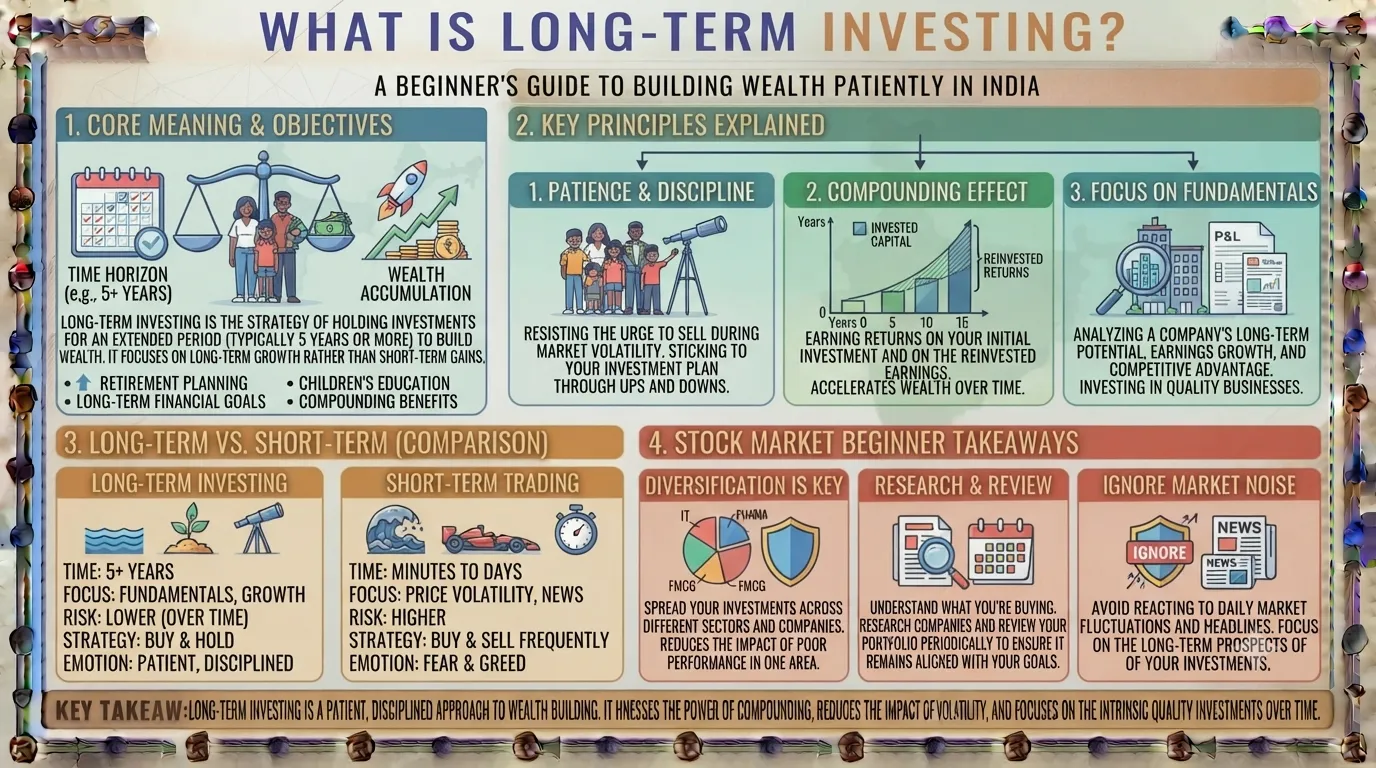
What Is Long-Term Investing? Meaning, Benefits, Strategies and Risks
Many people enter the stock market hoping to make quick profits. Long-term investing follows a different approach: instead of trying to predict every short-term price movement, investors buy assets with a clear financial purpose and hold them over an extended period. They focus on the underlying value of their investments, their financial goals and the ability to stay disciplined through market fluctuations.
In India, long-term investing can involve direct shares, diversified equity mutual funds, index funds, exchange-traded funds (ETFs), bonds and other financial assets. The appropriate mix depends on the investor's goals, time horizon, risk capacity and need for liquidity.
But holding an investment for years does not automatically make it a good investment. A weak business can continue deteriorating, an overpriced stock can deliver disappointing returns, and a portfolio that does not match an investor's financial needs can create problems even over a long period.
What Is Long-Term Investing?
Long-term investing is an approach in which an individual invests money in financial assets with the intention of holding them for an extended period, generally several years, to work towards long-term financial goals. The investor focuses on the quality and potential of the underlying investment rather than reacting to every daily market movement.
There is no single universal holding period that defines every long-term investment. The appropriate horizon depends on the asset, the investment strategy and the financial goal. For example, an investor building a retirement portfolio may have a horizon of several decades, while someone saving for a goal five years away has a much shorter period in which to manage market risk.
In stock market investing, the approach commonly involves:
- Investing based on a clearly defined financial goal.
- Understanding the company, fund or security before investing.
- Holding investments through normal market fluctuations when the original investment rationale remains valid.
- Reinvesting eligible income or distributions where appropriate.
- Reviewing the portfolio periodically rather than reacting to every price change.
- Adjusting the portfolio when financial goals, risk capacity or investment fundamentals change.
Long-term investing is therefore not simply buying a share and forgetting about it. It is a disciplined process of investing, monitoring and making decisions based on evidence.
How Does Long-Term Investing Work?
Long-term investing aims to benefit from the growth or income potential of financial assets over time. In equity investing, an investor owns shares in a business. If the business expands its operations, improves profitability and generates stronger cash flows, its long-term value may increase. The market price of its shares may reflect some of that progress, although prices can also be affected by valuation, interest rates, economic conditions and investor sentiment.
For funds and other assets, the return mechanism can be different. A mutual fund's value depends on its underlying portfolio, a bond may pay interest under its terms, and an ETF's market price reflects trading in its units and the value of its underlying assets.
1. Investing with a long-term goal
The process begins with a goal, such as retirement, children's higher education or another major future expense. The goal helps determine how much money may be required, when it will be needed and how much investment risk may be appropriate.
2. Selecting suitable investments
Investors choose assets based on their time horizon, risk capacity, liquidity needs and knowledge. Some may use diversified mutual funds or index funds, while others may select individual shares after studying the businesses. A portfolio can also include debt investments to balance risk, depending on the investor's circumstances.
3. Investing regularly or as a lump sum
An investor may invest a lump sum or contribute periodically. A Systematic Investment Plan (SIP) is a method of investing a fixed amount into a mutual fund scheme at regular intervals. A SIP helps establish a routine, but it does not guarantee profits or protect the investor from market declines.
4. Staying invested while reviewing the investment
Long-term investors generally avoid making decisions based only on daily price movements. However, they still need to review their holdings, check whether the original investment reasons remain valid and rebalance the portfolio when necessary.
Why Does Time Matter in Long-Term Investing?
Time can help an investment plan in several ways. It gives businesses an opportunity to develop, allows reinvested earnings to generate further returns and provides investors with more flexibility to manage short-term market fluctuations. However, time does not remove investment risk or guarantee that an asset will recover from a permanent decline.
The power of compounding
Compounding occurs when investment earnings are reinvested and begin generating additional earnings. Over time, growth can build on both the original investment and the accumulated returns.
For a lump-sum investment with a constant annual compound rate, the future value can be illustrated using:
Future Value = Principal × (1 + r)n
- Principal: Initial amount invested.
- r: Assumed annual rate of return expressed as a decimal.
- n: Number of years invested.
Hypothetical example: Suppose an investor invests ₹1,00,000 at an assumed annual compound return of 10% for 20 years, with all earnings retained in the investment.
Future Value = ₹1,00,000 × (1.10)20
The illustrative future value is approximately ₹6,72,750. The investment would have grown by approximately ₹5,72,750 before taxes, costs and inflation.
This is a mathematical illustration, not a forecast. Real market returns are uneven, can be negative and may not compound at a fixed rate. An equity investment can also lose value, including over extended periods.
Why starting earlier can make a difference
Starting earlier can provide more time for contributions and reinvested earnings to accumulate. Consider two hypothetical investors who each invest ₹5,000 at the end of every month and assume a constant 10% annual nominal return compounded monthly.
| Illustrative period | Total contributions | Estimated future value |
|---|---|---|
| 20 years | ₹12,00,000 | Approximately ₹37.97 lakh |
| 10 years | ₹6,00,000 | Approximately ₹10.24 lakh |
The calculation assumes a fixed monthly contribution, a constant monthly rate of 10% divided by 12 and no taxes or costs. Actual investment returns do not follow a smooth monthly path. The comparison demonstrates the mathematical effect of time and regular contributions under the stated assumption; it does not show what an actual mutual fund SIP will earn.
What Are the Main Long-Term Investing Strategies?
1. Buy-and-hold investing
Buy-and-hold investing means purchasing an asset after research and holding it for an extended period. In direct equity investing, the investor focuses on the company's business model, financial performance, competitive position, management and valuation.
Holding a stock for a long time is not a reason to ignore deteriorating fundamentals. If the business thesis is no longer valid, governance concerns emerge or the investment no longer fits the portfolio, the investor may need to reassess the position.
2. Systematic Investment Plan (SIP)
A SIP allows an investor to contribute a predetermined amount to a mutual fund scheme at regular intervals. It can make investing more consistent and reduce the pressure to decide when to invest the entire amount.
When the NAV is lower, a fixed contribution buys more units; when the NAV is higher, it buys fewer units. This is commonly called rupee-cost averaging. It does not prevent losses, guarantee a lower average purchase cost in every situation or ensure a positive return.
3. Index investing
Index investing aims to track a market index rather than select securities through active stock picking. An index mutual fund or ETF may provide exposure to a group of companies represented by an index such as the Nifty 50 or Sensex.
Investors should examine the fund's tracking difference, expense ratio, tracking error, portfolio construction and liquidity where relevant. An index fund still carries the risks of the market it tracks. A concentrated sector index, for example, is not equivalent to a broad-market index.
4. Fundamental investing
Fundamental investing involves analysing the business behind a share. Investors examine financial statements, revenue growth, profitability, debt, operating cash flow, management quality, competitive advantages and valuation.
A company can be financially strong and still be a poor investment if its share price already reflects unrealistic expectations. Business quality and purchase valuation should therefore be considered together.
5. Diversified portfolio investing
Instead of depending on one company or sector, investors can spread their money across different securities and asset classes. Diversification may reduce the impact of poor performance in a single holding, although it cannot eliminate market-wide risk or guarantee that the portfolio will avoid losses.
Asset allocation is the process of deciding how much of a portfolio to hold in different asset classes, such as equity, debt and other permitted investments. It should reflect the investor's financial goals, time horizon, risk tolerance and capacity to absorb losses.
Which Investments Can Be Used for Long-Term Goals?
Long-term investing is an approach, not a specific financial product. Different investment instruments can be used depending on the objective and risk profile.
| Investment | How it may contribute | Important considerations |
|---|---|---|
| Direct equity shares | Exposure to the growth and performance of individual businesses | Company-specific risk, valuation, governance and volatility |
| Equity mutual funds | Exposure to a portfolio of equity securities managed under a scheme objective | Market risk, fund costs, portfolio strategy and performance consistency |
| Index mutual funds | Exposure to securities represented in a selected market index | Index concentration, tracking difference, expense ratio and market risk |
| ETFs | Exchange-traded exposure to an underlying portfolio or index | Trading liquidity, bid-ask spread, tracking and market price |
| Bonds and debt funds | Interest income or exposure to fixed-income securities | Credit risk, interest-rate risk, maturity and liquidity |
| Hybrid funds | Exposure to a combination of asset classes | Actual allocation, rebalancing method, scheme risk and costs |
No single product is automatically suitable for every long-term investor. For example, an investor with a goal only a few years away may not be able to tolerate the same equity exposure as someone saving for retirement several decades away.
Long-Term Investing vs Short-Term Trading
Long-term investing and short-term trading differ in their objectives, holding periods and decision-making processes. Investors generally focus on an asset's long-term potential and financial goals, while traders seek to benefit from shorter-term price movements.
| Factor | Long-term investing | Short-term trading |
|---|---|---|
| Primary objective | Work towards long-term financial goals | Seek to benefit from short-term price movements |
| Holding period | Generally several years or longer | May range from minutes to weeks or months |
| Research focus | Business fundamentals, valuation and portfolio suitability | Price action, market conditions and trading setups |
| Activity | Generally fewer transactions | Usually more frequent transactions |
| Time commitment | Periodic research and review | Often requires closer and more frequent monitoring |
| Costs | Lower turnover may reduce transaction costs | Frequent activity can increase transaction costs |
| Main risks | Business deterioration, valuation, market and inflation risks | Market volatility, execution, leverage and behavioural risks |
Long-term investing is not risk-free, and trading is not automatically unsuccessful. The two approaches require different skills and processes. The important point is to choose an approach that matches the investor's objectives and capabilities rather than changing strategy whenever market conditions become uncomfortable.
For a more detailed comparison, read Investing vs Trading: Key Differences Every Indian Beginner Must Know.
What Are the Benefits of Long-Term Investing?
1. More time for compounding
Reinvested earnings can contribute to further growth over time. The effect depends on the returns actually achieved and whether earnings remain invested.
2. Less dependence on short-term market timing
A long-term approach can reduce the pressure to identify the perfect day to buy or sell. It does not remove the need to assess valuations or manage risk.
3. Potentially lower transaction frequency
Investors who make fewer transactions may incur fewer trading-related charges than those who frequently buy and sell. The actual costs depend on the instruments, platform and transaction terms.
4. Alignment with long-term financial goals
Long-term investing can be structured around goals such as retirement or future education expenses. Goal-based planning helps investors assess how much to invest and when the money will be needed.
5. Less need for daily market monitoring
Investors following a well-defined long-term process may not need to react to every daily price change. However, they should still review important company announcements, portfolio allocation and changes in their own financial situation.
What Are the Risks and Limitations of Long-Term Investing?
- Market risk: Equity and other market-linked investments can fall sharply, including during broad market downturns.
- Business risk: A company can lose customers, face competition, accumulate debt or suffer governance failures.
- Valuation risk: Even a good company can deliver poor investment returns if purchased at an excessive valuation.
- Inflation risk: The purchasing power of future investment proceeds may decline as prices rise.
- Concentration risk: Holding too much in one company, sector or asset class can expose the portfolio to a large loss.
- Liquidity risk: Some investments may be difficult to sell quickly at a reasonable price.
- Behavioural risk: Panic selling during a decline or buying because of market excitement can undermine a long-term plan.
- Opportunity cost: Holding an underperforming investment without reviewing its fundamentals can tie up capital that may be needed elsewhere.
- Goal mismatch: A long-term asset may be unsuitable for money needed in the near future.
Longer holding periods can help investors manage some short-term uncertainty, but they do not guarantee recovery from every decline. Diversification, asset allocation and periodic review remain important.
How to Start Long-Term Investing in India
Step 1: Set a specific financial goal
Define what the money is for and when you expect to need it. A retirement goal, for example, may require a different time horizon and portfolio from a planned expense in three years.
Step 2: Build financial stability first
Before committing money to volatile investments, consider whether you have sufficient emergency savings, manageable debt and appropriate insurance protection. Money needed for essential expenses should not be exposed to avoidable market risk.
Step 3: Understand your risk capacity
Risk tolerance is how comfortable you feel with fluctuations. Risk capacity is how much financial loss you can actually withstand without affecting essential goals. Both matter when choosing investments.
Step 4: Choose an appropriate investment approach
Decide whether you understand and have the time to research individual companies or whether diversified funds are more appropriate for your situation. Read the scheme documents and understand the investment objective, costs and risks before investing.
Step 5: Open the required investment account
For listed shares and ETFs, investors generally need a trading account with a registered stockbroker and a Demat account to hold securities electronically. Mutual fund investment routes and holding arrangements can differ. Check the charges, account terms and intermediary registration details before proceeding.
TradeSensi's guide explains how to open a Demat and trading account in India.
Step 6: Start with an amount that fits your plan
Choose an investment amount that does not interfere with regular expenses, emergency savings or debt obligations. If investing periodically, select a contribution that you can realistically maintain rather than an amount based on an optimistic return assumption.
Step 7: Review and rebalance periodically
Review whether the portfolio still matches your goals, risk profile and time horizon. For direct shares, examine business performance, financial statements, valuation and governance. For funds, examine the scheme objective, costs, portfolio and whether it continues to serve its intended role.
When the portfolio moves away from its planned asset allocation, rebalancing may bring it back in line. Rebalancing should follow a considered process and account for costs and taxes, rather than being driven by short-term market predictions.
How Often Should Long-Term Investors Review Their Portfolio?
Long-term investing does not require checking prices every hour, but it does require meaningful review. The appropriate frequency depends on the investments held and the investor's circumstances.
A practical review can include:
- Portfolio allocation: Has the mix of equity, debt and other assets moved away from the intended allocation?
- Investment thesis: Does the original reason for owning each direct stock or fund still hold?
- Financial performance: Are revenue, profits, cash flows or other relevant measures developing as expected?
- Risk and concentration: Has one holding or sector become too large a part of the portfolio?
- Costs and taxes: Are fees, transaction costs or tax implications changing the investment outcome?
- Personal goals: Has the target date, required amount, income or ability to take risk changed?
Major events such as a change in financial goals, job situation, family responsibilities or a company's governance can justify an earlier review. A falling share price alone does not prove that an investment thesis is broken, just as a rising share price does not prove that a business is improving.
Common Long-Term Investing Mistakes to Avoid
- Confusing long-term holding with blind holding: Investors should reassess an asset when its fundamentals or original investment rationale change.
- Buying only because a stock has fallen: A lower price does not automatically mean a stock is undervalued. The business may be deteriorating.
- Ignoring valuation: A strong company can still be an expensive investment.
- Following social media tips: Investment decisions should be based on independent research and reliable information, not unverified claims or guaranteed-return promises.
- Investing without an emergency fund: An unexpected cash requirement can force the sale of investments during an unfavourable market.
- Overconcentrating in one sector: A portfolio dependent on one industry can suffer when that industry faces a downturn.
- Assuming SIPs guarantee returns: A SIP is an investment method, not a capital guarantee or protection against losses.
- Ignoring inflation and costs: The nominal value of a portfolio does not show its real purchasing power after inflation, fees and taxes.
- Changing strategy after every correction: Frequent strategy changes can create unnecessary costs and undermine a carefully planned investment process.
Frequently Asked Questions About Long-Term Investing
1. What is considered long-term investing?
Long-term investing generally means holding financial assets for several years or longer to work towards a future financial goal. There is no single holding period that applies to every investment. The appropriate duration depends on the asset, strategy and goal.
2. How many years should I invest for the long term?
The required period depends on when you need the money and how much risk you can accept. Equity investments are generally more suitable for goals with longer horizons because they can experience substantial short-term declines. A long horizon does not guarantee positive returns, so the asset allocation must still fit the goal.
3. Is long-term investing better than trading?
Neither approach is universally better for everyone. Long-term investing focuses on business or asset value over an extended period, while trading seeks to benefit from shorter-term price movements. The appropriate approach depends on financial objectives, knowledge, time availability and risk management ability.
4. Can beginners start long-term investing with a small amount?
Some mutual fund schemes and investment platforms allow relatively small contributions, subject to their minimum investment requirements. The important point is to understand the product, its costs and risks and invest an amount that fits your financial situation.
5. Does long-term investing guarantee profits?
No. Market-linked investments can lose value, and even a long holding period does not guarantee recovery or profit. Business performance, valuation, economic conditions, interest rates and other factors can affect returns.
6. What is the difference between SIP and lump-sum investing?
A SIP invests a fixed amount at regular intervals, while lump-sum investing deploys a larger amount at one time. SIPs can support disciplined contributions and spread purchases across different market levels. Neither method guarantees better returns in every market condition.
7. Should long-term investors sell during a market crash?
A market decline alone is not enough to determine whether an investment should be sold. Investors should assess whether the underlying business or fund has deteriorated, whether their asset allocation remains appropriate and whether their financial goals or liquidity needs have changed. Decisions should be based on the investment plan and evidence rather than panic.
8. Is long-term investing possible through mutual funds?
Yes. Equity mutual funds, index funds and other schemes may be used for long-term goals, depending on their objectives and risk levels. Investors should examine the scheme's portfolio, costs, benchmark, investment strategy and risk disclosures before investing.
Conclusion: Long-Term Investing Requires Patience and a Clear Process
Long-term investing is a disciplined way to work towards financial goals by investing in suitable assets and allowing time to play a role in their growth or income potential. Compounding, regular contributions, diversification and fewer impulsive decisions can support the process, but none of them removes market risk.
The most important steps are to define the goal, understand the investment, choose an appropriate asset allocation, keep costs in view and review the portfolio when circumstances or fundamentals change. Long-term investing is not about holding every asset forever. It is about following a reasoned process for as long as the investment continues to serve its purpose.
Educational Disclaimer: This article is for educational and informational purposes only. It does not constitute investment advice or a recommendation to buy or sell any security or financial product. Investments in securities markets are subject to market risks, including possible loss of principal. Hypothetical calculations are illustrative and do not represent actual or expected returns. Review official product documents and consider consulting a SEBI-registered investment adviser before making investment decisions.