How to Open a Demat and Trading Account in India: Step-by-Step Guide
Learn how to open a Demat and trading account in India, which documents you need, how online KYC works, what charges to check and how to avoid common account-opening mistakes.
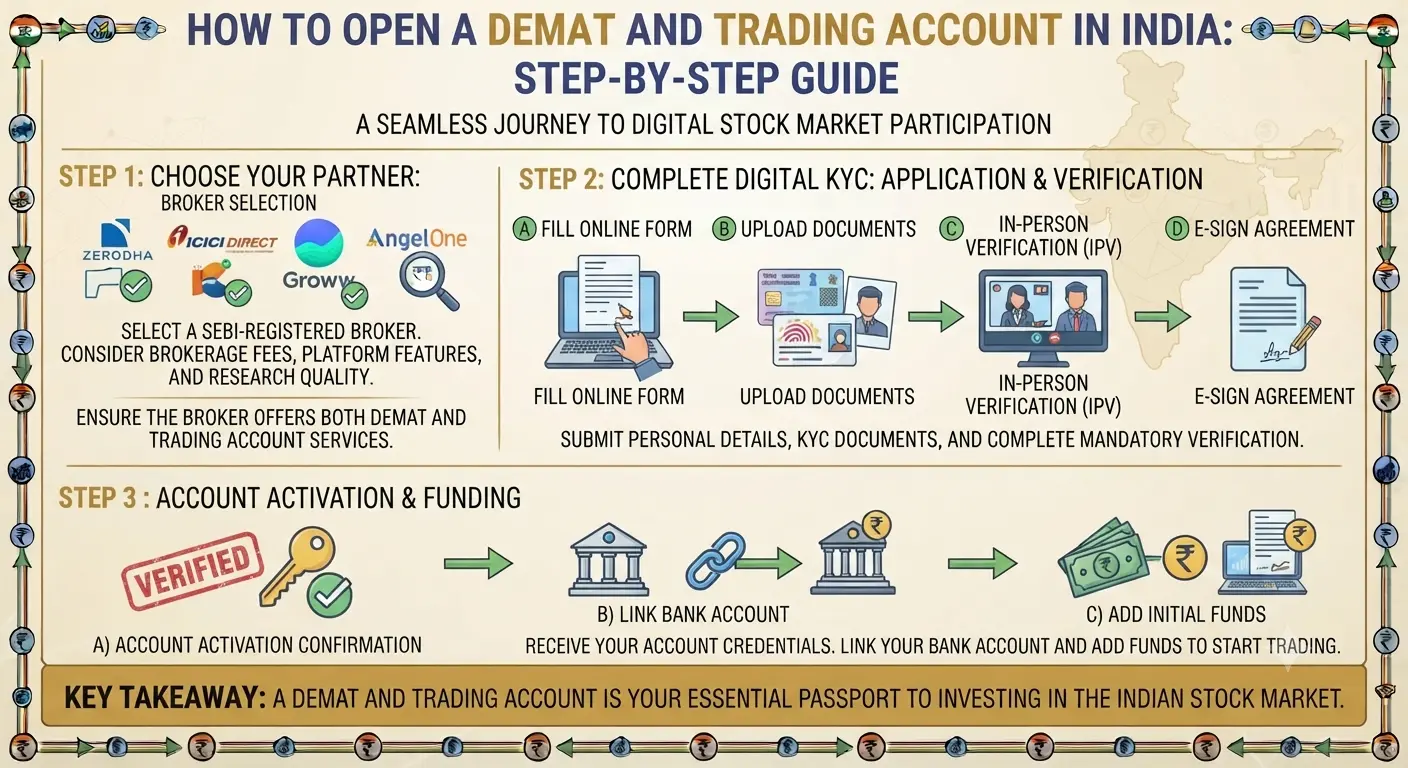
How to Open a Demat and Trading Account in India: Step-by-Step Guide
Have you ever opened a stock market app, searched for a company such as Reliance Industries or Tata Motors, and wondered how people actually buy its shares? You may have money in your savings account, but that alone does not allow you to purchase listed shares directly from the stock exchange.
Before you can start investing in shares, you generally need two important accounts: a Demat account and a trading account. The first holds your securities electronically, while the second allows you to place buy and sell orders through a stockbroker.
The good news is that opening these accounts in India has become much more convenient. Many brokers and Depository Participants offer digital onboarding, allowing eligible applicants to complete much of the process online. However, choosing the right provider and understanding the documents, charges and permissions matter just as much as completing the application.
In this guide, we will walk through the complete process of opening a Demat and trading account in India, explain the difference between them, discuss the documents you may need, and highlight the mistakes beginners should avoid before making their first investment.
What Are Demat and Trading Accounts?
Before opening either account, understand what each one actually does. They work together, but they are not the same.
What is a Demat account?
A Demat account, short for dematerialised account, is used to hold financial securities in electronic form. It works somewhat like a digital locker for eligible investments such as shares, exchange-traded funds (ETFs) and other securities supported by the depository system.
For example, imagine that you purchase 5 shares of a listed company. After the applicable settlement process is completed, those shares are credited to your Demat account. You can view your holdings through the facilities provided by your Depository Participant.
In India, the two main depositories are:
- NSDL: National Securities Depository Limited.
- CDSL: Central Depository Services (India) Limited.
You do not normally open a Demat account directly with NSDL or CDSL. Instead, you open it through a registered Depository Participant, commonly a bank, stockbroker or financial institution. The DP provides account-related services and connects your account to the relevant depository.
What is a trading account?
A trading account is opened with a stockbroker registered with SEBI and a recognised stock exchange. It allows you to place buy and sell orders in supported market segments.
For example, when you open your broker's app, search for a stock, enter a quantity and press the buy button, you are using the trading facility linked to your trading account. The broker routes your order to the relevant exchange, where it may be matched with an opposite order.
Your trading account also helps you view order status, executed transactions, available funds and related trading information.
Demat Account vs Trading Account: What Is the Difference?
Many beginners assume that a Demat account and a trading account are the same because brokers often open both together. Their functions, however, are different.
| Feature | Demat Account | Trading Account |
|---|---|---|
| Main purpose | Holds securities electronically | Places buy and sell orders |
| Opened through | Registered Depository Participant | Registered stockbroker |
| Connected institution | NSDL or CDSL | Recognised stock exchange through broker |
| Common use | Holding delivered shares | Buying and selling securities |
| Account information | Holdings and securities transactions | Orders, executed trades and funds-related records |
There is also a third account involved: your bank account. It is used to make or receive payments related to market transactions through permitted channels.
Think of the process this way:
- Bank account: Where your money is maintained.
- Trading account: Where you place your market orders.
- Demat account: Where securities purchased for delivery are held electronically.
Who Can Open a Demat and Trading Account in India?
Individuals who meet the applicable KYC and account-opening requirements can generally apply for Demat and trading accounts in India. The exact process depends on the account type, investor category and services being requested.
For an ordinary individual applicant, the broker or DP will generally ask for identity, address, PAN, bank and contact information. Additional checks or documents may apply depending on the circumstances.
Here are some common applicant situations:
- First-time investor: Can apply after completing the required KYC and onboarding process.
- College student or young adult: May apply if they meet the applicable age and legal requirements. A minor's account follows a separate process involving a guardian.
- Salaried employee: Can generally open an account using the required personal and bank details.
- Self-employed individual: Can apply with the required KYC information and any additional documents requested for the selected services.
- Existing investor: May open another account with another eligible DP or broker, subject to the relevant onboarding requirements.
Do not assume that every applicant has identical requirements. Confirm the current eligibility and document checklist with the selected provider before starting.
Documents Required to Open a Demat and Trading Account
Preparing your documents before starting the application can make the process smoother. Many digital onboarding journeys ask you to upload photographs or scanned copies, complete verification and electronically sign the forms.
The commonly requested documents and details include:
1. PAN card
PAN is an important part of securities-market KYC. Keep your PAN details ready and make sure the information you enter matches your official records.
2. Aadhaar or other accepted identity and address proof
Aadhaar-based verification is commonly used in digital onboarding. Depending on the permitted KYC route, other officially valid documents may be accepted for identity and address verification.
3. Bank account details
You will generally need to provide bank account information so the broker or DP can verify your account and connect the permitted payment and settlement process. Some providers may request a cancelled cheque, bank statement or another accepted proof.
4. Mobile number and email address
Your registered mobile number and email address are used for OTP verification, account communication, transaction alerts and important updates. Use contact details that you can access regularly.
5. Photograph and signature
Some providers ask for a live photograph, an image of your signature or both. Follow the image format and quality instructions shown during the application.
6. Income proof or additional documents, where applicable
If you request access to particular market segments or services, the broker may ask for additional information or supporting documents. Income-related proof may be required in certain cases.
Practical tip: Keep clear digital copies of your PAN, accepted identity/address proof, bank proof, photograph and signature ready. Do not upload documents through unofficial links or share them with unknown agents.
How to Open a Demat and Trading Account Online in India
Many providers allow eligible individuals to complete account opening digitally. The exact screens and sequence differ between providers, but the general process follows the steps below.
Step 1: Choose a SEBI-registered stockbroker and DP
Your first decision is choosing the provider. Several brokers offer both trading and Demat account services, which can make the onboarding journey more convenient.
However, do not select a provider only because an advertisement promises zero brokerage or a free account. First check whether the broker is registered with SEBI and is a member of the relevant recognised exchange. Also confirm the DP details for the Demat service.
Compare the following points:
- SEBI registration and exchange membership.
- Brokerage and other transaction charges.
- Demat account maintenance and service charges.
- Quality and reliability of the trading platform.
- Customer support and complaint-handling process.
- Availability of statements, contract notes and reports.
- Security features and transaction alerts.
A provider should be selected based on its overall service, transparency and suitability for your needs—not simply the lowest advertised price.
Step 2: Visit the provider's official website or application
Once you have selected a provider, visit its official website or download its official application from a trusted app store.
Look for an option such as Open Demat Account, Open Trading Account or Start Investing. Enter your mobile number or email address as requested.
You may receive an OTP to verify that you control the registered contact detail. Never share that OTP with a caller or an unknown person claiming to complete your application.
Step 3: Enter your PAN and personal details
The application will generally ask for your PAN and other personal information. Depending on the provider, some details may be retrieved or checked electronically.
Enter your name, date of birth and other details carefully. Even small differences between your application and official records can lead to verification problems or delays.
Step 4: Complete KYC verification
KYC stands for Know Your Customer. It is the process through which financial intermediaries verify the identity and other required details of their clients.
Depending on the onboarding route, you may be asked to complete Aadhaar-based e-KYC, upload accepted documents or use another permitted verification method.
Some applications also include video-based In-Person Verification (IPV). During this process, you may be asked to use your camera and follow the instructions to confirm your identity.
Make sure that you are using the provider's official website or application before submitting personal information.
Step 5: Verify your bank account
Enter the bank account details requested by the provider. The broker or DP may verify them using an electronic bank verification process, a penny-drop mechanism or supporting documents, depending on its process.
Check the account number, IFSC and account-holder details carefully. Incorrect bank information can create problems when transferring funds or receiving eligible payments.
Step 6: Provide the remaining details
The application may ask for your address, occupation, income range, nominee details and other information required for the account.
Read each question carefully and provide accurate information. If you are asked to choose whether to appoint a nominee or opt out, understand the choice and complete the required declaration. Do not select options randomly just to move to the next screen.
Step 7: Upload your photograph and signature
Some providers request a live photograph and a signature image. Make sure the photograph is clear and the signature is readable.
If the provider gives specific instructions about image size, format or background, follow them. An unclear or incomplete upload may require you to repeat the step.
Step 8: Review the agreements and electronically sign
Before submitting the application, review the account-opening documents, tariff sheet, rights and obligations, risk disclosures and any authorisations being requested.
Pay particular attention to:
- Brokerage and other applicable charges.
- Account maintenance and service fees.
- Terms for funds transfers and withdrawals.
- Demat debit authorisations and electronic delivery instructions.
- Power of Attorney or other optional authorisations, if presented.
- Risk disclosures and terms for the market segments you request.
Complete the electronic or Aadhaar-based eSign process where offered and permitted. Never sign blank forms or accept an authorisation you do not understand.
Step 9: Wait for verification and account activation
After submission, the provider checks the application and supporting information. If everything is in order, the account is activated and the provider sends confirmation through its registered communication channels.
You may receive a trading client code and Demat account details. Keep these details safely and check that the name and other information are correct.
If the application is pending, check whether the provider has requested a missing document, an additional verification step or a correction. Do not submit multiple applications unnecessarily before checking the status of the first one.
Can You Open Both Accounts Together?
Yes. Many stockbrokers offer a combined onboarding journey in which you apply for a trading account and a Demat account together. This can reduce the number of separate application steps for a beginner.
However, remember that the two accounts remain distinct. The trading account is maintained with the stockbroker, while the Demat account is serviced through a registered DP connected to NSDL or CDSL.
Before completing a combined application, check which entity is providing each service, what charges apply to each account and where you can access your account statements and service requests.
How Much Does It Cost to Open a Demat and Trading Account?
The cost depends on the provider and the services you choose. Some providers advertise zero account-opening fees, but that does not mean every service or transaction will be free.
It is useful to separate account-opening costs from the charges that may arise when you actually use the accounts.
Demat account charges
- Account-opening charges: Check the provider's terms and applicable rules. Depository investor charters state that investors should not be charged for opening a Demat account.
- Annual Maintenance Charges (AMC): A DP may have recurring maintenance charges depending on the account category and applicable rules.
- Demat debit charges: Charges may apply when securities are debited from your Demat account, according to the DP's disclosed tariff.
- Other service charges: Certain requests or services may carry separate fees.
Trading account and transaction charges
- Brokerage: The broker's charge for executed transactions under its tariff.
- Exchange transaction charges: Charges associated with transactions on the relevant exchange.
- STT: Securities Transaction Tax applicable to specified transactions.
- GST: Applicable tax on eligible services and charges.
- Stamp duty: Applicable duty on specified transactions.
- SEBI charges: Regulatory charges where applicable.
For example, suppose a broker advertises zero brokerage for a particular type of equity delivery trade. That does not automatically mean the transaction has no cost. Applicable statutory, exchange and other charges may still apply.
Before opening an account, download or save the provider's latest tariff sheet. Compare the total likely cost for the type of investing or trading you plan to do, rather than comparing only the brokerage headline.
How to Choose the Right Demat and Trading Account Provider
Choosing a provider is an important decision because you may use the platform for years. A low-cost account is useful, but poor service, unclear charges or unreliable order execution can create avoidable problems.
Use this checklist before making your decision:
- Check registration: Verify the stockbroker's SEBI registration and recognised exchange membership. Check the DP's registration and depository association as well.
- Understand the complete charges: Review brokerage, AMC, debit charges, taxes and other service fees.
- Test the platform experience: Look at the quality of the website or application, order information, statements and account reports.
- Review customer support: Check how the provider handles failed transactions, account-access problems and complaints.
- Check security: Look for strong authentication, transaction alerts and secure account-management facilities.
- Read the agreements: Understand the rights and obligations before signing or authorising anything.
- Keep records: Make sure you can access account-opening documents, contract notes and statements when needed.
There is no single provider that is automatically best for every investor. Someone who only wants to buy and hold shares may have different requirements from an active intraday trader.
What Should You Do After Your Account Is Opened?
Account activation is not the end of the process. Before placing your first order, take a few minutes to verify that everything is working correctly.
- Check your profile: Confirm your name, PAN, registered mobile number, email and bank details.
- Save your account information: Keep your trading client code and Demat account details in a secure place.
- Review your charges: Save the tariff sheet and understand what you may pay for transactions and services.
- Enable account security: Use a strong password and all available security features.
- Check statements and alerts: Confirm that you can access transaction notifications and account statements.
- Understand order types: Learn the difference between market orders, limit orders and other order options offered by your broker.
- Start with a plan: Understand the company, the risks and the amount you can afford to invest before placing an order.
Example: What Happens After You Open Both Accounts?
Consider a hypothetical first-time investor, Rahul. He has ₹10,000 in his savings account and wants to purchase shares worth ₹3,000 in a listed Indian company.
First, Rahul completes KYC and opens a trading account with a registered broker. He also opens a Demat account through the broker's DP service. Once the accounts are activated, he checks his profile, bank details and charges.
He then adds the required funds through the permitted payment method and places a buy order for the quantity he wants. Suppose the order is executed successfully for a total share value of ₹3,000, before applicable charges.
The trade goes through the exchange and clearing process. After the applicable settlement, the purchased shares are credited to Rahul's Demat account.
What happened here?
- His bank account was used for the money movement.
- His trading account was used to place and record the order.
- His Demat account received the shares purchased for delivery.
This is the basic relationship between the three accounts. The example is hypothetical and does not represent a recommendation to buy any particular security.
Common Mistakes to Avoid When Opening an Account
1. Choosing a broker only because of zero brokerage
Zero brokerage does not necessarily mean zero cost. Other charges may apply, and the provider's platform and support also matter. Review the complete tariff sheet before choosing.
2. Ignoring the provider's registration details
Do not open an account through an unknown person, social-media advertisement or unofficial website without checking the provider. Verify the broker and DP using official regulatory or exchange resources.
3. Entering incorrect personal information
Incorrect PAN, bank details, address or contact information can delay verification and create future account-management problems. Review your entries before submitting the application.
4. Signing documents without reading them
Account-opening forms may include important terms, fee schedules, risk disclosures and authorisations. Read them carefully. Never sign blank forms or accept optional permissions simply because the application recommends them.
5. Sharing OTPs and passwords
Never share your OTP, trading password or other authentication details with anyone. A genuine service representative should not need you to disclose your password to complete routine support.
6. Assuming account activation means you should start trading immediately
Opening an account gives you access to the market; it does not mean you are ready to trade. Learn how orders work, understand charges and research the investment before committing money.
7. Forgetting to check statements
Regularly review your trading records and Demat holdings. If you notice an unfamiliar transaction or incorrect entry, contact the provider through its official grievance channel and retain the relevant records.
Can You Open More Than One Demat or Trading Account?
Yes, an individual may open more than one Demat account, including accounts with different Depository Participants, subject to applicable rules and onboarding requirements.
Some investors also maintain trading accounts with more than one broker. This may be useful when comparing platform services or accessing different features. However, multiple accounts can mean additional maintenance costs, more statements to track and greater administrative effort.
If you are a beginner, first understand how one account works. Open additional accounts only when there is a practical reason to do so.
Frequently Asked Questions
1. Can I open a Demat and trading account online?
Yes. Many registered brokers and Depository Participants offer digital account opening for eligible applicants. The process may include online forms, document uploads, KYC verification, video IPV where required and electronic signing.
2. Is a Demat account mandatory to buy shares?
For normal equity delivery investing, a Demat account is generally required to hold the shares electronically. Some other market activities, such as eligible intraday or derivatives transactions, may not involve delivery of shares into a Demat account, but they have separate requirements.
3. Is PAN mandatory for opening a Demat and trading account?
PAN details form an important part of securities-market KYC and are generally required for these accounts, subject to applicable regulatory provisions and any permitted exceptions. Follow the current document checklist from the registered provider.
4. Can I open a Demat account without a bank account?
You generally need to provide bank account details for the required verification and permitted funds-related transactions when opening a trading and Demat setup. Check the selected provider's current requirements.
5. Is there any minimum balance required in a Demat account?
A Demat account does not generally require you to maintain a minimum number or value of shares. However, account maintenance or other service charges may apply under the provider's tariff and applicable rules.
6. How long does it take to open a Demat and trading account?
The time varies by provider and verification method. Some digital applications can be processed quickly when all information is correct, while others may take longer if documents or additional checks are required. Wait for official activation confirmation before assuming the account is ready.
7. Can I open a second Demat account?
Yes. Investors can open more than one Demat account, including with different DPs, subject to applicable requirements. Consider the additional maintenance charges and account-management work before doing so.
8. Is it safe to open a Demat and trading account?
Opening accounts through properly registered providers and following security practices helps you use the regulated market infrastructure. However, it does not remove investment risk or guarantee protection against every type of fraud. Verify the provider, protect your credentials and review your transactions regularly.
Conclusion
Opening a Demat and trading account is an important first step for anyone who wants to invest in India's securities markets. The process is often available online, but selecting a trustworthy provider and understanding the terms are essential.
Remember the basic difference: your bank account handles money, your trading account lets you place buy and sell orders, and your Demat account holds securities electronically. Many brokers offer both trading and Demat services together, making the onboarding process easier.
Before applying, prepare your KYC documents, verify the broker and DP, compare the complete charges and read the account agreements. Once your accounts are activated, check your details and learn how transactions work before placing your first order.
A properly opened account gives you access to the market. Making informed investment decisions still requires research, patience and an understanding of risk.
Educational disclaimer: This article is intended for general educational purposes only. It is not investment, trading, tax or legal advice and does not recommend any particular broker, security or investment strategy. Securities-market investments involve risk, including the possible loss of capital. Verify current regulations, eligibility and charges through official sources before taking action.