What Are IPOs and How Do They Work? A Complete Guide for Beginners
Understand what an Initial Public Offering (IPO) is, why companies go public, how IPO applications work in India, and what investors should check before applying.
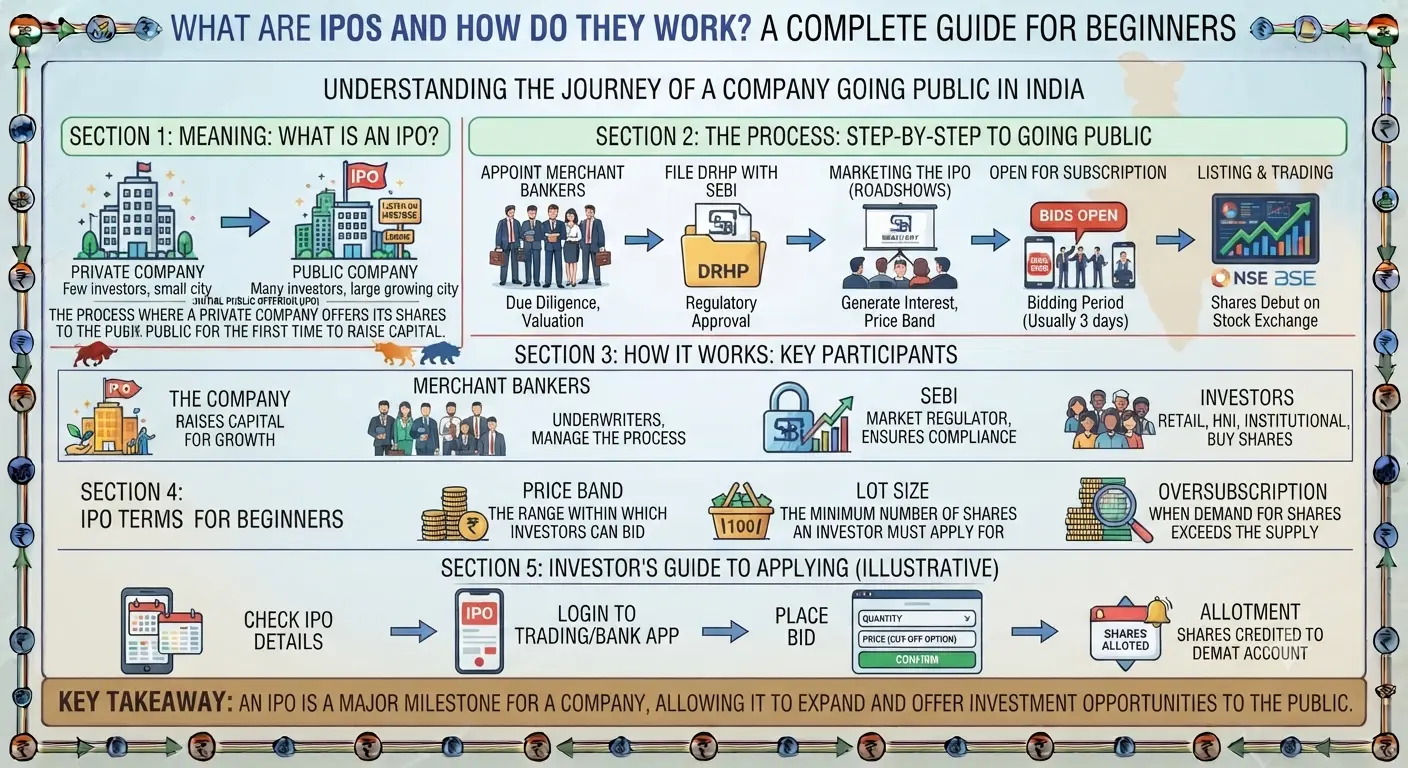
What Are IPOs and How Do They Work? A Complete Guide for Beginners
Imagine a company whose products you use every day. Until now, its shares have been held by its founders, early investors and other private shareholders. One day, the company announces that members of the public can apply to buy its shares. The offer opens for a few days, investors submit applications, and the company prepares to list its shares on the stock exchange.
That process is called an Initial Public Offering, or IPO. It is often the first time ordinary investors get an opportunity to own shares in an unlisted company through a public issue. But applying for an IPO is not the same as buying a guaranteed bargain. The issue price, the company's financial position, the purpose of the fundraise and the price at which the shares eventually trade all matter.
What Is an IPO?
An Initial Public Offering (IPO) is the process through which an unlisted company offers its shares to the public for the first time. The company may issue new shares to raise capital, existing shareholders may sell part of their holdings, or the offer may combine both. After the IPO, the company's shares can be listed and traded on a recognised stock exchange, subject to applicable requirements.
IPO stands for Initial Public Offering. It takes place in the primary market, where securities are offered by an issuer or existing shareholders to investors. Once the shares are listed, investors can generally buy and sell them from one another in the secondary market.
Why Do Companies Launch an IPO?
Going public is a major corporate decision. It can help a company raise money, provide an exit route for some existing shareholders and create a market for its shares. However, an IPO also brings disclosure obligations, regulatory compliance, public scrutiny and the pressure of reporting financial performance as a listed company.
1. To raise money for business expansion
A company may need capital to build factories, open new locations, develop technology, expand distribution or enter new markets. A fresh issue of shares can provide funds for these plans without requiring the company to borrow the entire amount.
2. To repay or reduce debt
Some companies use part of the proceeds from a fresh issue to repay borrowings. Lower debt may reduce interest costs and improve the balance sheet, although investors should examine why the debt accumulated and whether the business can generate sufficient cash in the future.
3. To provide an exit to existing investors
Founders, private equity funds, venture capital investors or other shareholders may want to sell some of their holdings. An IPO that includes an Offer for Sale allows these shareholders to sell shares to public investors.
4. To create a public market for shares
Listing gives eligible shareholders a recognised exchange through which they can trade their shares. It can also make it easier for the company to access public capital markets in the future, subject to applicable rules and market conditions.
What Are the Different Types of IPO Issues?
Two distinctions are particularly useful when reading an IPO announcement: whether the offer is a fresh issue or an Offer for Sale, and whether the shares are offered through a fixed-price issue or book building.
Fresh Issue of Shares
In a fresh issue, the company creates and offers new shares to investors. The money raised from those shares goes to the issuing company, after applicable issue expenses. The company may use the proceeds for the purposes disclosed in its offer document, such as expansion, debt repayment or working capital.
Because new shares are created, the total number of shares increases. Existing shareholders' percentage ownership may therefore be diluted, even if they continue to hold the same number of shares.
Offer for Sale (OFS)
In an Offer for Sale, existing shareholders sell some of the shares they already own. The shares are transferred to public investors, but the company does not receive the sale proceeds from those shares.
This distinction matters. An IPO headline may announce a large issue size, but that does not mean the company itself will receive the entire amount. Investors should check how much of the offer is a fresh issue and how much is an OFS.
| Point | Fresh Issue | Offer for Sale |
|---|---|---|
| Who sells the shares? | The company issues new shares | Existing shareholders sell their shares |
| Who receives the proceeds? | The issuing company | The selling shareholders |
| Number of shares | Increases | No new shares are created by the OFS itself |
| Potential ownership dilution | Can occur | Does not arise from the OFS itself |
Fixed-Price Issue
In a fixed-price issue, the offer price is stated in advance. Investors apply at that specified price. The price is not discovered through bids across a range during the offer period.
Book-Built Issue
In a book-built issue, the company announces a price band rather than one final price. Investors place bids within the stated range, specifying the quantity they want. The demand received during the bidding period helps determine the final issue price.
For example, suppose a hypothetical company announces a price band of ₹90 to ₹100 per share. Investors can bid within that range. A retail investor may also choose the cut-off option, which means agreeing to apply at the final price discovered through the book-building process, subject to the application's other conditions.
Choosing cut-off does not guarantee an allotment. If demand exceeds the shares available in a category, the allotment process still determines who receives shares.
How Does an IPO Work in India?
An IPO involves several stages. The company prepares its disclosures, files offer documents, determines the issue terms, accepts investor applications and completes allotment before the shares begin trading.
Step 1: The company appoints intermediaries
A company planning an IPO appoints market intermediaries, including merchant bankers or book-running lead managers, legal advisers, auditors and a registrar to the issue. These professionals help prepare disclosures, conduct due diligence, coordinate the offer and process applications and allotment.
Step 2: The company prepares and files the DRHP
The Draft Red Herring Prospectus (DRHP) is an important preliminary offer document. It contains information about the company's business, financial statements, promoters, management, risks, legal matters and the proposed use of funds.
The DRHP gives investors an early opportunity to understand the company and the proposed issue. It may not contain all the final issue details, such as the final price. Investors should not treat a draft document as the final basis for applying.
Step 3: Regulatory review and updated offer documents
The offer-document process involves regulatory and stock-exchange scrutiny under the applicable framework. The company and its intermediaries may need to respond to observations or requests for clarification and update disclosures.
The Red Herring Prospectus (RHP) is issued closer to the public offer. It provides updated information and the relevant issue terms, including the price band for a book-built issue. Investors should read the latest available offer document rather than rely only on an older DRHP or a summary published elsewhere.
Step 4: The company announces the price band and issue dates
For a book-built IPO, the price band sets the permitted bidding range. The company also announces the issue opening and closing dates, lot size, investor categories and other application details.
The lot size is the minimum number of shares an investor can apply for in the relevant category. For example, if a hypothetical IPO has a lot size of 20 shares and a price of ₹100 per share, one lot would represent an application amount of ₹2,000, before considering any applicable rules or changes in the final price. Actual lot sizes and amounts vary by issue.
Step 5: Investors submit IPO applications
Investors can apply through supported channels such as a registered stockbroker's platform or a bank's ASBA facility. Retail applications commonly use UPI as the payment mechanism within the applicable limit. The applicant must provide correct personal, Demat and bank or UPI details.
For a UPI-based application, the investor receives a mandate request and must approve it in the UPI app using the correct UPI PIN. Merely submitting the IPO form is not enough: the mandate must be accepted within the specified time.
Step 6: The IPO closes and allotment is finalised
After the bidding period ends, applications are reconciled and the basis of allotment is finalised in accordance with the applicable rules and investor-category allocation. If an issue receives more valid applications than the shares available in a category, some applicants may receive no shares.
Allotment is not decided simply by who applies first. The process follows the prescribed allocation method. The registrar publishes or facilitates access to the allotment status once it is finalised.
Step 7: Shares are credited and funds are debited or unblocked
If shares are allotted, the amount corresponding to the allotted shares is debited from the blocked funds and the shares are credited to the investor's Demat account. If the investor receives no allotment, the blocked amount is released. In a partial allotment, only the amount required for the allotted shares is debited and the remaining blocked amount is released.
Step 8: The shares are listed on the stock exchange
After allotment and completion of the required procedures, the shares are admitted to trading on the exchange. Investors can then buy and sell the listed shares in the secondary market during exchange trading hours.
For public issues covered by the current T+3 framework, listing is scheduled within three working days after the issue closes. The issue's offer documents and exchange notices should be checked for the actual timetable.
How Can Retail Investors Apply for an IPO?
Retail investors in India commonly apply using a broker's IPO facility with UPI or through a bank using ASBA. The exact steps differ by platform, but the underlying process is similar.
- Check the IPO details: Review the issue dates, price band, lot size, investor category and offer documents.
- Keep your details ready: You generally need a valid PAN, a Demat account and a bank account. Follow the platform's instructions for entering the details.
- Select the IPO: Open the IPO section of your broker's app or website and select the issue while applications are open.
- Enter your bid: Choose the number of lots and enter a bid price within the permitted range, or select cut-off where available and eligible.
- Provide your own UPI ID: If applying through UPI, use an eligible UPI ID linked to your own bank account. Third-party payment details can lead to rejection.
- Approve the mandate: Open the relevant UPI app and approve the block request using your UPI PIN before the deadline.
- Check application status: Confirm that the application and mandate have been successfully processed. Later, check allotment through the registrar or exchange's official facility.
Do not share your UPI PIN, OTP or banking password with anyone claiming to help with IPO allotment. A genuine application process does not require you to disclose these credentials to a broker, agent or caller.
What Is ASBA and How Does UPI Work in an IPO?
ASBA stands for Application Supported by Blocked Amount. It is a payment mechanism in which the application money is blocked in the investor's bank account rather than transferred to the company immediately when the application is submitted.
With UPI-based IPO applications, the investor submits the bid and UPI ID through a permitted intermediary. A mandate request is then sent to the UPI app. After the investor authorises the block, the application amount is blocked in the linked bank account.
If shares are allotted, the required amount is debited. If there is no allotment, the blocked funds are released. This is different from sending money to an unknown person or transferring funds directly to a broker.
| Application outcome | What happens to the money? | What happens to the shares? |
|---|---|---|
| Full allotment | Amount for allotted shares is debited | Allotted shares are credited to Demat |
| Partial allotment | Amount for allotted shares is debited; balance is unblocked | Only allotted shares are credited |
| No allotment | Blocked amount is released | No shares are credited |
What Should You Check Before Applying for an IPO?
An IPO can attract attention because of its brand, media coverage, subscription figures or expected listing performance. Those factors do not replace an assessment of the company. The offer document is the starting point for understanding what you are being asked to invest in.
1. Understand the company's business
Find out what the company sells, who its customers are, how it earns revenue and what differentiates it from competitors. Check whether its business depends heavily on one product, one customer, one supplier or a particular regulation.
2. Read the objects of the issue
Check how the company plans to use the money raised through the fresh issue. Expansion, debt repayment, acquisitions and working capital have different implications. Compare the stated purpose with the company's actual business needs and financial position.
3. Examine the fresh issue and OFS split
Identify how much of the offer consists of new shares and how much consists of existing shareholders selling their holdings. An OFS is not automatically negative, but investors should understand who is selling and why.
4. Review revenue, profit and cash flow
Do not judge a company on one profitable year. Look at revenue, operating profit, net profit and operating cash flow over multiple reporting periods. Check whether profits are supported by cash generated from the business.
5. Check borrowings and financial obligations
Review outstanding debt, interest costs, repayment obligations, contingent liabilities and any material guarantees. A company with growing revenue can still face financial pressure if borrowing and cash requirements rise faster than its ability to generate funds.
6. Compare the IPO valuation with listed peers
The issue price should be considered in relation to the company's earnings, assets, growth, risks and comparable listed businesses. Measures such as the price-to-earnings ratio can help, but comparisons are meaningful only when the companies have reasonably similar business models and financial characteristics.
7. Read the risk factors and legal disclosures
Look for pending litigation, regulatory issues, customer concentration, dependence on key personnel, related-party transactions and other risks specific to the company. Do not skip these sections simply because they are lengthy.
What Are the Risks of Investing in an IPO?
Newly listed shares can be volatile. An IPO does not guarantee that the share price will rise after listing, and investors may lose part or all of the amount invested.
- Uncertain listing price: The stock may list below its issue price if market demand is weak or investors reassess the company's valuation.
- High issue valuation: A well-known company can still be an expensive investment if the offer price already reflects ambitious growth expectations.
- Limited public trading history: Before listing, investors do not have the same history of exchange-traded price movements that is available for an established listed company.
- Business and financial risks: The company may face competition, debt pressure, weak cash flow, regulatory changes or execution problems.
- OFS and shareholder exits: Existing investors may sell part of their holdings. This should be understood in the context of the company's ownership and future plans.
- Market conditions: Even a sound company can list or trade poorly during a weak market or a period of reduced investor appetite.
What Happens After an IPO Is Listed?
Once the shares begin trading, the IPO moves from the primary market to the secondary market. Investors can place buy and sell orders through their brokers, and the market price changes according to demand and supply.
The listing price may be higher than, equal to or lower than the IPO issue price. If it opens above the issue price, that is commonly called a listing gain. If it opens below the issue price, an investor who received an allotment may face an immediate notional loss.
Neither outcome determines the company's long-term prospects. After listing, investors should continue monitoring business performance, financial results, disclosures and valuation rather than relying only on the first day's price movement.
Common IPO Mistakes Beginners Should Avoid
- Applying only because an IPO is heavily discussed on social media.
- Assuming high subscription automatically means the shares are fairly valued.
- Confusing the issue size with the amount the company will actually receive.
- Ignoring the difference between a fresh issue and an OFS.
- Skipping the RHP and relying entirely on short summaries.
- Using another person's UPI ID or bank account details.
- Forgetting to approve the UPI mandate before its deadline.
- Assuming allotment guarantees a listing gain.
- Investing money needed for near-term expenses in a volatile equity offer.
A Practical IPO Checklist for Retail Investors
Before submitting an application, take a moment to answer these questions:
- Do I understand the company's business and how it earns money?
- Have I read the latest RHP or offer document?
- Do I know how much of the issue is fresh shares and how much is OFS?
- Are the stated uses of the proceeds clear?
- Have I checked the company's financial performance, debt and cash flow?
- Have I considered the issue valuation against relevant peers?
- Do I understand the important risk factors?
- Can I afford the investment risk without depending on a listing gain?
If several answers are unclear, take time to research the issue. Missing an IPO is not a financial loss; investing without understanding the offer can be.
Conclusion
An IPO is the process through which an unlisted company offers shares to the public for the first time. It can help a company raise capital, allow existing shareholders to sell part of their holdings and create a public market for its shares.
For investors, the process involves more than submitting an application. Understanding the DRHP and RHP, distinguishing a fresh issue from an OFS, checking the company's financial position, understanding ASBA and UPI, and assessing valuation are all part of making an informed decision.
Most importantly, an IPO allotment is not a guaranteed profit. Once the shares list, their market price depends on demand, supply, business expectations and broader market conditions. Treat the offer as an investment in a business—not as a shortcut to a listing-day gain.
Frequently Asked Questions
1. What does IPO stand for?
IPO stands for Initial Public Offering. It is the first public offer of shares by an unlisted company. The offer may include newly issued shares, shares sold by existing shareholders, or both.
2. How does an IPO work in India?
A company prepares and files offer documents, announces issue terms, accepts applications and completes allotment. Successful applicants receive shares in their Demat accounts, while unused blocked funds are released. The shares then list on a recognised stock exchange.
3. What is the difference between a fresh issue and an OFS?
In a fresh issue, the company issues new shares and receives the proceeds. In an Offer for Sale, existing shareholders sell shares they already own and receive the proceeds. An IPO can contain either or both components.
4. What is the minimum amount required to apply for an IPO?
There is no single fixed amount for every IPO. The minimum application amount depends on the issue's price and lot size, along with the investor category and applicable rules. Check the lot size and application details in the offer document before applying.
5. Is IPO money deducted immediately after applying?
With ASBA or UPI-based applications, the application amount is generally blocked in the linked bank account. The amount required for allotted shares is debited after allotment. If no shares are allotted, the blocked funds are released.
6. Can I sell IPO shares on the listing day?
Once the shares are credited to your Demat account and trading begins on the exchange, you can generally place a sell order through your broker. Whether you should sell depends on your investment decision, the company's prospects, valuation and market conditions.
7. Does every IPO applicant receive shares?
No. If an IPO receives more valid applications than the shares available in a particular category, some applicants may receive no allotment. The final allocation follows the prescribed basis of allotment, not simply the order in which people applied.
8. Does SEBI approval mean an IPO is safe?
No. Regulatory review and disclosure requirements do not guarantee that a company is financially strong, fairly valued or likely to deliver positive returns. Investors must examine the offer document and make their own assessment of the risks.
Disclaimer
This article is for educational purposes only and is not investment advice or a recommendation to apply for any IPO or buy or sell any security. IPO investments are subject to market risks, and investors may lose capital. Read the latest offer documents and consider your financial circumstances before making an investment decision.