What Is Bank Nifty and How Does It Work?
Learn what Bank Nifty measures, how its banking stocks are selected and weighted, what moves the index, and how investors and traders use it.
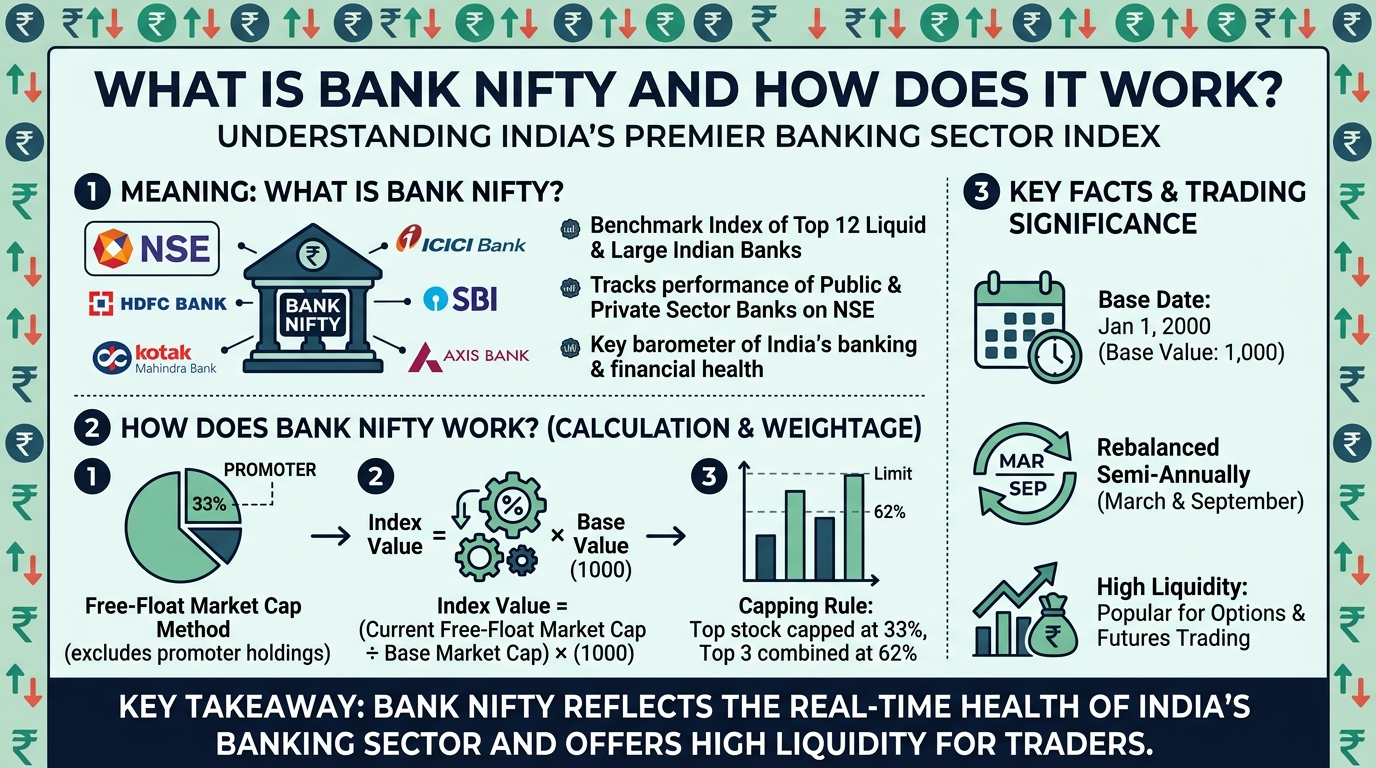
What Is Bank Nifty and How Does It Work?
When banking stocks rise sharply on the National Stock Exchange, you may notice Bank Nifty moving higher as well. On another day, the broader Nifty 50 may remain relatively steady while Bank Nifty falls. This difference often confuses people who are new to the stock market. Both are market indices, so why do they behave differently?
The reason is what each index represents. Bank Nifty focuses on selected banking stocks, while Nifty 50 tracks companies from several sectors. Understanding that distinction makes it easier to interpret banking-sector movements and understand why investors, analysts and derivatives traders follow the index.
What Is Bank Nifty?
Bank Nifty, officially called the Nifty Bank Index, is a sectoral stock market index that tracks the performance of large and liquid banking stocks listed on the National Stock Exchange of India (NSE). It provides a benchmark for understanding how the selected banking companies are performing as a group. It is calculated using a periodically capped free-float market-capitalisation methodology.
In simple terms, Bank Nifty brings the share-price performance of selected banks into one index value. Instead of looking at every banking stock separately, market participants can use the index to get a broad view of the selected banking companies.
It is not a bank, a bank account, a mutual fund or a single company share. It is a calculated market indicator. NSE Indices Limited manages the index, while its constituent shares are traded individually on the exchange.
What Does Bank Nifty Represent?
Bank Nifty represents the performance of a selected group of large and liquid banks. Its purpose is narrower than that of a broad-market index: it focuses on the banking part of the listed equity market rather than attempting to represent the entire stock market.
The index can include private-sector banks, public-sector banks and eligible small finance banks, subject to the index's selection rules. The exact composition is not permanent. Banks may enter or leave when the index is reviewed or when an exceptional change is required under the methodology.
According to the NSE Indices factsheet dated 30 April 2026, Nifty Bank had 14 constituents. The methodology document published in March 2026 also describes a maximum of 14 stocks. Readers should check the latest official constituent list before relying on a particular stock count or company list.
Examples of banks associated with the index
Examples of well-known banking companies that have appeared among Nifty Bank constituents include:
- HDFC Bank
- ICICI Bank
- State Bank of India
- Axis Bank
- Kotak Mahindra Bank
- Federal Bank
- Bank of Baroda
- AU Small Finance Bank
This is an illustrative list, not a guarantee that every name will remain in the index. Membership and weightage can change. Always use the latest NSE Indices constituent file for the current list.
How Does Bank Nifty Work?
Bank Nifty works by combining the market performance of its constituent banking stocks into a single index value. Each constituent has a weight, which determines how strongly its price movement affects the index.
A bank with a larger index weight generally has a greater influence on the index than a bank with a smaller weight. Therefore, Bank Nifty does not simply count how many banking stocks are rising or falling. It reflects their weighted performance.
For example, imagine that most banks in the index are trading higher, but one of the largest constituents falls sharply. That fall may offset gains in several smaller constituents. The index could therefore rise only slightly, remain almost unchanged or even decline.
How Is Bank Nifty Calculated?
Nifty Bank uses a periodically capped free-float market-capitalisation methodology. This means the calculation considers the market value of shares that are available for public trading, rather than treating every share held by promoters or other strategic holders as freely available in the market.
1. Understand market capitalisation
Market capitalisation is the total market value of a company's outstanding shares. A basic calculation is:
Market capitalisation = Share price × Total outstanding shares
Suppose a bank has 100 crore outstanding shares and its share price is ₹500. Its illustrative market capitalisation would be:
₹500 × 100 crore shares = ₹50,000 crore.
This is the company's full market capitalisation. The index calculation uses free-float market capitalisation instead.
2. Understand free-float market capitalisation
Not all outstanding shares are necessarily available for ordinary public trading. Some may be held by promoters, governments or other strategic shareholders. Free-float market capitalisation adjusts the full market value to reflect the shares considered available for trading under the index methodology.
Free-float market capitalisation = Share price × Shares available in the free float
For example, assume a bank has 100 crore outstanding shares, but only 60 crore are considered part of its free float. If its share price is ₹500:
- Full market capitalisation: ₹500 × 100 crore = ₹50,000 crore.
- Free-float market capitalisation: ₹500 × 60 crore = ₹30,000 crore.
The free-float figure is the relevant starting point for understanding the bank's weight in the index.
3. How stock weight is determined
A constituent's basic, uncapped weight is linked to its free-float market capitalisation relative to the combined free-float market capitalisation of all index constituents.
Illustrative stock weight = Stock's free-float market capitalisation ÷ Total free-float market capitalisation of the index × 100
Consider a simplified example with only three hypothetical banks:
| Bank | Free-float market capitalisation | Illustrative weight |
|---|---|---|
| Bank A | ₹60,000 crore | 60% |
| Bank B | ₹30,000 crore | 30% |
| Bank C | ₹10,000 crore | 10% |
| Total | ₹1,00,000 crore | 100% |
In this simplified illustration, Bank A has the largest weight. If its share price changes, its contribution to the combined index movement will generally be greater than that of Bank C, assuming other factors remain unchanged.
Important: This three-bank example explains the basic weighting concept. It is not the actual Bank Nifty calculation. The real index applies its prescribed constituent selection, free-float factors, capping rules, index divisor and corporate-action adjustments.
4. Why does the index use a cap?
A free-float-weighted index can become heavily influenced by its largest companies. Capping rules limit concentration at the time of the relevant weight realignment. The Nifty Bank methodology identifies the index as a periodically capped free-float index.
A cap does not mean a constituent's weight can never move above a stated limit between rebalancing dates. Market-price movements can cause weights to drift after a scheduled adjustment. The applicable limits and implementation rules should be checked in the latest methodology document rather than assumed from an old article.
5. How does the index value get calculated?
At a high level, the index value reflects the aggregate free-float market value of its constituents in relation to a base market value, adjusted through an index divisor. The divisor allows the index to remain comparable when events such as stock splits, rights issues or constituent changes alter the underlying share values or composition.
The Nifty Bank index has a base date of 1 January 2000 and a base value of 1,000. Its value is calculated in real time during the trading session. Investors do not need to calculate the index manually; the exchange and index provider publish the calculated value.
Why Does Bank Nifty Rise or Fall?
Bank Nifty responds to changes in the prices of its constituent stocks. Those share prices, in turn, react to company results, banking conditions, economic developments and investor expectations. Several factors are especially relevant to banks.
1. RBI interest-rate decisions
Changes in the Reserve Bank of India's policy rates can influence the cost of borrowing and the return banks earn on loans and deposits. The effect is not always immediate or identical for every bank. It depends on how quickly lending rates and deposit rates adjust, the bank's loan mix and its funding structure.
2. Loan growth and credit demand
When households and businesses borrow more, banks may see growth in their loan books. However, loan growth alone does not guarantee stronger profitability. Banks must also assess borrower quality, funding costs, credit losses and the return earned on those loans.
3. Deposit growth and funding costs
Banks need deposits and other funding sources to support lending. If deposit rates rise, the cost of funds may increase. If a bank cannot adjust its lending rates or product mix effectively, its margins may come under pressure.
4. Asset quality and bad loans
When borrowers fail to repay loans, banks may need to recognise bad loans and set aside provisions. A rise in stressed assets can affect earnings, capital and investor confidence. This is why market participants examine non-performing assets and credit costs when evaluating banking companies.
5. Quarterly results and management guidance
Investors assess net interest income, net interest margin, loan growth, deposit growth, provisions, bad-loan trends and profitability when banks publish results. A bank may report higher profit but still see its share price fall if the market expected better performance or if future guidance disappoints.
6. Broader market sentiment
Foreign and domestic institutional flows, global interest rates, economic data, geopolitical developments and movements in other markets can influence Indian banking shares. These factors may affect Bank Nifty even when there is no major announcement from an individual bank.
What Is the Difference Between Bank Nifty and Nifty 50?
Both indices are associated with the NSE, but they serve different purposes. Nifty 50 is a broad-market benchmark made up of companies across sectors. Bank Nifty focuses on selected banking stocks.
| Basis | Bank Nifty | Nifty 50 |
|---|---|---|
| Official name | Nifty Bank Index | Nifty 50 |
| Coverage | Selected banking stocks | Companies from multiple sectors |
| Purpose | Tracks the banking sector | Acts as a broad Indian equity-market benchmark |
| Constituent count | Maximum of 14 under the March 2026 methodology | 50 companies |
| Key influences | Bank earnings, credit growth, deposits, interest rates and asset quality | Performance across its constituent companies and sectors |
| Useful for | Understanding banking-stock performance | Understanding broader large-company market performance |
Banking companies are also part of the broader Indian equity market, so their performance can influence Nifty 50 as well. But the two indices can move by different percentages because their constituents, sector exposure and stock weights are different.
How Do Investors and Traders Use Bank Nifty?
Bank Nifty is used for more than watching daily market movements. Its role depends on the person using it and the financial product involved.
Understanding banking-sector performance
Investors can use the index as a quick reference for the direction of selected banking shares. If Bank Nifty is outperforming Nifty 50, it may indicate relative strength in the banking segment during that period. It does not, by itself, explain why the outperformance is happening or whether it will continue.
Comparing a bank with its sector
An investor researching a particular bank can compare its share-price performance with the index. If the bank has underperformed the sector over a chosen period, the next step is to investigate its earnings, valuation, asset quality and business performance. Underperformance alone is not proof that a share is undervalued.
Benchmarking investment products
Index funds and exchange-traded funds may use an index as a benchmark or seek to track it. The NSE Indices factsheet identifies Nifty Bank as an index that can be used for benchmarking fund portfolios and for launching index funds, ETFs and structured products.
Trading through derivatives
Eligible market participants may use futures and options linked to Bank Nifty to express a view on the index or manage certain market exposures. These are derivative contracts, not the index itself. Their prices, expiry, contract specifications, margin requirements and risks follow exchange rules and can change.
Derivatives can involve leverage, rapid losses and complex payoff structures. A correct view about the direction of the index does not automatically result in a profitable trade. Contract selection, timing, volatility, transaction costs and risk management also matter.
Is Bank Nifty the Same as Bank Nifty Futures?
No. This is an important distinction for beginners.
- Bank Nifty index: A calculated measure of the performance of its constituent banking stocks.
- Bank Nifty futures: Exchange-traded derivative contracts whose value is linked to the index, with a specified expiry and contract terms.
- Bank Nifty options: Derivative contracts that give the buyer a defined right, subject to the contract terms, to buy or sell exposure at a specified strike price.
You cannot purchase an index point in the same way you purchase a company's share. Exposure is obtained through eligible investment products or derivatives, each with its own costs, risks and structure. A beginner should understand the product before placing an order.
What Are the Risks and Limitations of Bank Nifty?
Bank Nifty is useful, but it is not a complete picture of the Indian economy or even of every financial company. Its sector focus creates specific limitations.
- Sector concentration: It focuses on banking stocks. A banking-sector shock can affect the index even if other sectors are performing well.
- Constituent concentration: Larger-weight banks can have a stronger influence on the index than smaller constituents.
- Interest-rate sensitivity: Changes in policy rates and funding costs can affect banks differently, making the sector's response difficult to predict.
- Credit risk: Deteriorating borrower quality and higher provisions can pressure bank earnings and share prices.
- Not a complete banking-sector measure: The index includes selected eligible companies, not every bank or every financial institution in India.
- Derivatives risk: Futures and options linked to the index can expose traders to leverage, volatility, time decay and losses.
For these reasons, the index should be treated as a sector benchmark, not as a standalone signal to buy or sell a security.
How Can Beginners Follow Bank Nifty More Carefully?
A beginner does not need to start with complex chart patterns or derivatives. A more useful starting point is to understand what the index measures and then connect its movements with the underlying banking businesses.
- Check the index and its constituents: Use the official NSE Indices page to confirm the current list of banks and their weights.
- Observe the largest constituents: Notice whether the banks with higher weights are contributing to the day's movement.
- Compare it with Nifty 50: This helps you see whether banking shares are moving differently from the wider market.
- Follow bank results: Read earnings releases and pay attention to margins, deposits, loan growth and asset quality.
- Track RBI announcements: Policy decisions and banking regulations can affect the sector, although their impact varies across companies.
- Separate analysis from a trade: Understanding why an index moved is different from deciding whether a derivative contract is suitable for you.
For learning purposes, maintain a simple observation journal. Record the index's movement, the performance of its major constituents and any relevant banking-sector announcement. Over time, this can help you distinguish a broad sector move from a reaction to one company's news.
Frequently Asked Questions About Bank Nifty
1. What is Bank Nifty in simple words?
Bank Nifty is a stock market index that tracks selected large and liquid banking stocks listed on the NSE. It gives market participants a single benchmark for following the performance of those banks as a group.
2. How many stocks are there in Bank Nifty?
The March 2026 NSE Indices methodology specifies a maximum of 14 stocks for Nifty Bank. The actual number and list of constituents should be confirmed from the latest official index information because membership can change.
3. How is Bank Nifty calculated?
It is calculated using a periodically capped free-float market-capitalisation methodology. The free-float market values of its constituent stocks determine their relative influence, subject to the index's capping and calculation rules.
4. Who manages Bank Nifty?
Nifty Bank is an index managed by NSE Indices Limited. Its value is calculated in real time during the trading session using the prescribed index methodology.
5. Why does Bank Nifty move more than Nifty 50 on some days?
The two indices track different groups of stocks. Bank Nifty is concentrated in banking companies, so banking-specific news or sharp moves in large constituents can have a greater effect on it. Nifty 50 has exposure to several sectors.
6. Can I buy Bank Nifty directly?
No. An index is a calculated value, not a share that can be purchased directly. Investors may obtain exposure through eligible funds or ETFs, where available, while derivatives traders may use exchange-traded futures and options. Each product has different risks and costs.
7. Is Bank Nifty suitable for beginners?
It can be useful for beginners to study banking-sector performance. However, trading futures and options is a different activity and can involve substantial risk. Beginners should first understand the index, the underlying banks and the product they intend to use.
8. What is the difference between Bank Nifty and Nifty Bank?
They are commonly used names for the same index. Its official name is Nifty Bank Index, while Bank Nifty is the widely used market term.
Conclusion
Bank Nifty provides a focused view of selected banking stocks listed on the NSE. Its value is driven by the weighted performance of its constituents, with free-float market capitalisation and index capping rules determining how much influence each bank has.
For investors, it can help assess the banking sector and compare individual banks with their peers. For traders, it is also the underlying reference for derivative contracts, but those products carry risks that are separate from simply following the index.
The most useful way to follow Bank Nifty is to look beyond the points gained or lost. Understand which banks contributed to the move, what changed in their business or the banking environment, and whether the movement reflects the wider sector or a company-specific event.
Disclaimer: This article is for educational and informational purposes only. It is not investment advice or a recommendation to buy, sell or trade any security or derivative. Market-linked products involve risk. Review official exchange information and consult a qualified financial professional where appropriate.