Understanding NSE and BSE Trading Ecosystems: How India's Stock Market Works
Discover how NSE and BSE work, how stock orders are matched, and how brokers, clearing corporations and depositories complete transactions in India's stock market.
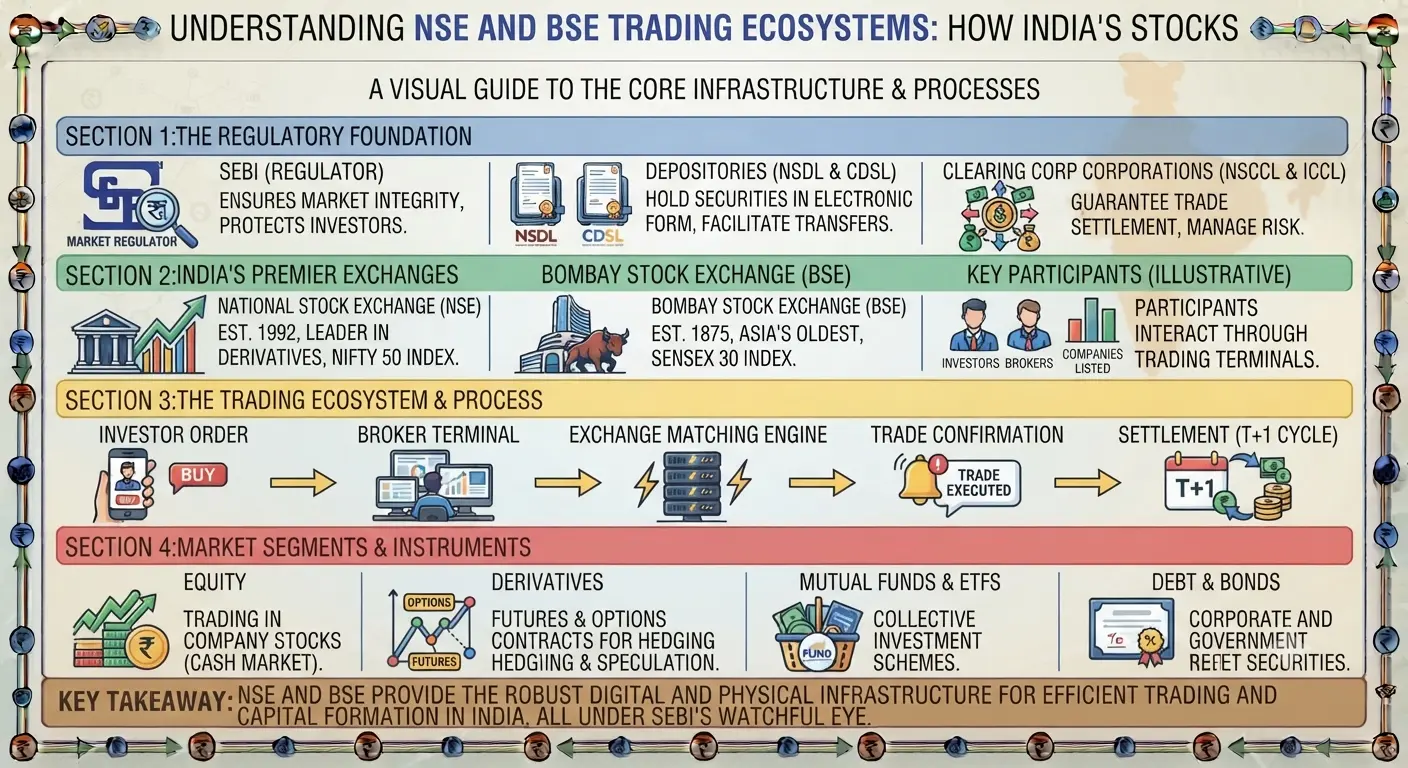
Understanding NSE and BSE Trading Ecosystems: How India's Stock Market Works
When an investor buys shares of Reliance Industries, HDFC Bank or Infosys through a trading app, the transaction may appear to happen with just a tap. A price is displayed, an order is placed, and the shares eventually appear in the investor's Demat account.
But several institutions and systems operate behind that simple experience. A stockbroker connects the investor to an exchange. The exchange matches compatible orders. A clearing corporation calculates obligations, while a depository facilitates the electronic holding and transfer of securities.
India's two major equity exchanges, the National Stock Exchange (NSE) and the Bombay Stock Exchange (BSE), operate within this broader infrastructure. Understanding how these institutions work together helps investors make sense of price differences, order execution, settlement and share ownership.
What Are NSE and BSE?
The National Stock Exchange of India (NSE) and BSE Limited are recognised stock exchanges where eligible securities are traded through regulated electronic trading systems.
In simple terms, they provide organised marketplaces where buyers and sellers can place orders for securities. Their trading systems bring compatible orders together and determine the prices at which transactions take place.
NSE is widely associated with the Nifty 50 index, while BSE is known for the Sensex, its benchmark index representing 30 constituent companies.
However, an exchange is much more than its benchmark index. It provides trading infrastructure, market surveillance, order matching, price discovery and access to different market segments.
National Stock Exchange (NSE)
NSE introduced an electronic trading environment that allows market participants across India to access its trading platform through authorised members. Its equity market includes shares of listed companies and other eligible securities.
The Nifty 50 is one of its best-known indices. It tracks a group of 50 companies selected according to the index methodology. The index is a market indicator, not a separate trading exchange.
Official information: NSE India.
Bombay Stock Exchange (BSE)
BSE is one of India's established stock exchanges. It provides trading facilities across several permitted market segments, including equities, derivatives and debt instruments.
Its best-known benchmark, the Sensex, tracks 30 selected companies listed on BSE. Like the Nifty 50, the Sensex is an index that represents market performance rather than a place where investors independently execute trades.
Official information: BSE India.
NSE vs BSE: What Is the Difference?
Both exchanges allow investors to trade eligible securities, but they have different trading histories, benchmark indices, market participation patterns and listed-company universes.
| Comparison | NSE | BSE |
|---|---|---|
| Full name | National Stock Exchange of India | BSE Limited (formerly Bombay Stock Exchange) |
| Well-known index | Nifty 50 | Sensex |
| Trading system | Electronic trading | Electronic trading |
| Market access | Through authorised trading members | Through authorised trading members |
| Market segments | Equity, derivatives and other permitted segments | Equity, derivatives and other permitted segments |
| Regulator | SEBI | SEBI |
The two exchanges should not be treated as identical marketplaces with interchangeable trading activity. Their order books, liquidity, trading volumes and available securities can differ.
For an investor, the more practical question is often not which exchange is older or more popular, but where a particular security has better liquidity, tighter bid-ask spreads and more suitable execution conditions.
How Does the Indian Stock Market Trading Ecosystem Work?
A stock exchange does not independently perform every activity involved in an investor's transaction. Different institutions have specific responsibilities.
The main participants include:
- SEBI: Regulates India's securities market and oversees relevant market intermediaries and institutions.
- Stock exchanges: Provide electronic trading platforms and match compatible buy and sell orders.
- Stockbrokers: Provide investors with access to exchange trading systems.
- Clearing corporations: Calculate and manage obligations arising from executed trades.
- Depositories: Maintain securities in electronic form.
- Depository Participants: Provide investors access to depository services.
- Banks: Facilitate the movement of money associated with transactions.
1. SEBI: The Market Regulator
The Securities and Exchange Board of India (SEBI) regulates the securities market under the applicable legal framework.
Its responsibilities include investor protection, regulation of market intermediaries, market supervision and developing the securities market.
SEBI is not a stock exchange. It does not operate the ordinary buy-and-sell order book through which retail investors trade shares.
2. Stockbrokers: The Investor's Access Point
Most retail investors cannot directly submit orders to NSE or BSE as exchange trading members. They use a registered stockbroker that provides a trading account and access to the relevant exchange.
For example, an investor using a brokerage application selects a listed company, enters the quantity and price, and submits a buy order.
The broker receives the instruction, applies relevant checks and routes the order into the appropriate exchange trading system.
A broker is therefore an intermediary between the investor and the exchange, not the exchange itself.
3. Stock Exchanges: Where Orders Meet
When an order reaches the exchange, the trading system evaluates it against compatible orders already available in the order book.
For example, suppose an investor wants to buy 10 shares of a company at ₹500 each. Another market participant is willing to sell 10 shares at ₹500.
If the orders are compatible and the applicable trading conditions are satisfied, the system can match them. A trade is then generated.
This process is known as order matching. It is central to price discovery, the process through which buying and selling interest helps determine market prices.
4. Clearing Corporations: Calculating Trade Obligations
A successful order match creates obligations. The buyer is required to provide funds, and the seller is required to deliver securities under the applicable settlement arrangements.
Clearing corporations calculate these obligations and manage the clearing and settlement process.
They help reduce settlement risk through established procedures, margin requirements, netting arrangements and risk-management mechanisms.
For example, NSE Clearing performs clearing and settlement functions for trades executed in the relevant exchange segments.
5. Depositories: Electronic Ownership of Shares
Physical share certificates are no longer the normal method of holding listed shares for retail market transactions. Securities are generally held electronically through depositories.
India has two principal depositories:
- NSDL: National Securities Depository Limited.
- CDSL: Central Depository Services (India) Limited.
Investors access these services through a Depository Participant (DP), which may be a bank, broker or another eligible institution.
Your Demat account records your electronic securities holdings. Your trading account, on the other hand, facilitates buying and selling through your broker.
What Happens When You Buy Shares? A Practical Example
Consider a hypothetical investor who wants to purchase 10 shares of a listed company at ₹500 per share.
The value of the purchase, excluding charges, is:
10 × ₹500 = ₹5,000
Here is how the transaction moves through the market infrastructure.
- Order placement: The investor logs into a brokerage application and submits a buy order for 10 shares.
- Broker processing: The broker checks the order and applicable funds or margin requirements before routing it.
- Exchange matching: The exchange matches the order with a compatible sell order when the conditions are met.
- Trade confirmation: The transaction is recorded and trade details are communicated through the relevant systems.
- Clearing: The clearing corporation calculates the obligations of the relevant clearing members.
- Settlement: Funds and securities move through the established settlement infrastructure.
- Demat credit: Once the applicable delivery process is completed, the shares are credited to the investor's Demat account.
This example explains the normal delivery-based equity transaction. Intraday trades, derivatives and other market segments can have different obligations and processes.
How Does Order Matching and Price Discovery Work?
Two prices are particularly important when examining an exchange order book.
- Bid price: The highest price a buyer is currently willing to pay.
- Ask price: The lowest price a seller is currently willing to accept.
Suppose the order book for a hypothetical share displays:
| Side | Price | Quantity |
|---|---|---|
| Best bid | ₹498 | 200 shares |
| Best ask | ₹500 | 150 shares |
| Next ask | ₹501 | 300 shares |
The difference between the best ask and best bid is called the bid-ask spread. In this example, the spread is ₹2.
If a buyer places a market order, the order may execute against available sell orders at different prices, depending on available quantities and market conditions.
A limit order, in contrast, specifies the maximum buying price or minimum selling price acceptable to the investor. It may remain unexecuted if a compatible counter-order does not appear.
Market depth describes the available buying and selling interest at different price levels. A deeper order book can provide more information about available liquidity, although it does not eliminate execution risk.
Trading Accounts, Demat Accounts and Bank Accounts: Understanding the Difference
New investors sometimes assume that a trading account and a Demat account are the same thing. They serve different purposes.
| Account | Main purpose |
|---|---|
| Trading account | Places buy and sell orders through a broker. |
| Demat account | Holds securities in electronic form. |
| Bank account | Provides funds for transactions and receives applicable payments. |
These accounts work together, but they are not interchangeable. A trading account does not itself represent electronic share ownership, and a Demat account is not an exchange order book.
SEBI's investor education portal explains the role of trading accounts, Demat accounts and Depository Participants in the investment process.
What Is T+1 Settlement in the Indian Stock Market?
The settlement cycle describes the time required to complete the financial and securities obligations arising from a trade.
In T+1 settlement, T represents the trading day and T+1 represents the next eligible working settlement day.
For example, if a normal eligible equity transaction takes place on Monday, settlement generally occurs on Tuesday, assuming there is no intervening settlement holiday.
In practical terms, the buyer's funds and the seller's securities are processed through the settlement system. The buyer receives the securities through the depository framework once the applicable settlement process is completed.
India also has a T+0 settlement framework for eligible securities and transactions. It is not correct to assume that every security or every trade automatically follows T+0.
Investors should check the applicable exchange and clearing corporation notices for the relevant security and settlement type.
Do NSE and BSE Have Different Trading Prices for the Same Share?
Yes. The same company can have different quoted prices on NSE and BSE at a particular moment.
This can happen because each exchange maintains its own order book. Buying interest, selling interest, available quantities and trading activity can differ between the two platforms.
For example, a hypothetical share might show a best available selling price of ₹500 on NSE and ₹500.50 on BSE.
However, the displayed difference does not automatically mean an investor can earn a risk-free profit. Transaction charges, liquidity, execution timing, available quantities and price movements all matter.
Investors should compare executable prices and total transaction costs rather than relying only on the last traded price.
How Should Beginners Choose Between NSE and BSE?
There is no universal rule that one exchange is always better for every security.
Before placing an order, consider these factors:
- Liquidity: Examine the available buying and selling quantities.
- Bid-ask spread: Compare the difference between the best bid and ask.
- Execution price: Check the actual price available for your intended quantity.
- Transaction charges: Understand brokerage and applicable statutory or exchange-related charges.
- Order type: Decide whether a market order or limit order is more appropriate for your circumstances.
- Security availability: Confirm that the relevant security and trading facility are available on the selected exchange.
Beginners should also understand that an exchange's popularity does not guarantee that every trade will execute at the best possible price.
Common Mistakes Beginners Make
Confusing NSE and Nifty
NSE is an exchange. Nifty 50 is an index associated with NSE. An index measures the performance of selected securities; it is not itself a stock exchange.
Confusing BSE and Sensex
BSE is the exchange, whereas Sensex is its well-known benchmark index.
Assuming the Broker Owns the Shares
A broker facilitates transactions. Securities held in a Demat account are recorded through the depository system.
Ignoring Liquidity
A quoted price does not guarantee that the entire desired quantity can be purchased at that price.
Assuming Every Trade Settles Immediately
Trade execution and settlement are separate stages. The applicable settlement cycle determines when the obligations are completed.
Believing NSE Is Always Cheaper Than BSE
There is no universal exchange-wide rule that guarantees better execution prices on one exchange. Compare the actual order books and transaction costs.
How Can Investors Learn to Read the Trading Ecosystem?
A useful way to understand the market is to follow one transaction from beginning to end.
- Open a brokerage platform and examine the same security on NSE and BSE.
- Compare the best bid and ask prices.
- Observe the available quantities and market depth.
- Understand the difference between market and limit orders.
- Study the trade confirmation and contract note.
- Review the relevant settlement information.
- Check how the resulting holding appears in the Demat account.
SEBI's investor education resources and the official NSE and BSE websites are useful starting points for learning about market infrastructure and investor responsibilities.
Frequently Asked Questions
1. What is the main difference between NSE and BSE?
NSE and BSE are separate recognised stock exchanges in India. Both provide electronic trading facilities, but they operate independent order books and have different benchmark indices. Nifty 50 is associated with NSE, while Sensex is associated with BSE.
2. Can I buy the same company's shares on NSE and BSE?
Yes, when the company is listed and the security is available for trading on both exchanges. Investors can select the exchange through their broker, subject to the broker's facilities and applicable trading conditions.
3. Is NSE regulated by SEBI?
Yes. NSE operates within India's securities-market regulatory framework and is regulated by SEBI. BSE also operates under SEBI's regulatory framework.
4. What is the role of a stockbroker?
A stockbroker provides investors access to exchange trading systems. It receives orders, performs applicable checks and routes orders to the relevant exchange. Brokers also provide transaction records and other account-related services.
5. What is the difference between NSDL and CDSL?
NSDL and CDSL are India's two principal securities depositories. Both facilitate electronic holding and transfer of securities through registered Depository Participants. They are separate institutions with their own operational frameworks.
6. What happens after a stock market order is executed?
After execution, the trade enters the clearing and settlement process. The relevant clearing corporation calculates obligations, and funds and securities are transferred through the settlement and depository infrastructure.
7. What does T+1 mean in share trading?
T+1 means settlement takes place on the next eligible working settlement day after the trade date. Applicable holidays and the settlement type can affect the actual timeline.
8. Which exchange should a beginner use, NSE or BSE?
Neither exchange is automatically the best choice for every security. Beginners should compare available liquidity, bid-ask spreads, execution prices and applicable transaction costs before placing an order.
Conclusion: Understanding the System Behind Every Stock Market Trade
NSE and BSE are central parts of India's stock market, but neither operates in isolation. Brokers connect investors to exchange platforms, exchanges match orders, clearing corporations manage trade obligations, banks facilitate money movement and depositories maintain securities in electronic form.
Once investors understand these separate responsibilities, many common questions become easier to answer. They can distinguish between order execution and settlement, understand why Demat and trading accounts are different, and evaluate price and liquidity differences across exchanges more carefully.
The objective is not simply to know where shares are traded. It is to understand the infrastructure that makes buying, selling and holding securities possible.
Educational Disclaimer
This article is intended solely for general financial education and informational purposes. It does not constitute investment advice, a recommendation to buy or sell securities, or a guarantee of returns. Market rules and settlement arrangements may change. Verify current information with SEBI, NSE, BSE and the relevant clearing corporation before making financial decisions.