What Are Large-Cap, Mid-Cap and Small-Cap Stocks? Meaning, Differences and Examples
Learn how large-cap, mid-cap and small-cap stocks are classified in India, how they differ in size and risk, and what investors should examine before investing in each category.
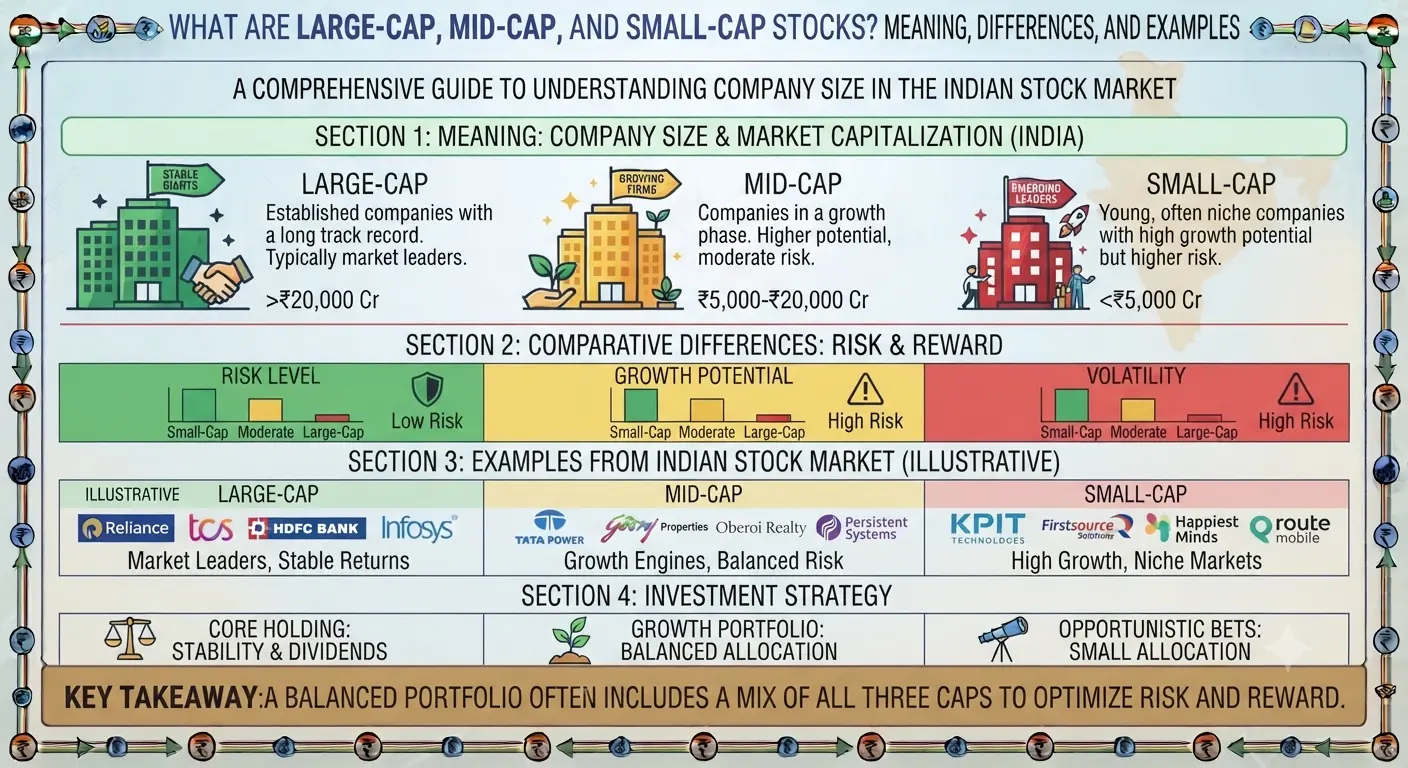
What Are Large-Cap, Mid-Cap and Small-Cap Stocks? Meaning, Differences and Examples
Two companies can both be listed on the NSE, operate in the same industry and sell similar products, yet their shares may belong to very different market-cap categories. One may be classified as large-cap, another as mid-cap, and a third as small-cap. These labels tell investors something about the relative size of a listed company, but they do not tell the complete story about its business quality or investment risk.
For someone learning the Indian stock market, the distinction matters. Company size can influence how a stock behaves during market movements, how easily investors can trade it and how much attention it receives from institutional investors. However, a smaller company is not automatically a better growth opportunity, just as a large company is not automatically a safe investment.
What Are Large-Cap, Mid-Cap and Small-Cap Stocks?
Large-cap, mid-cap and small-cap stocks are shares of listed companies grouped according to their full market capitalisation ranking. Under India's SEBI framework, the top 100 companies by full market capitalisation are large-cap, companies ranked 101 to 250 are mid-cap, and companies ranked 251 onwards are small-cap.
The categories are based on a company's relative position in the market, not on a permanent rupee-value threshold. The ranking can change as companies' market values change.
What Does Market Capitalisation Mean?
Market capitalisation, often shortened to market cap, represents the market value of a company's outstanding equity shares. It is calculated by multiplying the current market price of one share by the total number of outstanding shares.
Market Capitalisation = Current Share Price × Total Outstanding Shares
For example, imagine a hypothetical Indian company has 20 crore outstanding shares and its share price is ₹150. Its market capitalisation would be:
₹150 × 20 crore shares = ₹3,000 crore
This figure represents the market value of the company's equity at that share price. It does not mean the company has ₹3,000 crore in its bank account, nor does it represent the value of all its assets.
Market capitalisation can change when the share price moves or when the number of outstanding shares changes. A rise in share price increases market cap if the share count remains the same. A fresh issue of shares can also change the calculation.
How Are Large-Cap, Mid-Cap and Small-Cap Stocks Classified in India?
SEBI established a uniform classification framework for large-cap, mid-cap and small-cap companies to bring consistency to the investment universe used by equity mutual fund schemes. AMFI prepares and publishes the consolidated stock list using market-capitalisation data from recognised stock exchanges.
| Category | Company's rank by full market capitalisation | Basic meaning |
|---|---|---|
| Large-cap | 1st to 100th | The 100 largest companies in the ranking |
| Mid-cap | 101st to 250th | The next 150 companies |
| Small-cap | 251st onwards | Companies ranked after the top 250 |
Why does AMFI publish the list?
Market capitalisation changes over time, so a company's category cannot be treated as permanent. AMFI publishes an updated list based on data from the end of June and December. For companies listed on more than one recognised stock exchange, the framework considers the average full market capitalisation across those exchanges. The consolidated ranking also uses the average full market capitalisation over the previous six months.
This means an investor should check the latest list rather than rely on an old article, an outdated spreadsheet or a remembered classification. The latest available AMFI list should be consulted when identifying a company's current category.
What Are Large-Cap Stocks?
Large-cap stocks are shares of companies ranked among the top 100 listed entities by full market capitalisation under the Indian classification framework. These companies are generally among the biggest businesses in the listed market.
Large companies may have established operations, wider customer bases, recognised brands, access to capital and a longer operating history. Some are market leaders in their industries. These characteristics can make their businesses more resilient than those of smaller competitors in certain situations, although this is not guaranteed.
Characteristics of large-cap companies
- Established operations: Many have operated for years and have developed sizeable business networks.
- Greater market visibility: Large companies are often followed by analysts, institutions and financial media.
- Potentially better trading liquidity: Many large-cap shares have substantial trading activity, although liquidity still varies from stock to stock.
- More mature business lines: Some operate in established markets where growth may be steadier rather than exceptionally fast.
- Institutional participation: They may be more widely held by mutual funds, insurance companies and other institutional investors.
Advantages and limitations of large-cap stocks
Large-cap companies can offer investors exposure to established businesses. Their scale, financial resources and market presence may help them manage competitive pressure or temporary economic weakness. Their shares may also be easier to trade than those of less actively traded smaller companies.
However, size does not remove investment risk. A large company can become overvalued, lose market share, take on excessive debt or report weak earnings. Its share price can fall sharply when business expectations deteriorate. Investors should still examine valuation, profitability, debt, cash flow and management quality.
What Are Mid-Cap Stocks?
Mid-cap stocks are shares of companies ranked from 101st to 250th by full market capitalisation. They sit between the largest listed businesses and the smaller companies in the classification.
Mid-cap companies can include businesses that have already built a meaningful market presence but still have room to expand into new products, regions or customer segments. Some may be growing quickly; others may operate in mature industries or face business challenges. Their size alone does not reveal which situation applies.
Characteristics of mid-cap companies
- Intermediate business scale: They are smaller than the top 100 companies but larger than the small-cap group.
- Potential expansion opportunities: Some may be increasing capacity, entering new markets or gaining market share.
- Varied business maturity: The category includes companies at different stages of development.
- Changing market position: A company may move into the large-cap group or fall into the small-cap group as its ranking changes.
- Company-specific risk: Financial strength, competition and management quality can vary considerably.
Advantages and limitations of mid-cap stocks
A successful mid-cap business may have more room to expand than a mature industry leader. Investors looking for companies with a combination of an established operating base and further growth opportunities may therefore study this segment.
The trade-off is that mid-cap shares can be more volatile and less liquid than many large-cap shares. Business setbacks, funding difficulties or disappointing earnings can have a significant effect on their market value. Investors should not assume that a company will become a large-cap simply because it currently belongs to the mid-cap category.
What Are Small-Cap Stocks?
Small-cap stocks are shares of companies ranked 251st onwards by full market capitalisation. They represent the smaller companies in the listed market under this ranking system.
The small-cap category is broad. It can include emerging businesses, specialised manufacturers, niche service providers and companies operating in established industries. Some have strong business models and expansion plans; others may have limited financial resources, concentrated customer bases or inconsistent earnings.
Characteristics of small-cap companies
- Smaller market value: Their full market capitalisation ranking is below the top 250 companies.
- Different growth stages: Some are relatively young businesses, while others may have operated for decades.
- Potentially lower trading liquidity: Certain small-cap shares have fewer active buyers and sellers.
- Greater sensitivity to business developments: A new contract, loss of a major customer or funding problem can materially affect a smaller business.
- Wide differences in quality: The category includes both financially strong companies and businesses with significant weaknesses.
Advantages and limitations of small-cap stocks
A smaller company may have opportunities to grow its revenue, expand production or enter markets that are not yet significant contributors to its business. If it executes well, that expansion can improve its financial performance.
But potential growth is not the same as an assured return. Small-cap shares can experience sharp price movements, and some may be difficult to sell quickly at a desired price. Smaller businesses can also have limited access to funding, weaker bargaining power and greater dependence on a small number of customers or suppliers.
Investors should pay particular attention to cash flow, debt, promoter conduct, corporate disclosures, trading liquidity and the quality of the company's underlying business.
Large-Cap vs Mid-Cap vs Small-Cap Stocks: Key Differences
The main difference is the company's position in the market-capitalisation ranking. Other characteristics, such as volatility, liquidity and growth opportunities, are common tendencies rather than rules that apply to every stock.
| Comparison | Large-cap | Mid-cap | Small-cap |
|---|---|---|---|
| SEBI ranking | 1–100 | 101–250 | 251 onwards |
| Relative company size | Largest | Medium-sized | Smaller |
| Business maturity | Often more established | Varies by company | Varies by company |
| Typical liquidity tendency | Often higher | Can be moderate | Can be lower |
| Price volatility tendency | Can be relatively lower | Can be higher | Can be higher |
| Growth opportunities | Depend on business and valuation | Depend on business and valuation | Depend on business and valuation |
| Key risks to examine | Valuation, competition and business maturity | Execution, funding and competition | Liquidity, financial strength and governance |
It is tempting to read this table as a simple risk ladder, but that would be an oversimplification. A highly indebted large-cap company may be financially weaker than a small-cap company with strong cash flows and conservative borrowing. The category is a starting point for research, not a substitute for it.
Does a Small-Cap Stock Have More Growth Potential?
It can, but the category alone cannot establish that. A smaller company may have a larger addressable market relative to its current size. If it develops a competitive advantage, wins customers and manages its finances well, its earnings may grow substantially.
However, smaller companies also face obstacles. They may struggle to raise capital, compete with larger businesses, retain skilled employees or withstand a downturn. Some operate in narrow markets where expansion is difficult. Others may be priced at high valuations because investors already expect rapid growth.
For this reason, investors should distinguish between business growth potential and stock return potential. Even a growing company can deliver poor stock returns if its shares were purchased at an excessive valuation.
Can a Company Move from Small-Cap to Mid-Cap or Large-Cap?
Yes. These classifications are based on relative market-capitalisation rankings, which can change over time. A company may move from small-cap to mid-cap if its ranking rises into the 101–250 range. It may later enter the top 100 and become large-cap.
The reverse can also happen. If a company's market value falls relative to other listed companies, its ranking may decline. A large-cap company can move into the mid-cap group, and a mid-cap company can move into the small-cap group.
These changes do not necessarily mean the company's business has improved or deteriorated by the same degree. Market prices can move because of changing expectations, broader market conditions or investor sentiment. A category change should prompt further research, not an automatic buy or sell decision.
How Should Investors Evaluate Stocks Across These Categories?
Instead of choosing a stock only because it is large-cap, mid-cap or small-cap, examine the business behind the share. The following checks can help organise that research.
1. Understand the company's business
Identify what the company sells, who its customers are, how it earns revenue and what gives it an advantage over competitors. A business that is difficult to understand may require more research before an investment decision.
2. Examine revenue and profit trends
Review several years of revenue, operating profit and net profit. Look for consistency and understand why results have changed. A sudden increase in profit may be temporary or may come from a one-off event.
3. Check debt and cash flow
Compare borrowings with the company's ability to generate cash. Accounting profits do not always translate into cash received from customers. Persistent weak operating cash flow, rising debt or high interest costs deserve attention.
4. Assess valuation
Compare valuation measures such as price-to-earnings (P/E) and price-to-book (P/B) with relevant peers, while considering differences in growth, profitability and risk. A low valuation does not automatically make a stock cheap, and a high valuation does not automatically make it unsuitable.
5. Review governance and disclosures
Read annual reports, exchange announcements and auditor observations. Pay attention to related-party transactions, changes in auditor, promoter pledging where relevant, regulatory disclosures and the quality of explanations given by management.
6. Consider liquidity and your investment horizon
Check trading volumes and bid-ask spreads before investing, particularly in smaller companies. An investor may be able to buy a share easily but find it harder to sell a large holding during a period of weak demand.
Common Mistakes Investors Make
- Assuming small-cap means cheap: Company size and valuation are different concepts. A small-cap share can be expensive.
- Assuming large-cap means safe: Large companies can still face financial stress, business disruption and sharp share-price declines.
- Using outdated classifications: A company's category can change. Check the latest AMFI list rather than relying on old information.
- Chasing past performance: A stock that has risen sharply may already reflect optimistic expectations.
- Ignoring liquidity: Trading activity matters, particularly when an investor needs to exit a position.
- Confusing company size with business quality: Market capitalisation does not measure management quality, debt levels, profitability or corporate governance.
- Buying only because a company may become a large-cap: A possible future ranking upgrade is not a reliable investment thesis on its own.
How Can You Check Whether an Indian Stock Is Large-Cap, Mid-Cap or Small-Cap?
For the classification used in the Indian mutual fund framework, refer to the latest consolidated list published by the Association of Mutual Funds in India (AMFI). The list provides the ranking used to identify large-cap, mid-cap and small-cap companies.
- Visit the official AMFI website.
- Open the section titled “Categorisation of Stocks”.
- Find the latest available half-yearly list.
- Search for the company name or stock identifier in the list.
- Check its ranking and identify the corresponding category.
Do not rely on a fixed market-cap number copied from an old article. The rupee value separating the categories changes as the market and company rankings change.
Conclusion
Large-cap, mid-cap and small-cap stocks represent different company-size groups based on full market-capitalisation rankings. In India, the top 100 companies are classified as large-cap, ranks 101 to 250 as mid-cap and rank 251 onwards as small-cap under the SEBI framework used for equity mutual fund investment universes.
These categories can help investors understand a company's relative size, but they do not measure its financial health or guarantee a particular level of risk or return. A sound investment decision requires a closer look at the company's business, financial statements, valuation, management, governance and liquidity. Start with the category, then do the work of understanding the company.
Frequently Asked Questions
1. What is the difference between large-cap, mid-cap and small-cap stocks?
The difference is based on a company's full market-capitalisation ranking. In India, ranks 1–100 are large-cap, 101–250 are mid-cap and 251 onwards are small-cap. The categories indicate relative company size, not guaranteed investment performance.
2. How many companies are classified as large-cap in India?
The large-cap category consists of the top 100 companies by full market capitalisation ranking under the SEBI framework. The companies occupying those positions can change when the official list is updated.
3. Are mid-cap stocks riskier than large-cap stocks?
Mid-cap stocks can be more volatile and less liquid than many large-cap stocks, but this is not true of every company. Financial strength, valuation, governance, industry conditions and trading liquidity all influence a stock's risk.
4. Are small-cap stocks suitable for beginners?
Small-cap stocks can involve higher volatility, lower liquidity and greater company-specific risks. Beginners should understand these risks and learn how to assess a company's financial position before investing. The category alone cannot determine whether a stock is suitable for an individual.
5. Can a small-cap company become a large-cap company?
Yes. If its full market-capitalisation ranking rises into the top 100, it can be classified as large-cap in the applicable updated list. A company can also move in the opposite direction if its relative ranking falls.
6. Does a large market capitalisation mean a company is financially strong?
No. Market capitalisation reflects the market value of a company's outstanding equity shares. It does not directly measure debt, cash flow, profitability, governance or the quality of its business.
7. How often are large-cap, mid-cap and small-cap classifications updated?
AMFI's consolidated classification list is updated every six months using data as of the end of June and December. Investors should refer to the latest available list when checking a company's category.
8. Where can I check the latest list of large-cap, mid-cap and small-cap stocks?
You can check the official “Categorisation of Stocks” section on the AMFI website. It publishes the consolidated list used for the classification framework.
Disclaimer
This article is for educational purposes only and should not be treated as investment advice or a recommendation to buy or sell any security. Equity investments are subject to market risks, including the possible loss of capital. Investors should conduct their own research and consider their financial goals and risk tolerance before making investment decisions.