How Does the Indian Stock Market Settlement System Work? T+1, Pay-In and Pay-Out Explained
Learn how stock market trades are settled in India, how T+1 works, when money and shares are transferred, and what roles clearing corporations, brokers and depositories play.
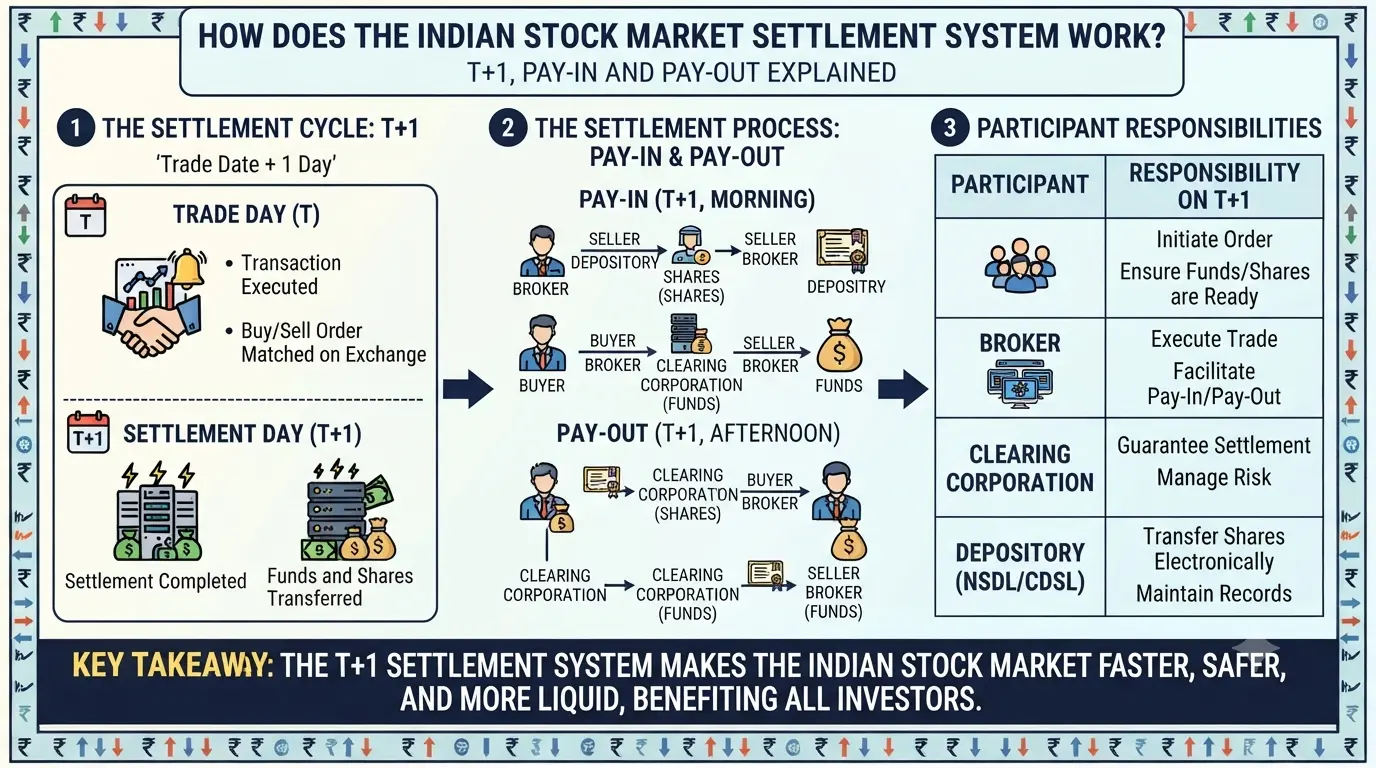
How Does the Indian Stock Market Settlement System Work?
You buy 10 shares of a company through your trading app. The order is executed, and the app immediately shows the purchase in your portfolio. But have the shares already reached your Demat account? And if you sell them tomorrow, when will the money become available?
These questions are about settlement — the process that completes a stock market transaction after a trade has been executed. The order may be matched in seconds, but the transfer of money and securities follows a defined process involving the broker, stock exchange, clearing corporation and depositories.
For regular equity delivery trades in India, the standard cycle is T+1. An optional T+0 settlement cycle is also available for eligible securities and participating brokers. Knowing the difference helps investors understand when shares are credited, when sale proceeds become available and why a displayed balance may not always be immediately withdrawable.
What Is the Stock Market Settlement System?
The stock market settlement system is the process through which the buyer receives securities and the seller receives money after a trade. It takes place after the exchange matches a buy order with a sell order.
In a normal delivery purchase, the buyer has to pay the required funds and the seller has to deliver the shares. The clearing corporation coordinates the obligations and ensures that the funds and securities move through the prescribed settlement process.
In India, regular equity cash-market trades generally follow a T+1 rolling settlement cycle. Here, T means the trading day and T+1 means the next applicable settlement working day. The optional T+0 cycle allows same-day settlement for eligible trades, subject to the applicable exchange and broker arrangements.
Trading, Clearing and Settlement: What Is the Difference?
These three terms are connected, but they do not mean the same thing.
- Trading: A buy and sell order are matched on the stock exchange. This creates a trade and the corresponding obligations.
- Clearing: The clearing corporation calculates what each clearing member must deliver or receive in funds and securities.
- Settlement: Those obligations are completed through the transfer of funds and securities.
For example, suppose an investor buys 20 shares of a listed company. The exchange matches the order with a seller. The clearing process determines the relevant obligations, and settlement completes the transfer of the shares to the buyer and the corresponding money to the seller through the market infrastructure.
A trade confirmation therefore tells you that the order was executed. It does not, by itself, mean that every settlement step has already been completed.
Who Is Involved in the Indian Settlement Process?
1. Stock Exchange
Stock exchanges such as the National Stock Exchange (NSE) and BSE provide the regulated marketplace where buy and sell orders are matched. They also transmit trade information required for clearing and settlement.
2. Clearing Corporation
A clearing corporation calculates settlement obligations and coordinates the movement of funds and securities. It acts as the central counterparty within the clearing framework, helping manage the risk that one side of a transaction may fail to meet its obligation.
For trades executed on NSE, NSE Clearing performs the clearing and settlement functions for the relevant market segment. Other exchanges have their own clearing arrangements.
3. Stockbroker
Your broker provides access to the exchange and maintains your trading account and transaction records. It collects or arranges the funds and securities required for your trades and reflects the relevant credits and debits in your account.
4. Depositories: NSDL and CDSL
India has two securities depositories: National Securities Depository Limited (NSDL) and Central Depository Services (India) Limited (CDSL). They maintain securities in electronic form through the depository system.
Your Demat account is opened through a Depository Participant (DP), which acts as the link between you and the depository. When shares are delivered after a purchase, they are credited electronically rather than being handed over as physical certificates.
How Does T+1 Settlement Work?
T+1 is the standard rolling settlement cycle for regular equity cash-market trades. Each trading day's eligible trades are settled according to their own settlement schedule. The next applicable working day is normally the settlement day.
Consider a hypothetical example in which an investor buys shares on Monday and there is no settlement holiday on Tuesday.
- Monday — Trade day (T): The investor places a buy order. Once matched, the trade is executed. The broker records the transaction and the clearing process determines the obligations.
- Tuesday — Settlement day (T+1): The required funds and securities are transferred through the clearing and depository systems. After the payout process, the purchased shares are credited to the investor's Demat account.
The exact operational cut-offs and the time at which an investor sees a credit can depend on the exchange, clearing corporation, depository and broker's systems. T+1 should be understood as a settlement cycle, not a promise that every account will update at the same clock time.
What If There Is a Settlement Holiday?
T+1 means the next applicable settlement working day, not automatically the next calendar day. Saturdays, Sundays and notified settlement holidays can affect the schedule. If a market trade takes place before a settlement holiday, the settlement date may move to the next eligible working day.
Investors should check the relevant exchange or clearing corporation settlement calendar instead of calculating the date only by adding one calendar day.
What Happens When You Buy Shares?
When you buy shares for delivery, you take on a funds obligation. The broker and clearing system process the payment side, while the seller's securities are delivered through the settlement infrastructure.
For example, assume you purchase 10 shares at ₹500 each. The basic trade value is ₹5,000, excluding applicable charges. After the trade is executed, the settlement process handles the funds and securities obligations. Once the securities payout is completed, the shares are credited to your Demat account.
SEBI's direct payout framework requires securities payout to be credited directly to the client's Demat account, subject to the applicable operational process. This is an important investor-protection measure: the securities are not simply treated as the broker's own holdings.
What Happens When You Sell Shares?
When you sell shares held in your Demat account, the securities required for delivery are transferred towards the settlement obligation. The corresponding sale proceeds are processed through the clearing and banking system.
For example, assume you sell 10 shares at ₹550 each. The gross sale value is ₹5,500, before applicable charges and taxes. Under the regular T+1 cycle, the settlement of the funds obligation normally takes place on the next applicable settlement working day.
Do not confuse a sale value displayed in your trading app with immediately withdrawable bank money. A broker may show funds or buying power according to its ledger and risk policies, while the actual withdrawal availability depends on completion of settlement and the broker's withdrawal process. Check the funds statement and withdrawal status rather than relying only on the portfolio screen.
What Are Pay-In and Pay-Out?
Pay-in and pay-out are two central stages of settlement.
Pay-In
Pay-in is the stage at which clearing members provide the funds or securities they owe to the clearing corporation. For a buyer, the relevant funds obligation must be met. For a seller, the required securities must be delivered through the depository system.
Pay-Out
Pay-out is the stage at which the clearing corporation releases the funds or securities due to clearing members and investors through the prescribed channels. A buyer receives securities, while a seller receives the corresponding funds, subject to the settlement obligations.
Think of pay-in as bringing what is owed into the settlement system and pay-out as distributing what is due to the receiving side. The clearing corporation coordinates these movements so that the two sides of the transaction can be completed in an organized manner.
T+1 vs T+0 Settlement: What Is the Difference?
India introduced an optional T+0 rolling settlement cycle in addition to the existing T+1 cycle. T+0 refers to settlement on the same trading day, subject to eligibility and the operational rules of the exchange and clearing corporation.
| Feature | T+1 Settlement | Optional T+0 Settlement |
|---|---|---|
| Settlement timing | Next applicable settlement working day | Same trading day |
| Availability | Standard cycle for regular eligible equity cash-market trades | Only for eligible securities and supported arrangements |
| Operational window | Follows the applicable T+1 schedule | Has specific trading and settlement cut-offs |
| Investor choice | Regular settlement route | Optional where the broker and security support it |
The optional T+0 facility was introduced in March 2024 and its scope was subsequently expanded through SEBI's December 2024 circular. It is not correct to assume that every listed share or every broker account automatically supports T+0. Investors should check the current eligible-security list and confirm availability with their broker.
T+0 also does not mean instant settlement at the moment an order is placed. It has its own cut-off times, obligation calculation and pay-in/pay-out process. It is a same-day settlement cycle, not an unrestricted real-time transfer system.
What Is a Short Delivery, and What Happens Next?
A short delivery occurs when the seller's side fails to deliver the required quantity of securities by the settlement deadline. This can happen because the seller does not have sufficient deliverable shares or because of an operational failure.
In the normal settlement segment, the clearing corporation can conduct a buy-in auction to obtain the undelivered shares. If the auction is successful, the securities obtained through the auction can be used to meet the buyer's delivery obligation. The auction settlement generally follows the applicable post-settlement schedule.
If the required shares cannot be obtained or the settlement type follows a different rule, a close-out mechanism may apply. The buyer may receive a cash close-out amount instead of the missing shares. The calculation depends on the applicable exchange and clearing corporation rules; it should not be assumed to equal the original purchase price.
For a retail buyer, a short delivery can mean that the expected shares do not arrive in the Demat account on the usual T+1 timeline. The broker's transaction or holdings screen may show a short-delivery status or a later credit. Check the broker's official explanation and contract note for the specific trade.
Does Settlement Work the Same Way for Intraday and F&O Trades?
No. The T+1 explanation in this article primarily concerns delivery-based equity trades in the cash market.
- Equity delivery: Shares are bought or sold with the intention of taking or giving delivery. The regular cash-market settlement cycle applies.
- Intraday equity: Positions are generally squared off within the same trading session. If a position is not squared off as required, broker and exchange rules may lead to a different outcome.
- Futures and options: These contracts have separate obligations, including margins, premiums, mark-to-market settlements and expiry-related settlement rules. Do not apply the cash-equity delivery example to every F&O position.
Before trading a product, understand its contract specifications and settlement obligations. A trading app may display all products in one portfolio, but that does not mean their settlement mechanics are identical.
Common Settlement Mistakes Beginners Should Avoid
- Assuming execution means settlement: An executed order creates obligations; settlement completes them.
- Counting calendar days instead of settlement days: Holidays can change the expected settlement date.
- Assuming every share supports T+0: The facility is optional and limited by eligibility and broker support.
- Confusing app balance with withdrawable funds: Check the settled funds and withdrawal status.
- Thinking a Demat account executes trades: The trading account and broker provide market access; the Demat account holds securities electronically.
- Applying cash-market rules to F&O: Derivatives have different settlement and risk requirements.
How Can Investors Check Whether a Trade Has Settled?
Investors do not need to calculate clearing obligations themselves. They should, however, know where to verify the outcome of a trade.
- Check the order book or trade book to confirm that the order was executed.
- Review the contract note issued by the broker for trade details and applicable charges.
- For a purchase, check the holdings or transaction statement in the Demat account after the expected settlement.
- For a sale, review the funds ledger and withdrawal section to distinguish settled proceeds from funds that are still unavailable for withdrawal.
- If the shares or money are missing beyond the expected timeline, contact the broker with the order ID, trade date and contract note. Escalate through the applicable exchange or investor grievance mechanism if the issue remains unresolved.
Frequently Asked Questions
1. What is the settlement cycle in the Indian stock market?
The regular settlement cycle for equity cash-market delivery trades in India is T+1. This means the trade is normally settled on the next applicable settlement working day. An optional T+0 cycle is also available for eligible securities and supported broker arrangements.
2. When do I receive shares after buying them?
Under the regular T+1 cycle, shares are normally credited to the buyer's Demat account on the next applicable settlement working day, after the payout process. Holidays, short delivery or operational issues can affect the timing.
3. When can I withdraw money after selling shares?
Sale proceeds are processed through the settlement system. The amount shown in a trading account may not be immediately withdrawable. Actual withdrawal availability depends on settlement completion and the broker's applicable process.
4. Is T+0 settlement compulsory in India?
No. T+0 is an optional settlement cycle that operates alongside T+1 for eligible securities and participating arrangements. Investors should confirm whether their broker and the particular security support it.
5. What happens if a seller does not deliver shares?
In the normal settlement segment, the clearing corporation may conduct a buy-in auction to obtain the missing shares. If delivery cannot be completed under the applicable rules, a close-out mechanism may apply.
6. Do NSE and BSE follow the same settlement process?
Both operate within SEBI's regulatory framework and use clearing and settlement infrastructure. The exact operational schedule, circulars and procedures should be checked with the relevant exchange and its clearing corporation.
7. Does T+1 mean I receive shares exactly 24 hours after buying?
No. T+1 refers to the next applicable settlement working day, not a fixed 24-hour period. Settlement holidays, cut-off times and exceptional situations can affect when the credit appears.
8. Is stock market settlement the same for equity and options?
No. Delivery-based equity trades, intraday positions, futures and options can have different obligations and settlement rules. Investors should check the specifications of the particular product rather than assume that every trade follows the equity cash-market T+1 process.
Conclusion
The Indian stock market settlement system ensures that a completed trade results in the proper transfer of money and securities. The exchange matches orders, the clearing corporation calculates and coordinates obligations, brokers facilitate client transactions, and depositories maintain securities in electronic form.
For regular equity delivery trades, T+1 is the standard settlement cycle, while optional T+0 is available only where the security and broker arrangements support it. Understanding pay-in, pay-out, settlement holidays and short delivery helps investors interpret their trading accounts more accurately and avoid confusion after executing an order.
Educational disclaimer: This article is for financial education only. Settlement procedures and eligibility can change through exchange, clearing corporation and SEBI circulars. Verify the latest applicable rules with official sources and your broker before making transaction-related decisions. This article is not investment advice.