How to Buy and Sell Shares in India: A Step-by-Step Guide
Learn how to buy and sell shares in India, from choosing a stockbroker and placing your first order to understanding order types, settlement, charges, taxes and common beginner mistakes.
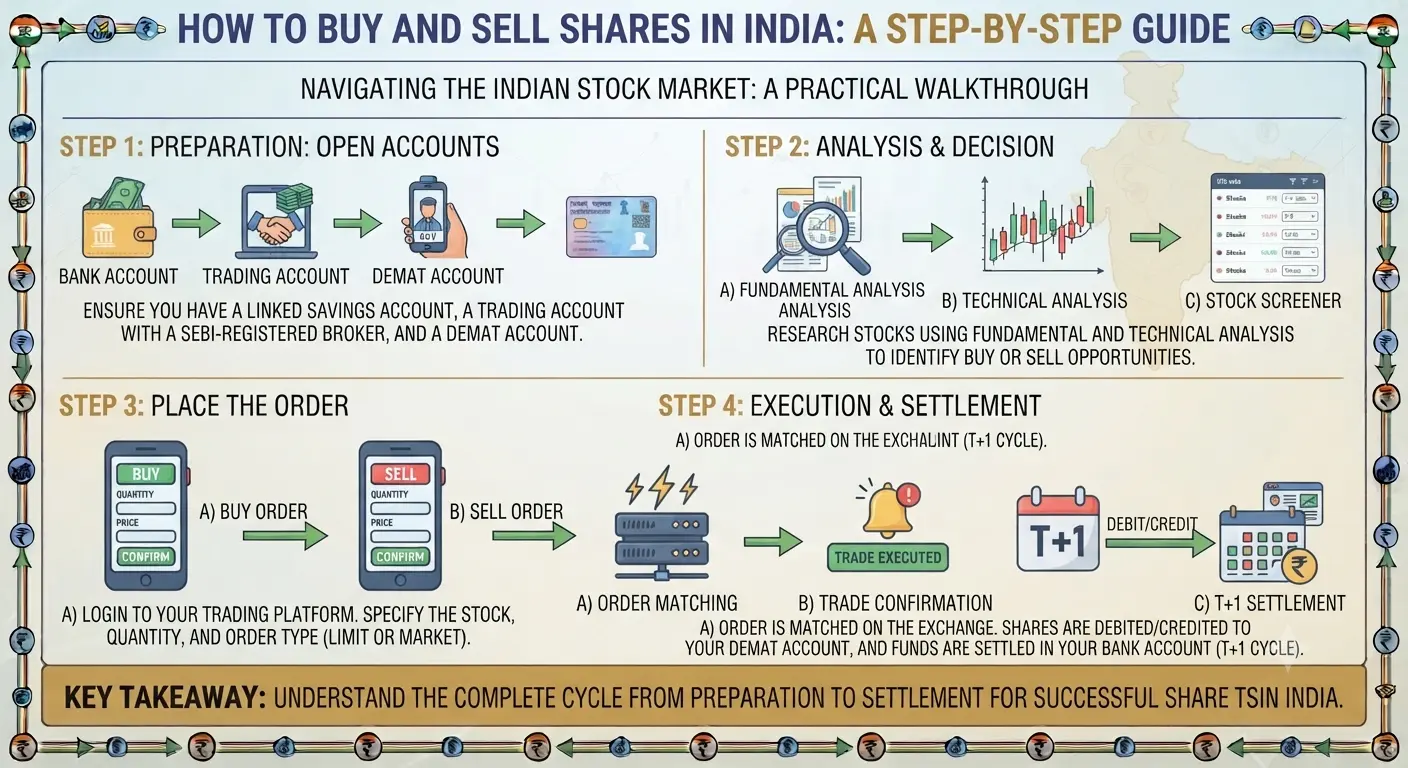
How to Buy and Sell Shares in India: A Step-by-Step Guide
Suppose you have been using a company's products for years. You see its name in the news, notice that its business is expanding and start wondering whether you can become a part-owner of that company. The next question is practical: where do you go, how do you place an order, and what actually happens after you press the Buy button?
Buying and selling shares in India is now possible through online trading platforms, but the process involves more than selecting a company and entering a quantity. You need the right accounts, a basic understanding of stock orders, enough funds or shares to complete a trade, and an awareness of transaction costs and settlement.
This guide explains the complete process using the Indian cash-equity market as its reference. It covers delivery-based share investing and ordinary share sales. Intraday trading, futures and options, IPO applications and mutual fund purchases are different activities and are not treated as interchangeable.
How do you buy and sell shares in India?
To buy or sell listed shares in India, open a trading account with a SEBI-registered stockbroker and a Demat account to hold securities electronically. Link your bank account, complete KYC, add funds, select a listed share and place a buy or sell order through the broker's platform. The order is executed only when it finds a matching order on the exchange.
India's main stock exchanges include the National Stock Exchange (NSE) and BSE. A retail investor generally accesses them through a registered broker rather than placing an order directly with the exchange.
What do you need before buying your first share?
There are three connected parts to the process: a bank account for money, a trading account for placing orders, and a Demat account for holding shares. They perform different jobs, even when a broker's app presents them together in one interface.
1. Bank account: where the money comes from
Your bank account is used to transfer money to your broker and receive eligible sale proceeds or withdrawals. Use a bank account in your own name and follow the broker's permitted funding and withdrawal methods. Avoid sending trading money to an employee's personal account or to an unrelated individual.
2. Trading account: where buy and sell orders are placed
A trading account gives you access to the broker's platform. You use it to search for a security, choose an exchange, enter the quantity and price conditions, and submit an order. The broker routes eligible orders to the exchange after its checks.
3. Demat account: where your shares are held
A Demat account holds securities in electronic form. In India, depository services are provided through NSDL and CDSL, which work through registered Depository Participants (DPs). Your broker may also provide the Demat account service, or it may be maintained through another DP.
Think of the distinction this way: the trading account helps you transact; the Demat account records your electronic holdings. A trading app showing a position immediately after a purchase does not necessarily mean the final settlement and depository credit have already completed.
Step 1: Choose a SEBI-registered stockbroker
Your broker is the intermediary through which you access the exchange. Choosing one only because an advertisement says that its account is free is a weak approach. The headline offer may not tell you what you will pay when you buy, sell, hold securities or request additional services.
Before opening an account, examine the following:
- Regulatory status: Verify the broker's registration and exchange membership using official SEBI or exchange resources.
- Brokerage: Understand how the broker charges for delivery trades, intraday trades and other products. Do not assume all services have the same pricing.
- Demat charges: Check account maintenance charges, debit transaction charges and other DP-related fees, if applicable.
- Platform reliability: Look at order placement, order modification, fund transfer and support processes. A low fee is not useful if you cannot manage an order reliably.
- Statements and support: Check how you receive contract notes, account statements, transaction alerts and complaint support.
- Terms and permissions: Read the rights and obligations, risk disclosure documents and any authorisations requested during onboarding.
Compare the complete cost structure rather than relying on the phrase “zero brokerage” or “free Demat account”. Statutory levies and service charges may still apply. The exact amount depends on the transaction, the applicable rules and the broker's current tariff.
Step 2: Open your trading and Demat accounts
Most brokers provide a digital onboarding process. The exact screens and documents vary, but the broad process usually includes identity verification, PAN details, bank verification, personal information and the required declarations.
Keep the following information ready, subject to the broker's current requirements:
- PAN details.
- Aadhaar-linked mobile access where Aadhaar-based e-KYC is used.
- Bank account details and proof where requested.
- Address and personal information.
- Photograph, signature or video verification if required by the onboarding process.
Read the account terms before submitting them. Check that your name, PAN, bank details, mobile number and email address are correct. Incorrect or mismatched information can delay activation or create problems when you later need to withdraw funds or verify a transaction.
Do not share your password, OTP, TPIN or other authentication details with anyone claiming to help you place a trade. A legitimate support representative should not need you to disclose your login credentials.
Step 3: Understand what you are buying
Once your account is active, it may be tempting to search for a familiar company and buy a few shares immediately. A company's popularity, product visibility or social-media attention does not automatically make its stock suitable for your financial goals.
Before placing an order, understand at least these points:
- Business: What does the company sell, and how does it earn revenue?
- Financial position: Are revenue, profits, cash flow and debt moving in a direction you can explain?
- Valuation: What price are investors paying relative to the company's earnings, assets or other relevant measures?
- Risks: What could damage the company's business, margins or ability to repay debt?
- Time horizon: Are you considering ownership over years, or are you trying to profit from a short-term price movement?
- Portfolio exposure: Would this purchase make too much of your money dependent on one company or sector?
For example, a company can report higher sales while its profits fall because costs are rising faster. Another company may show strong profits but carry substantial debt or face regulatory uncertainty. Looking at the share price alone will not reveal these issues.
Use company filings, annual reports, exchange announcements and other reliable information. A tip in a messaging group is not a substitute for research. If you cannot explain why you are considering a share and what could go wrong, you do not yet understand the proposed investment well enough.
Step 4: Add money to your trading account
After deciding what you want to research, transfer funds using the payment methods supported by your broker. The available balance should be sufficient for the intended purchase and applicable charges. Some brokers may apply their own fund-crediting and risk-management checks before allowing an order.
Consider a hypothetical example. You want to buy 10 shares at an intended limit price of ₹250 each. The basic order value is:
10 shares × ₹250 = ₹2,500
That is not necessarily the final amount payable. Brokerage, statutory charges and other applicable fees may increase the total. Check the order preview or broker's charge calculator before confirming.
Do not transfer money you may need immediately for rent, fees, medical expenses or other essential commitments. Share prices can fall, and a sale may not happen at the price or time you expect.
Step 5: Find the correct share on the trading platform
Search using the company's name or its exchange symbol. Before proceeding, confirm that the result is the intended listed security. Similar company names, different share classes and securities listed on more than one exchange can cause confusion.
Check:
- The full security or company name.
- The trading symbol.
- The exchange selected, such as NSE or BSE.
- The current displayed price and whether the market is open.
- The quantity and order type you intend to use.
A share's displayed last-traded price is not a promise that your order will execute at that price. The price can change as new buy and sell orders enter the exchange.
Step 6: Understand market, limit and stop-loss orders
The order type determines the conditions under which your broker attempts to execute your instruction. Beginners should understand the difference before submitting an order.
Market order
A market order instructs the broker to seek execution at the best available prices in the order book. It prioritises execution rather than a specific price. However, it does not guarantee the exact price visible when you tap Buy or Sell.
Suppose the best available sell orders are at ₹250.00, ₹250.20 and ₹250.50. If your buy quantity is larger than the quantity available at the first price, the order may execute across multiple price levels. The average execution price can therefore be higher than ₹250.
Limit order
A limit order specifies the maximum price you are willing to pay when buying, or the minimum price you are willing to accept when selling. It gives you price control, but execution is not guaranteed.
For example, you place a buy limit order for 10 shares at ₹240. The order can execute at ₹240 or lower, subject to available matching sell orders. If sellers are only willing to sell at ₹245, your order may remain pending rather than buying at the higher price.
Stop-loss order
A stop-loss order is designed to trigger an order when a specified trigger price is reached. Its purpose is to help manage downside exposure, not to guarantee that the final execution will occur at the trigger price. A fast-moving or illiquid market can produce a worse execution price.
Broker platforms may offer different stop-loss variants and conditions. Understand the trigger price, limit price and validity rules shown by your broker before using them. Do not assume every stop-loss order behaves identically.
Quick comparison of common order types
| Order type | Main purpose | What it does not guarantee |
|---|---|---|
| Market | Seek execution at available market prices | A specific execution price |
| Limit | Set a maximum buy price or minimum sell price | Execution or full quantity |
| Stop-loss | Trigger an order after a specified price condition | Protection at an exact final execution price |
Step 7: Place your first buy order
Once you have checked the company, security symbol, exchange, available funds and order type, the buying process generally follows these steps:
- Log in to your broker's official app or website.
- Search for the intended company or security symbol.
- Open the correct security page and verify the exchange.
- Select Buy.
- Enter the quantity you want to purchase.
- Select the order type, such as market or limit.
- Enter a limit or trigger price if the selected order requires one.
- Review the estimated order value and applicable charges.
- Confirm the order and check its status in the order book.
Do not assume that pressing the Buy button means you own the shares. The order may be pending, partially filled, rejected or cancelled. You should verify the final order status and executed quantity.
What happens after you place a buy order?
This is the part many beginner guides skip. Your order does not simply travel from your phone to another investor's phone. The broker routes the order to the exchange's trading system after relevant checks. The exchange's order book brings together buy and sell instructions.
Orders are generally matched according to price-time priority: better-priced orders receive priority, and where prices are equal, earlier orders generally receive priority. A match between compatible buy and sell orders creates a trade.
Consider a hypothetical order book:
| Sell orders | Price | Buy orders |
|---|---|---|
| 5 shares | ₹252 | — |
| 10 shares | ₹251 | — |
| — | ₹250 | 8 shares |
| — | ₹249 | 12 shares |
The lowest displayed sell price is ₹251, while the highest displayed buy price is ₹250. These orders do not match at that moment because their prices differ. If a buyer raises the bid to a price that meets a seller's offer, a trade may occur. This difference between the best buy and sell prices is called the bid-ask spread.
Even after an order is accepted by the broker, it may not execute. A limit order can remain open because the market never reaches the specified price, or because other orders have priority at that price. Always check whether the order is open, partially executed, fully executed, rejected or cancelled.
Step 8: Understand settlement and Demat credit
Execution and settlement are two different stages. Execution means the exchange has matched the order and created a trade. Settlement is the process through which the funds and securities are delivered between the relevant participants.
For the normal equity rolling-settlement cycle at NSE, settlement is on a T+1 basis. Here, T means the trade date and T+1 means the next working settlement day. Intervening weekends and applicable exchange or bank holidays affect the calendar. Special settlement arrangements or security-specific conditions may differ, so check the relevant exchange and broker information.
For a typical purchase, the buyer provides the required funds and the securities are delivered through the clearing and depository system. The shares are then reflected in the investor's Demat holdings after the applicable settlement and processing steps. A broker may display a provisional or unsettled position before the final depository credit is complete.
For example, a trade executed on Monday may typically settle on Tuesday if Tuesday is a working settlement day. If the next day is a settlement holiday, the settlement date moves according to the applicable calendar. Do not interpret T+1 as “24 hours in every situation”.
Step 9: How to sell shares you own
Selling shares is similar to buying, but you must ensure that the quantity is available for sale and that the broker's delivery authorisation requirements are satisfied. The exact process can vary by broker and by the type of holding.
- Log in to your broker's official platform.
- Open the holdings or portfolio section.
- Select the security you intend to sell.
- Check the available quantity and any restrictions.
- Select Sell and enter the quantity.
- Choose a market or limit order as appropriate.
- Review the order details and applicable charges.
- Complete any required authorisation, such as the broker's supported TPIN or depository verification process.
- Submit the order and verify its execution status.
Never share your TPIN or OTP with another person. If an authorisation request appears, make sure it is within the broker's official app or a legitimate depository-linked process.
What happens after you sell?
When a sell order is executed, the corresponding shares are delivered through the settlement process and the sale proceeds are processed. The broker's ledger may show the amount before it is eligible for withdrawal to your bank account. Withdrawal timing depends on settlement, broker processing and any applicable restrictions.
Do not confuse the amount shown as a trading balance with the amount immediately withdrawable. Check the available-to-withdraw figure and the broker's settlement information.
A practical example: buying and later selling shares
Assume an investor buys 10 shares of a hypothetical listed company at ₹250 per share using a limit order. The order is fully executed at ₹250.
- Quantity purchased: 10 shares
- Purchase price per share: ₹250
- Basic purchase value: ₹2,500
Several months later, the investor places a sell order for all 10 shares at ₹280. Assume the order is fully executed at that price.
- Quantity sold: 10 shares
- Sale price per share: ₹280
- Basic sale value: ₹2,800
- Difference between sale and purchase values: ₹300
The ₹300 difference is the gross price gain in this simplified example. It is not automatically the investor's final profit. Brokerage, statutory charges, taxes and other applicable costs affect the net result. The applicable tax treatment also depends on the nature of the transaction and the rules in force.
The reverse is equally possible. If the shares are sold at ₹220, the basic sale value is ₹2,200 and the price difference is a ₹300 loss before costs and taxes. A share purchase does not guarantee that the price will rise.
What charges apply when you buy and sell shares?
The total cost of a share transaction can include several components. Some are charged by the broker or depository service provider; others are statutory or exchange-related levies. The applicable rates and treatment can change, so use the broker's current tariff and a current charge calculator rather than relying on an old screenshot or a generic online estimate.
- Brokerage: The broker's fee for executing the transaction, based on its pricing plan and the type of trade.
- Securities Transaction Tax (STT): A statutory tax on specified securities transactions. Its applicability and rate depend on the transaction type.
- Exchange transaction charges: Charges associated with the exchange where the trade is executed.
- SEBI fees: Regulatory charges applicable under the relevant framework.
- Stamp duty: A statutory charge that applies according to the nature of the transaction.
- GST: Tax on applicable broker and service charges, as prescribed by the prevailing rules.
- Depository Participant (DP) charges: Charges that may apply when securities are debited from a Demat account, subject to the provider's tariff and applicable terms.
One practical point is easy to miss: a small brokerage fee does not mean the total transaction cost is zero. Review the contract note after execution. It records the trade details and itemised charges, allowing you to compare the actual amount with the order preview.
Delivery investing and intraday trading are not the same
A beginner should know which product or order mode is being selected. In a delivery-based equity purchase, the intention is to receive and hold the shares in the Demat account after settlement. In intraday trading, the position is opened and closed within the same trading session under the broker's product rules.
| Feature | Delivery-based purchase | Intraday trade |
|---|---|---|
| Basic intention | Buy shares to hold beyond the trading session | Open and close a position within the same session |
| Share holding | Shares are delivered to the Demat account after settlement | Usually treated as an intraday position, not a delivery holding |
| Time horizon | Can be longer term | Short term, within the session |
| Risk | Exposed to price and company risks while held | Can involve rapid price movements, leverage or forced square-off rules depending on the product |
Intraday trading is not simply a faster version of investing. It has different costs, risk controls and execution pressures. Beginners should understand those differences before selecting an intraday product.
When can you buy and sell shares in India?
The NSE normal equity market session generally runs from 9:15 a.m. to 3:30 p.m. Indian Standard Time on trading days. There is also a pre-open session, and exchanges may announce special sessions or holiday schedules. Orders entered outside normal trading hours may be handled according to the broker's order types and exchange rules; they are not necessarily executed immediately.
Check the exchange holiday calendar and the platform's order rules before planning a trade. A market order submitted when the normal market is closed should not be assumed to execute at the last displayed price.
Common mistakes beginners should avoid
Buying because a stock is trending
Online popularity does not establish a company's financial strength or fair value. Research the business and the risks rather than treating social-media attention as an investment thesis.
Assuming every order is executed
An accepted order can remain pending or be partially filled. Check the order book and trade book instead of assuming that a tap completed the transaction.
Using a market order without considering liquidity
Thinly traded shares can have a wide bid-ask spread. A market order may execute at a less favourable price than expected, particularly when the quantity is large relative to available orders.
Ignoring the total cost
Brokerage is only one possible component. Review statutory levies, DP charges and the contract note to understand the complete cost of buying and selling.
Confusing holdings with positions
Broker platforms may show delivery holdings, intraday positions and unsettled quantities in separate sections. Learn what each label means before placing another order.
Sharing OTPs, passwords or TPINs
Never give account credentials or authorisation codes to callers, messaging-group administrators or people promising guaranteed returns. Use official broker and depository channels.
Investing money needed for near-term expenses
Shares can decline in value and may not be saleable at the price you want. Avoid committing money that must be available for essential expenses on a fixed date.
A sensible checklist before your first trade
- Have I verified that my broker is registered?
- Are my bank, trading and Demat details correct?
- Do I understand the company's business and the reason I am considering it?
- Have I checked the correct security name, symbol and exchange?
- Do I understand the difference between market and limit orders?
- Have I checked the estimated total charges?
- Can I afford a fall in the share price without disrupting essential expenses?
- Will I check the order status and contract note after execution?
Frequently asked questions
Can I buy shares in India without a Demat account?
For ordinary delivery-based purchases of listed shares, you generally need a Demat account to hold the securities electronically. Some products and trading arrangements work differently, but they should not be confused with buying and holding delivery shares.
Can I buy shares directly from NSE or BSE?
Retail investors generally place orders through a stockbroker that is a member of the relevant exchange. The broker routes eligible orders to the exchange's trading system. Use a SEBI-registered intermediary and verify its credentials.
What is the minimum amount needed to buy shares?
There is no single minimum investment amount for every listed share. The basic amount depends on the share price and quantity, along with applicable charges. Some securities may have specific market-lot or trading conditions, so check the security details before placing an order.
Can I sell shares on the same day I buy them?
That depends on the product selected, broker rules, exchange conditions and whether the purchase is treated as an intraday position or a delivery trade. Do not assume a delivery purchase can always be sold immediately in the same way as an intraday position.
How long does it take for purchased shares to appear in my Demat account?
Normal equity rolling settlement at NSE follows a T+1 cycle, meaning the next working settlement day after the trade date. The actual calendar depends on holidays and applicable settlement arrangements. A broker may show an unsettled position before final Demat credit.
How do I know whether my buy or sell order was successful?
Check the order book and trade book in your broker's platform. Look for the order status, executed quantity, average price and trade details. A contract note should also be issued for executed trades; review it and report discrepancies promptly.
Do I pay charges when I sell shares?
Yes, a sale can attract applicable brokerage, statutory levies, exchange charges, GST on relevant services and other fees depending on the transaction and provider. A Demat debit or DP charge may also apply. Review the broker's current tariff and the contract note.
Is buying shares the same as investing in mutual funds?
No. Buying an individual share gives you exposure to a particular listed company. A mutual fund pools money from investors and invests according to its scheme mandate. The products have different structures, risks, costs and methods of ownership.
Conclusion
Buying and selling shares in India involves a clear sequence: choose a registered broker, complete KYC, connect your bank and Demat arrangements, understand the security, fund the account, place an order and verify its execution and settlement. The app makes the process convenient, but it does not remove the need to understand prices, order types, charges or risk.
Your first objective should not be to place as many trades as possible. It should be to understand one transaction completely: why you selected the security, what price and quantity you entered, whether the order executed, what it cost and how the shares or sale proceeds were settled. That foundation is more useful than following a tip or copying another investor's trade.
Disclaimer: This article is for educational purposes only and is not investment advice, a recommendation to buy or sell any security, or a guarantee of returns. Shares involve market risk, including the possible loss of capital. Verify current regulations, charges and tax treatment through official sources or a qualified professional before making financial decisions.