What Is Stock Market Investing? A Complete Beginner's Guide to India
Understand what stock market investing means, how shares work, how to start investing in India, and how to evaluate investments while managing risk.
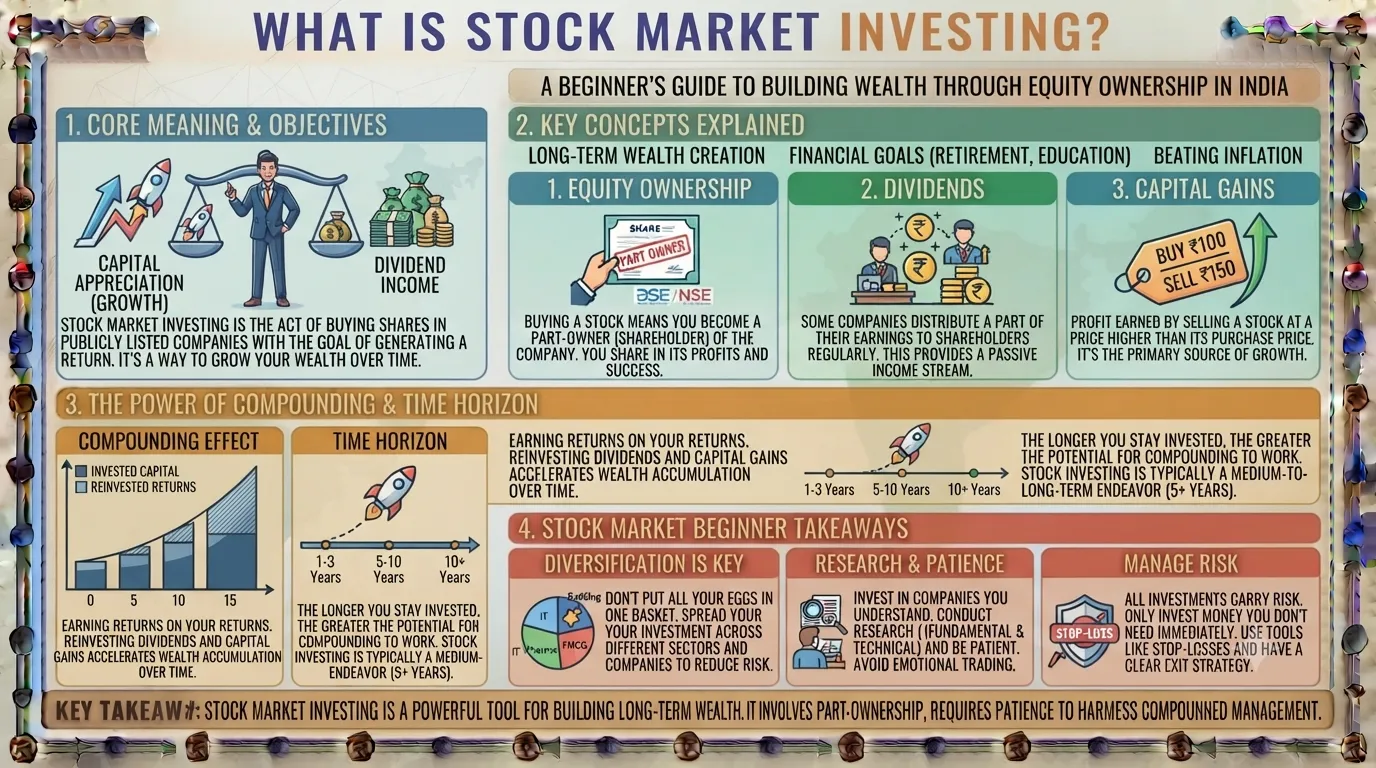
What Is Stock Market Investing? A Complete Beginner's Guide to India
Stock market investing is one way individuals can participate in the growth of businesses and potentially build wealth over time. However, buying shares is not simply about purchasing a stock when its price is low and selling it when the price rises. Successful investing requires understanding the businesses behind shares, evaluating their financial performance, managing risk and making decisions based on clearly defined financial goals.
In India, investors can participate in the stock market through exchanges such as the National Stock Exchange (NSE) and the Bombay Stock Exchange (BSE). They can purchase individual company shares, invest through mutual funds and exchange-traded funds (ETFs), or access other securities available in the market.
For beginners, the most important starting point is understanding what they are investing in, how the market operates and what risks they are accepting.
What Is Stock Market Investing?
Stock market investing means purchasing shares or other market-linked securities with the objective of generating returns over time. When an investor purchases an equity share of a company, they acquire a proportional ownership interest in that business.
For example, suppose a publicly listed Indian company has 10 crore outstanding equity shares. An investor purchases 1,000 shares. Ignoring differences between share classes and other corporate arrangements, the investor owns a very small proportional interest in that company.
If the business grows, increases its profitability and attracts investor demand, its share price may appreciate. The shareholder may also receive dividends if the company declares them. However, neither capital appreciation nor dividend income is guaranteed.
Stock market investing generally involves three important elements:
- Ownership: Buying equity shares gives investors an ownership interest in a company.
- Potential returns: Investors may benefit from capital appreciation and dividends.
- Risk: Share prices can decline, companies can underperform and investors can lose part or all of their invested capital.
How Does Stock Market Investing Work in India?
The Indian stock market operates through a regulated electronic marketplace where buyers and sellers place orders to purchase or sell securities. Stock exchanges facilitate the matching of these orders, while brokers, clearing corporations and depositories support the transaction process.
1. Companies issue shares to raise capital
Companies require money to expand operations, develop products, repay debt, invest in infrastructure or pursue other business objectives. One way to raise capital is by issuing shares to investors.
When a company offers shares to the public for the first time, it may conduct an Initial Public Offering (IPO). Investors who receive shares through an IPO become shareholders of the company.
2. Investors buy and sell shares through stock exchanges
After listing, shares can be purchased and sold in the secondary market. Investors generally access this market through a stockbroker connected to an exchange such as NSE or BSE.
For example, suppose an investor wants to purchase shares of an Indian listed company. The investor places a buy order through a broker. The broker routes the order to the exchange, where the exchange's order-matching system attempts to match it with a suitable seller.
The transaction is completed when compatible buy and sell orders are matched.
3. Shares are held electronically
After the applicable settlement process, purchased securities are credited to the investor's Demat account. A Demat account stores securities in electronic form.
4. Share prices change according to market conditions
Share prices are influenced by demand and supply, company earnings, future expectations, economic conditions, interest rates, industry developments and investor sentiment.
For example, a company reporting higher profits may attract buying interest. However, its share price may still fall if investors expected even stronger results or if future business guidance disappoints.
This is why investors must examine both actual company performance and what the market already expects.
Primary Market vs Secondary Market
Investors generally encounter two important segments when participating in the stock market.
| Basis | Primary Market | Secondary Market |
|---|---|---|
| Meaning | Companies issue securities to raise capital. | Investors buy and sell already-issued securities. |
| Transaction | Investors subscribe to a new issue. | Buyers purchase securities from existing holders. |
| Example | Applying for an IPO. | Buying listed shares through NSE or BSE. |
| Who receives the money? | The issuing company receives the proceeds, subject to the issue structure. | The selling investor receives the sale proceeds, subject to charges and settlement. |
An important distinction is that buying an existing listed share in the secondary market generally does not directly provide fresh capital to the company. It transfers ownership between investors.
What Are the Different Types of Stock Market Investments?
The securities market provides access to several financial instruments. They have different return structures, ownership characteristics, liquidity conditions and risk levels.
1. Equity Shares
Equity shares represent ownership in a company. Investors may benefit from an increase in the market value of their shares and dividends declared by the company.
However, equity shareholders face business risks, market volatility, valuation risks and the possibility of capital loss.
2. Mutual Funds
A mutual fund collects money from multiple investors and invests it in a portfolio of securities according to its investment objective.
Depending on the scheme, a mutual fund may invest in equities, bonds, money-market instruments or a combination of assets.
Mutual funds allow investors to access diversified portfolios without independently selecting every security. However, diversification does not eliminate market risk, and fund expenses can affect returns.
3. Index Funds
An index fund attempts to replicate the performance of a selected market index, such as the Nifty 50, subject to tracking differences and expenses.
Instead of selecting individual companies, an investor gains exposure to the securities represented in the index.
4. Exchange-Traded Funds (ETFs)
ETFs are investment funds whose units trade on stock exchanges. They may track an equity index, bond index, commodity or another underlying asset.
Unlike conventional open-ended mutual fund transactions, ETF units are bought and sold on the exchange during trading hours. Investors should consider liquidity, bid-ask spreads, tracking differences and costs.
5. Bonds
Bonds are debt instruments through which governments or companies borrow money from investors. Bondholders may receive interest payments according to the bond's terms.
Important risks include issuer default, interest-rate movements, credit deterioration and liquidity constraints. The repayment of principal depends on the issuer meeting its obligations.
6. REITs and InvITs
Real Estate Investment Trusts (REITs) and Infrastructure Investment Trusts (InvITs) provide investors with exposure to income-generating real estate and infrastructure assets through listed or otherwise regulated investment structures.
Their returns depend on asset performance, distributions, financing conditions, occupancy or usage levels, regulation and market valuations.
7. Derivatives: Futures and Options
Derivatives are contracts whose value depends on an underlying asset, index or other reference.
Futures create contractual obligations, while options provide the buyer with a right but not an obligation, subject to the contract terms. Derivatives can be used for hedging and speculation, but leverage, expiry, margin requirements and complex pricing can create substantial losses.
Derivatives should not be treated as ordinary long-term share investments. Beginners should understand their risks before considering participation.
Investing vs Trading: What Is the Difference?
Investing and trading both involve buying and selling financial instruments, but their objectives, holding periods and decision-making approaches differ.
| Basis | Investing | Trading |
|---|---|---|
| Main objective | Potential long-term wealth creation. | Profit from shorter-term price movements. |
| Holding period | Generally months or years. | Seconds, minutes, days or weeks, depending on strategy. |
| Analysis | Business performance, valuation and financial health. | Price action, market structure, technical analysis and catalysts. |
| Decision frequency | Usually lower. | Usually higher. |
| Major risks | Business deterioration, valuation and market risk. | Volatility, leverage, execution costs and rapid losses. |
| Typical approach | Portfolio construction and periodic review. | Entry, exit and position-risk management. |
For example, an investor may purchase shares after studying a company's business model, competitive position and financial performance, intending to hold them for several years.
A trader may purchase the same shares because a short-term price pattern suggests a potential movement over the next few sessions.
Neither approach guarantees profits. The appropriate approach depends on financial objectives, knowledge, time availability, risk capacity and the individual's ability to follow a consistent process.
How Can Investors Earn Money From the Stock Market?
Stock market investors may generate returns through multiple sources.
1. Capital Appreciation
Capital appreciation occurs when the market value of an investment increases.
Hypothetical example:
- Purchase price per share: ₹200
- Number of shares purchased: 50
- Total purchase value: ₹10,000
- Later selling price per share: ₹260
- Total selling value: ₹13,000
Gross capital gain:
₹13,000 − ₹10,000 = ₹3,000
Gross percentage return:
(₹3,000 ÷ ₹10,000) × 100 = 30%
This example excludes brokerage, taxes, statutory charges and other transaction costs. It also assumes that all 50 shares are sold at ₹260.
2. Dividend Income
Some companies distribute a portion of their profits or reserves to eligible shareholders in the form of dividends.
Hypothetical example: If a company declares a dividend of ₹5 per share and an investor holds 100 eligible shares on the relevant record date, the gross dividend entitlement would be ₹500, subject to applicable tax and payment rules.
Companies are not obligated to distribute dividends every year. They may retain earnings for business expansion, debt repayment or other corporate requirements.
3. Compounding Over Time
Compounding occurs when investment returns remain invested and can generate additional returns in subsequent periods.
Consider a hypothetical investment of ₹50,000 growing at an assumed annual rate of 10%, compounded annually, with no additional contributions, withdrawals, fees or taxes.
Future value formula:
FV = P × (1 + r)n
Where:
- P = Initial investment
- r = Annual rate of return
- n = Number of years
After 10 years:
₹50,000 × (1.10)10 ≈ ₹1,29,687
This is a mathematical illustration, not a prediction or guaranteed stock market return. Actual equity returns fluctuate and may be negative.
How to Start Stock Market Investing in India: Step-by-Step
Starting to invest requires more than downloading a trading application. Investors should first understand their financial position, choose suitable investment instruments and complete the required account-opening procedures.
Step 1: Define Your Financial Goals
Determine why you want to invest. Your objective could be long-term wealth creation, retirement planning, funding education or another financial requirement.
Also decide when you may need the money. An investment intended for a long-term goal may be unsuitable for money needed in the immediate future.
Step 2: Understand Your Risk Capacity
Risk capacity refers to your financial ability to withstand losses. Risk tolerance describes your willingness to accept fluctuations in investment value.
These are related but different concepts. An investor may be emotionally comfortable with volatility but financially unable to tolerate a substantial loss.
Consider your income stability, outstanding debt, emergency savings, financial obligations and investment horizon before committing money.
Step 3: Complete the Required Financial Preparation
Do not use borrowed money or essential household funds for speculative investments. Maintain an appropriate emergency reserve and address high-interest debt before taking unnecessary market exposure.
Money required for near-term expenses should generally not be exposed to substantial equity-market volatility.
Step 4: Open a Demat and Trading Account
For direct investment in listed equity shares, investors generally require:
- Demat account: Holds securities in electronic form.
- Trading account: Allows investors to place buy and sell orders through a stockbroker.
- Bank account: Supports payments and receipt of funds.
In India, NSDL and CDSL are the two depositories. Depository Participants provide investors with access to depository services.
Complete the applicable KYC requirements and choose an appropriately registered intermediary. A Demat account is not necessarily required for every form of mutual fund investment, as investors can also transact directly through applicable mutual fund channels.
Step 5: Select an Appropriate Investment Instrument
Investors can consider individual shares, diversified mutual funds, index funds, ETFs and other eligible securities.
Direct stock selection requires an understanding of individual businesses and their financial risks. Pooled investments may provide diversification but still carry risks associated with their underlying assets.
Step 6: Research Before Purchasing
Before investing in an individual company, examine its business model, financial statements, debt, profitability, cash flow, competitive position, management quality and valuation.
Do not purchase a stock merely because it is popular, has recently risen or is being discussed on social media.
Step 7: Place Your First Investment
Once you understand the security, costs and risks, place an order through your chosen intermediary.
Check the company name, exchange, quantity, order type and price before confirming the transaction.
Step 8: Monitor and Review Your Portfolio
Review your investments periodically against your original goals and investment thesis.
Monitor important changes in business performance, debt, management, valuation and industry conditions. Avoid reacting to every short-term price fluctuation without understanding its cause.
How to Evaluate a Stock Before Investing
Choosing a company requires examining the underlying business rather than focusing exclusively on its share price.
1. Understand the Business Model
Find out what the company sells, who its customers are, how it earns revenue and what factors influence its operating costs.
If you cannot explain how a company makes money, you may not understand its investment risks sufficiently.
2. Examine Revenue and Profit Growth
Review the company's financial performance across multiple reporting periods. Check whether revenue growth is supported by sustainable business demand and whether profitability is improving.
Revenue growth alone is not enough. Rising expenses, declining margins or poor cash conversion may weaken the quality of earnings.
3. Check Debt and Financial Stability
Examine outstanding borrowings, interest expenses, repayment obligations and available cash.
High debt can become a significant problem when revenue declines, interest costs increase or the company struggles to generate sufficient operating cash flow.
4. Analyse Cash Flow
Operating cash flow helps investors understand how much cash the business generates through its normal activities.
Compare operating cash flow with reported profits. A company consistently reporting profits without corresponding cash generation deserves closer examination.
5. Understand Valuation
A good company is not automatically a good investment at every price.
Investors commonly examine financial ratios such as:
- Price-to-Earnings (P/E): Compares market price per share with earnings per share.
- Price-to-Book (P/B): Compares market value with accounting book value.
- Return on Equity (ROE): Measures profitability relative to shareholders' equity.
- Return on Capital Employed (ROCE): Measures operating profitability relative to capital employed.
- Debt-to-Equity: Compares a company's debt with its shareholders' equity.
No single ratio can establish whether a stock is attractive. Ratios should be interpreted in the context of industry characteristics, accounting quality, business growth and valuation assumptions.
6. Examine Management and Corporate Governance
Review management disclosures, related-party transactions, promoter share pledging, auditor observations, regulatory disclosures and the company's history of capital allocation.
Weak corporate governance can create risks even when reported financial performance initially appears strong.
What Are the Benefits of Stock Market Investing?
Potential Long-Term Wealth Creation
Equity investments provide an opportunity to participate in the growth of businesses. Companies that successfully expand their operations and profitability may create value for shareholders.
Ownership in Businesses
Shareholders acquire an ownership interest in listed companies and may receive eligible corporate benefits, including dividends and certain voting rights.
Liquidity
Shares listed on active exchanges can generally be bought and sold during market trading sessions. However, liquidity varies considerably across securities, and selling may become difficult or expensive in illiquid markets.
Access to Multiple Industries
Investors can obtain exposure to sectors such as banking, technology, healthcare, manufacturing, energy and consumer businesses.
Flexible Investment Amounts
Direct equity investments can begin with the market price of an eligible whole share, excluding applicable charges. Mutual funds and other products may offer different investment minimums depending on the scheme.
Risks and Limitations of Stock Market Investing
Stock market investing carries several risks. Understanding these risks is essential before committing capital.
1. Market Risk
Broad market declines caused by economic uncertainty, global developments, interest-rate changes or investor sentiment can reduce the value of many investments simultaneously.
2. Business Risk
A company may experience declining demand, increasing competition, operational failures, financial difficulties or management problems. These developments can negatively affect its share price.
3. Valuation Risk
Investors may pay too much for a company relative to its actual earnings, cash flow and future growth potential. Even a fundamentally strong business can deliver disappointing investment returns when purchased at an excessive valuation.
4. Liquidity Risk
Some shares have limited trading activity. Investors may not be able to sell their holdings quickly at the expected price.
5. Inflation Risk
Investment returns should be considered after accounting for inflation. A positive nominal return does not necessarily mean purchasing power has increased.
6. Behavioural Risk
Fear, greed, overconfidence, herd behaviour and panic selling can lead investors to make decisions that conflict with their original investment plans.
7. Regulatory and Fraud Risks
Investors may encounter misleading promotions, impersonation scams, unregistered intermediaries and fraudulent schemes. Verify the registration and legitimacy of intermediaries, read official disclosures and avoid guaranteed-return promises.
Common Stock Market Investing Mistakes Beginners Should Avoid
- Buying based on tips: Social media recommendations are not a substitute for independent research.
- Ignoring valuation: A rapidly growing business may already be priced for unrealistic future performance.
- Investing emergency money: Market volatility can force investors to sell at an unfavourable time.
- Concentrating investments: Putting too much capital into one company or sector increases concentration risk.
- Confusing price with value: A low share price does not necessarily mean a stock is undervalued.
- Ignoring costs and taxes: Brokerage, statutory charges, fund expenses and applicable taxes affect net returns.
- Overreacting to daily news: Short-term price movements do not always indicate a change in long-term business prospects.
- Expecting guaranteed returns: No legitimate equity investment can promise risk-free profits.
Stock Market Investing in India: Important Institutions
India's securities market depends on several institutions that support regulation, trading, settlement, investor protection and securities ownership.
| Institution | Role |
|---|---|
| SEBI | Regulates India's securities market and works to protect investor interests. |
| NSE | Operates a recognised stock exchange and facilitates securities trading. |
| BSE | Operates a recognised stock exchange and facilitates securities trading. |
| NSDL | Provides depository services for holding and transferring securities electronically. |
| CDSL | Provides depository services for holding and transferring securities electronically. |
| Stockbrokers | Provide access to exchanges and facilitate client transactions. |
Understanding these institutions helps investors distinguish between the organisation regulating the market, the exchange executing trades and the depository maintaining electronic securities records.
How Should Beginners Build a Responsible Investment Approach?
A disciplined investment process is more useful than continuously searching for the next stock that might rise quickly.
- Define your financial goals and investment horizon.
- Maintain emergency savings and manage high-interest debt.
- Understand the risk characteristics of the investment instrument.
- Start with an investment amount that is financially manageable.
- Study companies and investment products before purchasing them.
- Diversify appropriately instead of concentrating all capital in a few holdings.
- Review the portfolio periodically rather than reacting to every market movement.
- Keep records of transactions, charges, statements and investment decisions.
- Use official disclosures and credible financial information.
- Seek professional advice from an appropriately SEBI-registered investment adviser when necessary.
Investors should also remember that diversification reduces certain concentration risks but cannot eliminate losses during broad market declines.
Frequently Asked Questions About Stock Market Investing
1. What is stock market investing in simple words?
Stock market investing means purchasing shares or other securities to potentially earn returns over time. Buying an equity share gives an investor an ownership interest in a company. Returns may come from capital appreciation and dividends, but losses are also possible.
2. How much money do I need to start investing in the stock market in India?
There is no single minimum amount for all stock market investments. For direct equity purchases, the required amount depends on the price and quantity of shares purchased, along with transaction charges. Mutual funds have scheme-specific minimum investment requirements.
3. Is stock market investing suitable for beginners?
Beginners can participate in the stock market after understanding investment products, risks, financial goals and basic market operations. Diversified investment products may be worth studying before attempting individual stock selection.
4. What is the difference between stock market investing and trading?
Investing generally focuses on longer-term ownership and potential business growth, while trading focuses on shorter-term price movements. Their holding periods, strategies and risk profiles differ.
5. Can I lose money in stock market investing?
Yes. Share prices can decline because of company-specific problems, economic conditions, market corrections and changing investor expectations. Investors may lose part or all of the money invested in an individual company.
6. Do I need a Demat account to invest in stocks?
For direct investment in listed equity shares in India, a Demat account is generally required to hold the shares electronically. Investors also need an appropriate trading account and a bank account. Some mutual fund investments can be made without a Demat account.
7. What is the safest way for beginners to invest in the stock market?
There is no completely risk-free equity investment. Beginners can study diversified index funds and mutual funds as alternatives to selecting individual shares. They should evaluate the fund's investment objective, costs, risks and suitability before investing.
8. How long should I hold stock market investments?
The holding period should depend on the financial goal, investment instrument, valuation and underlying investment thesis. Equity investing is generally more appropriate for money that can remain invested over a longer horizon, but a longer holding period does not guarantee positive returns.
Conclusion
Stock market investing allows individuals to participate in the ownership and potential growth of businesses through equity shares and other market-linked instruments. In India, investors can access this market through NSE, BSE, registered intermediaries and regulated investment products.
However, successful investing requires more than opening an account and purchasing shares. Investors need to understand business performance, valuation, market conditions, transaction costs and the risks associated with their chosen securities.
For beginners, the sensible starting point is to define financial goals, understand risk capacity, learn how different investment instruments work and develop a disciplined research process. Decisions should be based on verified information rather than market rumours, guaranteed-return claims or short-term excitement.
The objective should be to make informed financial decisions, not to chase quick profits.
Educational Disclaimer: This article is intended solely for educational and informational purposes. It does not constitute investment advice, research recommendations or a recommendation to buy or sell any security. Securities market investments are subject to market risks. Past performance does not guarantee future results. Readers should examine relevant official disclosures and consider consulting a SEBI-registered investment adviser before making investment decisions.