What Is Return on Capital Employed (ROCE)? Formula, Calculation and Meaning
Understand Return on Capital Employed (ROCE), its formula, calculation and interpretation. Learn how Indian investors can use ROCE to assess business profitability, capital efficiency and financial performance.
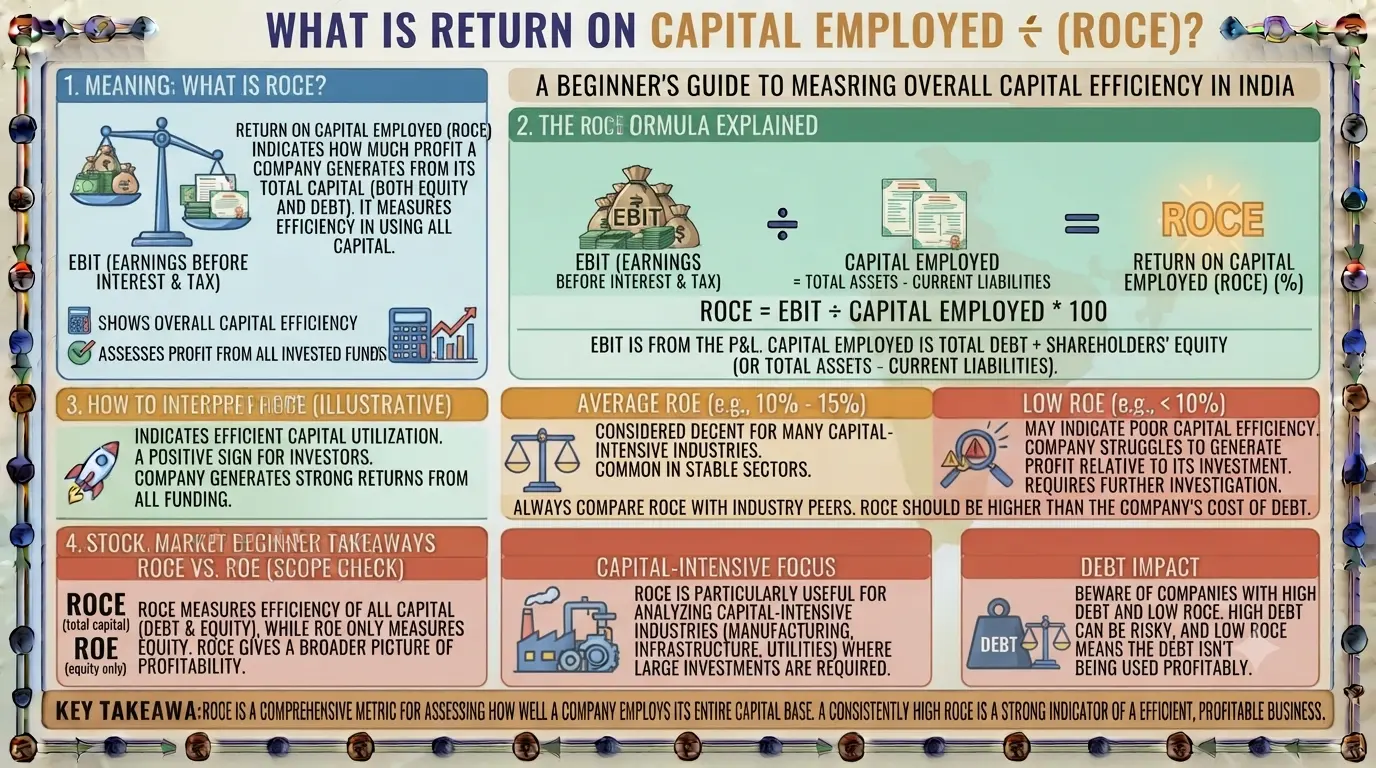
What Is Return on Capital Employed (ROCE)?
Return on Capital Employed (ROCE) is a profitability ratio that measures how efficiently a company uses the capital invested in its business to generate operating profit. It compares earnings before interest and tax (EBIT) with the capital employed to run the business.
ROCE = EBIT ÷ Average Capital Employed × 100
A ROCE of 18% means the company generated ₹18 in EBIT for every ₹100 of average capital employed during the period. It is a measure of business and capital efficiency, not the return an investor personally earns on a stock.
Why ROCE Matters
A company needs money to buy equipment, build factories, maintain inventory, fund receivables and support daily operations. That money may come from shareholders, lenders or other long-term funding sources. ROCE assesses the operating profit generated in relation to this capital base.
It is especially useful when comparing companies that use significant capital, such as manufacturers, infrastructure businesses, utilities, telecom operators and transport companies. It can also help investors assess whether management is generating better operating returns from the resources entrusted to the business.
ROCE Formula
The commonly used formula is:
ROCE (%) = EBIT ÷ Capital Employed × 100
For a period-based analysis, average capital employed is generally more representative:
Average Capital Employed = (Opening Capital Employed + Closing Capital Employed) ÷ 2
ROCE (%) = EBIT for the period ÷ Average Capital Employed × 100
EBIT means earnings before interest and tax. It is profit before deducting finance costs and income-tax expense. In a simple presentation, EBIT may be derived as profit before tax plus finance costs, subject to adjustments for non-operating income, exceptional items and the analyst's chosen definition.
Capital employed represents the funds committed to the business. Two commonly used balance-sheet approaches are:
- Capital Employed = Total Assets − Current Liabilities
- Capital Employed = Shareholders' Equity + Long-term Debt (or a clearly defined broader funding base)
These approaches are not automatically identical in every company's reporting presentation. Analysts may include current borrowings, lease liabilities, deferred tax liabilities or deduct surplus cash, depending on the stated methodology. Some company disclosures use year-end capital rather than an average. There is no single universally applied ROCE definition across every data provider and company disclosure. Always inspect the calculation notes and use the same method when comparing companies or years.
How to Calculate ROCE: A Hypothetical Indian Example
Assume an imaginary Indian manufacturing company reports EBIT of ₹240 crore for FY2025–26. Its capital employed was ₹1,400 crore at the beginning of the year and ₹1,600 crore at the end.
Step 1: Calculate Average Capital Employed
(₹1,400 crore + ₹1,600 crore) ÷ 2 = ₹1,500 crore.
Step 2: Divide EBIT by Average Capital Employed
₹240 crore ÷ ₹1,500 crore = 0.16.
Step 3: Convert the Result into a Percentage
0.16 × 100 = 16%.
The company's ROCE is 16%. In this example, it generated ₹16 of EBIT for every ₹100 of average capital employed during the year. The example is hypothetical and does not describe an actual listed company.
Why Average Capital Employed Is Useful
EBIT is earned over an entire financial year, while the balance sheet reports capital at a particular date. Using only closing capital can distort the ratio if a company raises debt, issues shares, sells assets or completes a major project near year-end. Averaging opening and closing balances better matches the capital base with the period's earnings.
An average of two dates is still an approximation. If capital changes sharply during the year, quarterly or monthly average balances may provide a more representative denominator, if reliable data is available.
What Is a Good ROCE?
There is no universal percentage that makes every company attractive. A 15% ROCE may be strong in one capital-intensive industry but ordinary or weak in another. Compare a company with similar businesses, its own history and the returns available from alternative uses of capital.
A useful starting point is to examine whether ROCE is consistently above the company's estimated cost of capital. That comparison is not a mechanical buy signal: cost of capital is an estimate, risk changes over time, and accounting ROCE is not identical to a discounted-cash-flow return. A sustained spread between ROCE and the cost of capital can indicate value creation, while a persistent shortfall may suggest that capital is not earning enough to compensate its providers.
High ROCE can indicate strong margins, efficient asset use, a capital-light model or a competitive advantage. But check how it was achieved. A very high ratio may reflect old assets carried at low book values, unusually low working capital, a temporary profit spike, asset sales or a shrinking capital base.
Low or falling ROCE may indicate weak margins, underused factories, rising costs, poor working-capital control, heavy investment before new capacity becomes productive or a difficult industry cycle. It is a prompt to investigate, not proof of poor management.
ROCE and the Capital-Efficiency Drivers
ROCE can be decomposed into operating profit margin and capital turnover when both use consistent definitions:
ROCE = (EBIT ÷ Revenue) × (Revenue ÷ Average Capital Employed)
The first component, EBIT margin, shows how much operating profit the company earns from each rupee of revenue. The second, capital turnover, shows how much revenue it generates from each rupee of capital employed.
For example, a business can improve ROCE by increasing prices or controlling operating costs, which may lift its EBIT margin. It can also improve capital turnover by using factories more productively, reducing excess inventory, collecting receivables faster or generating more sales from existing assets.
This breakdown helps explain whether a change in ROCE comes from better profitability, more efficient use of capital, or both. Growth that requires disproportionately large capital investment may not improve ROCE.
ROCE vs ROE vs ROA vs ROIC
ROCE, return on equity (ROE), return on assets (ROA) and return on invested capital (ROIC) are related but answer different questions.
- ROCE compares EBIT with capital employed, generally covering equity and debt funding. It focuses on operating profit before interest and tax.
- ROE compares profit attributable to equity shareholders with shareholders' equity. It measures the accounting return generated on the equity base and is affected by leverage.
- ROA compares net income with total assets, although some analysts use operating profit or average assets depending on purpose. It assesses profit relative to the asset base.
- ROIC generally compares after-tax operating profit (NOPAT) with invested capital. Its definitions of invested capital and operating adjustments can differ by analyst.
ROCE is useful when assessing operating returns on a broad capital base. ROE is more directly about the accounting return on shareholders' funds. ROA focuses on assets, while ROIC often aims to estimate returns on capital invested in core operations after tax. Do not compare the percentages without checking numerator and denominator definitions.
How Debt Affects ROCE
Because ROCE uses EBIT, interest expense is not deducted from the numerator. Borrowing therefore does not automatically reduce EBIT. Debt may finance productive assets and help a company expand, but it also creates fixed repayment and interest obligations.
If borrowed funds generate operating returns above their cost, the investment may improve business economics. If projects underperform, the company can be left with interest costs, refinancing risk and underutilised assets. ROCE alone does not show whether debt is manageable. Review debt levels, interest coverage, maturity schedules, cash flows and liquidity alongside it.
A company with high ROCE and modest debt may have a different risk profile from one reporting the same ROCE with heavy borrowing. Also verify whether the capital-employed denominator includes all relevant borrowings and lease liabilities.
Limitations of ROCE
ROCE is based on accounting figures and can be affected by accounting policies, asset age, depreciation methods, acquisitions, impairments and revaluation. Older assets may have low carrying values, making the denominator smaller and ROCE appear higher even if the underlying physical assets have not become more productive.
The ratio may be distorted by one-off gains, non-operating income, exceptional expenses or unusual working-capital balances. Cash-rich companies may show lower ROCE if excess cash is included in capital employed but does not contribute much operating profit. Some analysts adjust for surplus cash, but such adjustments must be transparent and consistent.
ROCE can also be difficult to interpret for companies with negative or very small capital employed, major restructuring, volatile commodity cycles or rapidly expanding capacity. A single year's ratio can be misleading. It does not measure valuation, cash conversion, governance quality, competitive durability or the price an investor pays for the shares.
Sector Considerations for Indian Investors
Manufacturing and Automobile Companies
For manufacturing and automobile businesses, examine capacity utilisation, plant investment, depreciation, inventory and receivable cycles. New factories may depress ROCE initially because capital is invested before full production and sales arrive.
Infrastructure, Power and Telecom
For infrastructure, power and telecom companies, long project lives, regulation, leverage and concession structures matter. Compare businesses with similar asset ownership, tariff frameworks and project stages. A construction phase can temporarily reduce returns.
IT and Asset-Light Businesses
For IT and other asset-light services, ROCE may be high because the business needs relatively little physical capital. That does not automatically make it superior to a manufacturer: the business models, margins, human-capital requirements and accounting treatment differ.
Banks and Financial Institutions
Banks and many financial institutions require special care. Deposits and borrowings are part of their operating model, so the usual industrial-company interpretation of capital employed and EBIT may not be comparable. Investors commonly examine return on assets, return on equity, net interest margin, asset quality, provisioning and capital adequacy for banks. Use sector-appropriate measures rather than treating a bank's ROCE as directly comparable with a manufacturer's.
How Investors Can Use ROCE When Analysing Indian Stocks
Start with audited annual reports and exchange-filed financial statements. Review the income statement for operating profit or EBIT and the balance sheet for the components used in capital employed. Read the company's ratio definitions and notes rather than assuming a screener uses the same formula as another provider.
Then:
- Calculate ROCE across several financial years using a consistent method.
- Compare the company with listed peers operating in similar segments.
- Review EBIT margin and capital turnover to identify the drivers.
- Check debt, interest coverage, operating cash flow and working-capital movements.
- Identify acquisitions, asset sales, new plants, impairments and exceptional items.
- Compare ROCE with an estimated cost of capital, while recognising the uncertainty in that estimate.
- Review valuation separately. A high-quality business can still be overpriced.
Use consolidated or standalone financial statements consistently. If the business has material subsidiaries, consolidated figures may better represent the group, but compare like with like. Also check whether minority interests, lease liabilities, cash balances and non-operating assets are treated consistently.
For a broader stock-research framework, read TradeSensi's Stocks to Watch: 5 Things to Check Before Investing.
Common Mistakes When Interpreting ROCE
- Treating a high ROCE as an automatic buy signal: ROCE does not tell you whether the share price is reasonable.
- Comparing different industries: asset intensity, margins and working-capital needs vary widely.
- Ignoring the denominator: a falling capital base can raise ROCE even when operating profit is flat.
- Using EBITDA instead of EBIT without labelling the change: EBITDA excludes depreciation and amortisation, so it is not the same numerator.
- Ignoring debt and cash flow: a ratio cannot replace solvency and cash-conversion analysis.
- Mixing formulas: comparing one company's EBIT divided by average capital with another's EBIT divided by closing capital can produce misleading conclusions.
- Using one year only: cyclicality and investment timing can change the ratio substantially.
Frequently Asked Questions About ROCE
What Does ROCE Stand For?
ROCE stands for Return on Capital Employed. It is a profitability ratio used to assess how efficiently a company generates operating profit from the capital used in its business.
What Is the Formula for ROCE?
A commonly used formula is EBIT divided by capital employed, multiplied by 100. For period analysis, many analysts use average capital employed: EBIT ÷ average capital employed × 100.
What Does a 20% ROCE Mean?
It means the company generated ₹20 of EBIT for every ₹100 of capital employed under the calculation method used. It does not mean shareholders earned a 20% stock return.
Is a Higher ROCE Always Better?
Not necessarily. A high ROCE can be affected by old assets, one-off gains or a small capital base. Review its sustainability, cash flow, debt, business risks and valuation.
What Is a Good ROCE for Indian Stocks?
There is no single benchmark for all Indian stocks. Compare the company with similar listed peers and its own long-term history, and consider the industry's capital intensity and cost of capital.
What Is the Difference Between ROCE and ROE?
ROCE compares EBIT with capital employed, generally covering debt and equity. ROE compares profit attributable to equity shareholders with shareholders' equity. ROCE focuses on operating returns across capital providers, while ROE focuses on the equity base.
Does ROCE Include Debt?
The capital-employed denominator generally includes debt as well as equity, although the exact definition varies. EBIT is measured before interest, so the ratio evaluates operating profit before financing costs.
Why Is Average Capital Employed Used?
Because EBIT is earned over a period but capital employed is reported at a point in time. Averaging opening and closing balances can better reflect the capital used throughout the year, especially when it changes.
Conclusion
ROCE helps investors understand how effectively a company converts the capital committed to its operations into operating profit. Its greatest value comes from consistent multi-year analysis, peer comparisons and understanding the drivers behind the ratio—not from treating one percentage as a verdict.
Before drawing conclusions, verify the formula used, study EBIT margin and capital turnover, and assess debt, cash flow, investment plans and valuation. ROCE is a useful part of fundamental analysis, but it should always be read alongside the full financial statements and other relevant measures.
Educational disclaimer: This article is for general educational purposes only. It is not investment advice, a recommendation to buy or sell any security, or a guarantee of returns. Financial ratios have limitations and may be calculated differently by companies and data providers. Review official disclosures and consider your financial circumstances and risk tolerance before making investment decisions.