What Is Portfolio Diversification? Meaning, Benefits, Types and Examples
Learn what portfolio diversification means, how spreading investments across assets and sectors can help manage risk, and how Indian investors can build and maintain a diversified portfolio.
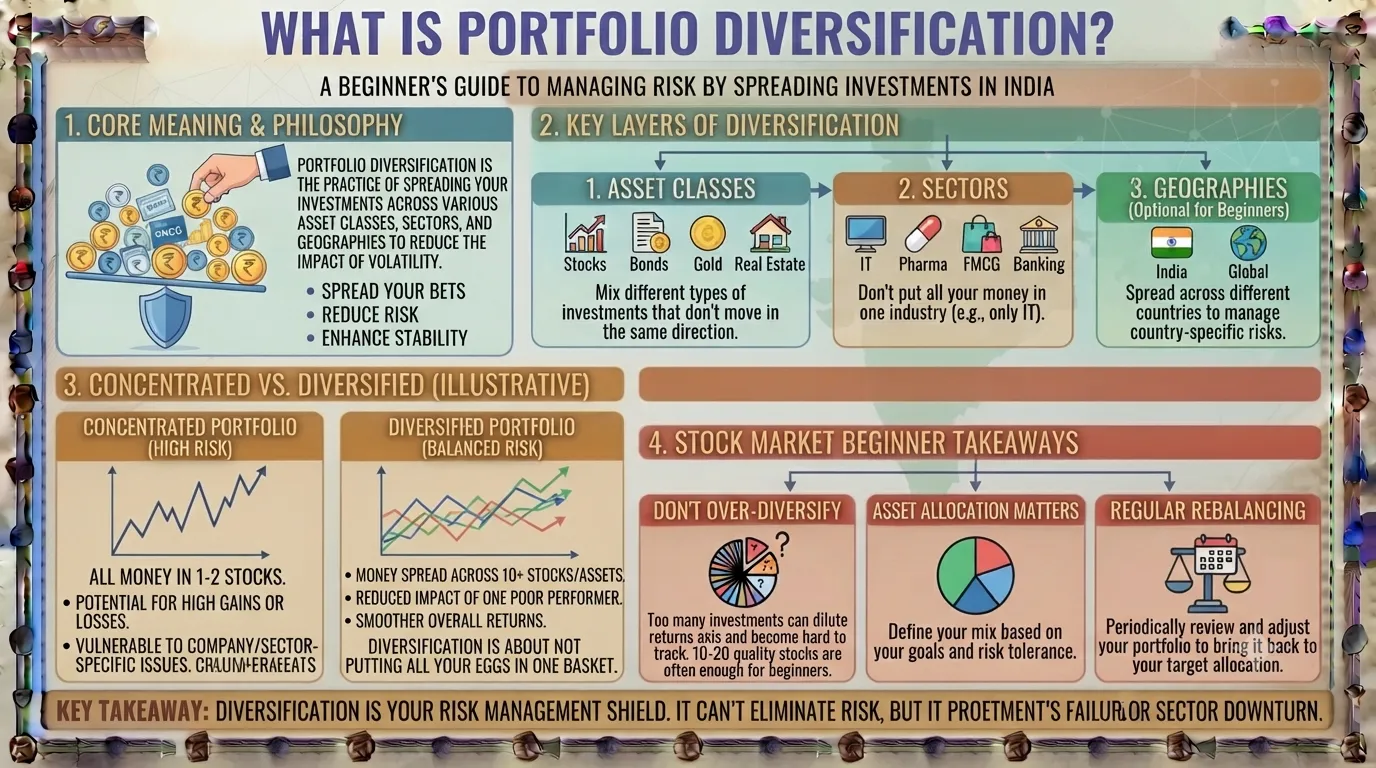
What Is Portfolio Diversification? Meaning, Benefits, Types and Examples
Portfolio diversification is an investment strategy in which you spread your money across different investments, asset classes, industries, companies or geographical markets instead of depending heavily on a single investment. The purpose is to reduce the impact that poor performance in one holding or market segment can have on your overall portfolio.
For example, an investor who puts all their money into shares of one banking company is exposed to that company's business and sector risks. An investor who spreads money across banking, healthcare, consumer goods, government securities and other suitable assets is exposed to a wider range of return drivers. If one part performs poorly, other holdings may help offset some of the impact.
However, diversification does not guarantee profits, prevent every loss or make an unsuitable investment safe. Its effectiveness depends on what you own, how those investments behave in relation to one another, how much you allocate to each and whether the mix matches your financial goals and risk tolerance.
What Does Portfolio Diversification Mean?
A portfolio is the collection of investments held by an individual or institution. It may include shares, mutual funds, exchange-traded funds (ETFs), bonds, fixed deposits, gold and other financial or real assets.
Diversification means distributing that portfolio across investments that do not all depend on the same company, sector, economic factor or market condition. The aim is to avoid a situation where one adverse event causes a disproportionately large loss to the entire portfolio.
Consider two hypothetical investors:
- Investor A: Invests ₹5,00,000 entirely in shares of one company.
- Investor B: Invests ₹5,00,000 across several companies in different industries and also holds suitable debt investments and cash reserves.
If the first company's share price falls sharply, Investor A's entire equity investment is affected. Investor B may also experience losses, particularly if the wider market declines, but the effect of one company's problem may be smaller because the portfolio is not dependent on that single holding.
The example illustrates the principle, not a guaranteed outcome. A diversified portfolio can still lose value when several holdings fall together.
Why Is Portfolio Diversification Important?
Investments are exposed to different risks. A company's earnings may weaken, an industry may face regulation, interest rates may change, inflation may rise, or a broad market decline may affect many securities at once.
When a portfolio is concentrated, a single company, sector or economic event can have an unusually large effect on its value. Diversification reduces dependence on any one source of return or risk.
It can help investors:
- Reduce company-specific concentration risk.
- Limit excessive exposure to one industry or market segment.
- Spread investments across different asset classes.
- Manage portfolio volatility when holdings respond differently to market conditions.
- Build an investment mix that reflects financial goals and time horizon.
- Avoid making the entire financial plan dependent on one stock or investment theme.
Diversification is a risk-management approach. It is not a method for predicting which asset will perform best or for eliminating market risk.
How Does Portfolio Diversification Work?
Diversification works by combining investments whose prices or returns do not move in exactly the same way at the same time. This relationship is commonly discussed through a concept called correlation.
Understanding Correlation
Correlation measures how two investments move in relation to each other. It is commonly expressed between -1 and +1:
- Positive correlation: Two investments tend to move in the same direction.
- Negative correlation: Two investments tend to move in opposite directions.
- Low or near-zero correlation: Their movements show little consistent relationship.
For example, two companies operating in the same industry may be affected by similar economic conditions. Their share prices may therefore move in similar directions. Holding both does not necessarily provide as much diversification as holding companies from unrelated industries.
By contrast, different asset classes may respond differently to interest rates, inflation, economic growth or market stress. Combining them may reduce the extent to which the entire portfolio moves in one direction.
Correlation is not fixed. Relationships between assets can change over time, and investments that appeared to behave differently in normal conditions may fall together during a severe market shock.
Why the Number of Investments Is Not Enough
Owning many investments does not automatically make a portfolio diversified. If most holdings are exposed to the same underlying risk, the portfolio may remain concentrated.
For instance, owning ten banking stocks gives exposure to ten companies, but all ten are still exposed to many common banking-sector factors. Adding a healthcare company, a consumer business or a suitable debt instrument may introduce different risk drivers.
The quality of diversification matters more than the raw number of holdings.
Types of Portfolio Diversification
Investors can diversify at several levels. A well-considered portfolio looks beyond the number of shares and considers asset classes, industries, company characteristics and geographical exposure.
1. Asset-Class Diversification
Asset-class diversification means spreading investments across broad categories such as:
- Equity: Shares and equity-oriented mutual funds or ETFs.
- Debt: Government securities, bonds, debt mutual funds and other fixed-income instruments.
- Cash and cash equivalents: Savings balances and suitable short-term liquid instruments.
- Gold: Physical gold, eligible gold-linked instruments or gold funds, depending on the investor's needs and understanding.
- Real estate: Direct property or eligible listed real-estate investment vehicles.
These categories have different risk, liquidity, income and return characteristics. Their suitability depends on the investor's goals, time horizon, financial position and ability to tolerate losses.
2. Industry and Sector Diversification
Sector diversification means spreading equity exposure across different industries rather than concentrating on one sector.
In the Indian market, examples of sectors include:
- Banking and financial services.
- Information technology.
- Healthcare and pharmaceuticals.
- Consumer goods and retail.
- Automobiles and auto components.
- Energy and utilities.
- Capital goods and infrastructure.
- Telecommunications.
Different sectors can respond differently to changes in economic growth, interest rates, commodity prices, regulation and consumer demand. However, sector labels alone do not establish diversification. Two companies in different sectors may still share important risk exposures.
3. Company-Level Diversification
Company-level diversification means avoiding excessive dependence on a single company's performance. Investors can examine different businesses, management quality, financial strength, revenue sources and competitive positions.
Holding several companies can reduce the impact of a problem specific to one business. It cannot eliminate broad market risk, and owning several weak companies does not create a strong portfolio.
4. Market-Capitalisation Diversification
Equity investors may spread exposure across large-cap, mid-cap and small-cap companies.
- Large-cap stocks: Shares of relatively large companies, often with more established businesses and higher market capitalisation.
- Mid-cap stocks: Shares of medium-sized listed companies, which may have different growth and volatility characteristics.
- Small-cap stocks: Shares of smaller listed companies, which can carry higher liquidity, business and price-volatility risks.
Different market-cap segments may perform differently across market cycles. Adding smaller companies does not automatically improve a portfolio: the allocation must reflect the investor's ability to withstand volatility and potential losses.
5. Geographic Diversification
Geographic diversification means spreading investments across countries or regions instead of relying entirely on one domestic market.
An Indian investor may have most income, employment exposure, property and financial assets linked to India's economy. International investments can introduce exposure to other economies, currencies and industries. They also introduce additional risks, including currency fluctuations, international taxation, regulatory differences and overseas market volatility.
International diversification should be assessed in the context of the investor's overall financial position and the rules applicable to the investment route.
6. Investment-Style Diversification
Investors may also diversify across investment styles, such as:
- Growth investing: Focuses on businesses expected to grow revenue or earnings.
- Value investing: Looks for securities considered undervalued relative to an assessment of their fundamentals.
- Dividend-oriented investing: Focuses on companies with a record or policy of distributing profits, while recognising that dividends are not guaranteed.
These styles can behave differently under changing market conditions. However, style labels may overlap, and a fund or stock should be evaluated by its actual holdings and risk exposures.
Portfolio Diversification Example in Indian Rupees
The following is a hypothetical illustration of how an investor might distribute ₹5,00,000 across different asset categories. It is not a recommended allocation or a model portfolio for every investor.
| Asset Category | Illustrative Allocation | Amount |
|---|---|---|
| Equity investments | 50% | ₹2,50,000 |
| Debt investments | 30% | ₹1,50,000 |
| Gold | 10% | ₹50,000 |
| Cash or liquid reserves | 10% | ₹50,000 |
| Total | 100% | ₹5,00,000 |
Within the equity portion, the investor might spread exposure across multiple industries and companies, or use diversified funds that hold a broad basket of securities. The debt portion could be distributed across suitable instruments after considering credit risk, interest-rate risk, liquidity and maturity.
The percentages are illustrative only. A person saving for a near-term expense may need a more conservative allocation and greater liquidity. Someone investing for a long-term goal may be able to accept more market volatility, depending on their financial circumstances and risk capacity.
How Concentration Risk Can Affect a Portfolio
Consider a hypothetical portfolio worth ₹4,00,000, invested entirely in one company's shares. If the share price falls by 30%, the portfolio value falls to ₹2,80,000, a loss of ₹1,20,000.
Now consider a different hypothetical portfolio of ₹4,00,000, with 25% allocated to that company and the remaining 75% spread across other assets. If only that company's share price falls by 30% and all other holdings remain unchanged, the loss attributable to that holding is:
₹4,00,000 × 25% × 30% = ₹30,000.
The portfolio would be worth ₹3,70,000 before considering any changes in the other holdings, costs or taxes. This example isolates one company's impact. In an actual market decline, other holdings may also fall, so the result could be worse.
Diversification vs Asset Allocation
These terms are related, but they do not mean the same thing.
| Basis | Asset Allocation | Diversification |
|---|---|---|
| Meaning | Deciding how much money goes into each broad asset class. | Spreading investments across different holdings and risk exposures. |
| Main focus | Overall mix of equity, debt, gold, cash and other assets. | Reducing excessive dependence on one holding, sector, market or risk factor. |
| Example | Choosing an equity and debt allocation. | Spreading equity holdings across companies and sectors. |
| Purpose | Aligning the portfolio's broad risk-return profile with the investor's goals. | Managing concentration and the impact of individual risks. |
Asset allocation establishes the broad structure of a portfolio. Diversification determines how exposures are distributed within and across that structure. Both need to be considered together.
Diversification Through Mutual Funds and ETFs
Mutual funds and ETFs can make diversification easier because one fund may hold securities from multiple companies or issuers. An investor can obtain exposure to a basket of investments without purchasing every security individually.
However, not every fund is broadly diversified.
Broad-Market Funds
A broad-market index fund or ETF may hold securities representing a wide section of a market index. This can reduce dependence on a single company compared with owning only one or two shares. But the fund remains exposed to equity-market risk and may be concentrated in its largest constituents or particular sectors.
Sector and Thematic Funds
A sector fund focuses on a particular industry, while a thematic fund invests around a specific idea or economic theme. Such funds can provide targeted exposure, but they should not automatically be treated as diversified core holdings. Several funds focused on related themes may create substantial overlap.
Check Portfolio Overlap
Before holding multiple funds, examine:
- Their top holdings.
- The percentage of assets invested in the same companies.
- Their sector and market-cap allocations.
- Their benchmark and investment mandate.
- Whether the additional fund introduces a genuinely different exposure.
Owning three funds that hold many of the same large companies may provide less diversification than the fund count suggests.
What Is Over-Diversification?
Over-diversification occurs when investors add so many investments that the portfolio becomes unnecessarily complex without meaningfully improving its risk profile.
It can create problems such as:
- Repeated or overlapping holdings across mutual funds and ETFs.
- More difficulty monitoring the portfolio.
- Higher transaction or administrative costs in some situations.
- Unclear investment decisions and unintended exposure.
- Limited benefit from adding another holding that behaves almost identically to existing investments.
There is no universal ideal number of stocks or funds for every investor. The right number depends on portfolio size, investment knowledge, available research time, costs and the breadth of each holding.
What Are the Limitations of Portfolio Diversification?
Diversification is useful, but it has clear limitations.
It Cannot Eliminate Market Risk
Market-wide events such as severe economic stress, major geopolitical developments or broad liquidity shocks can affect many asset classes and securities simultaneously. Diversification may reduce the impact of some risks, but it cannot eliminate systemic market risk.
It May Reduce the Benefit of a Single Outstanding Investment
If one stock performs exceptionally well, a diversified portfolio with a smaller allocation to that stock may earn less than a concentrated portfolio holding only that winner. Diversification accepts this trade-off in exchange for reducing dependence on a small number of outcomes.
Different Assets Can Become More Correlated
Assets that usually move differently may begin moving together during periods of market stress. Historical correlation is useful for analysis, but it does not guarantee future behaviour.
It Does Not Protect Against Poor Investment Selection
A portfolio can be spread across many companies and still perform poorly if the underlying businesses are weak, valuations are excessive or the chosen investments are unsuitable.
Costs and Taxes Still Matter
Buying and selling frequently to adjust a portfolio may create brokerage, transaction costs and tax consequences. Investors should consider these costs before making changes and understand the tax treatment applicable to their holdings.
How to Build a Diversified Portfolio: Step by Step
Step 1: Identify Your Financial Goals
Start by identifying what the money is for: retirement, education, a home purchase or another goal. The date when the money will be required affects the amount of risk that may be appropriate.
Step 2: Understand Your Risk Capacity and Risk Tolerance
Risk tolerance is your willingness to experience investment losses. Risk capacity is your financial ability to absorb them without compromising essential needs or goals. These are related but not identical. A person may be emotionally comfortable with volatility but still have low financial capacity to take risk because the money is needed soon.
Step 3: Decide Your Asset Allocation
Determine the broad mix of equity, debt, cash and any other suitable asset classes. Do not copy an allocation from another investor without considering differences in goals, income, liabilities and time horizon.
Step 4: Diversify Within Each Asset Class
For equity exposure, examine company, sector, market-cap and geographic concentration. For debt exposure, consider issuer quality, maturity, interest-rate sensitivity and liquidity. For funds, review the underlying portfolio rather than relying only on the fund name.
Step 5: Review Costs, Liquidity and Tax Implications
Compare expense ratios, transaction costs, exit loads, credit risk, redemption conditions and applicable tax rules. A portfolio that looks diversified on paper may not be suitable if its holdings are difficult to sell when the money is needed.
Step 6: Monitor and Rebalance
Market movements can change the original allocation. If equities rise sharply, they may become a larger share of the portfolio than intended. Rebalancing means bringing the allocation closer to its target by redirecting new contributions or, where appropriate, selling some holdings and adding to others.
Rebalancing should be guided by a planned review schedule or defined allocation limits, not by every short-term market movement. Consider taxes and transaction costs before selling.
What Is Portfolio Rebalancing?
Rebalancing is the process of adjusting a portfolio when its actual asset allocation moves away from the intended allocation. It helps maintain the risk profile originally chosen for the financial goal.
For example, suppose a hypothetical portfolio starts with:
- 60% equity: ₹3,00,000
- 40% debt: ₹2,00,000
- Total: ₹5,00,000
After a period of market gains, assume equity rises to ₹3,60,000 while debt remains at ₹2,00,000. The portfolio is now worth ₹5,60,000.
The revised allocation is approximately:
- Equity: 64.3%
- Debt: 35.7%
If the investor's chosen target remains 60% equity and 40% debt, the portfolio has drifted from that target. The investor can assess whether rebalancing is appropriate, taking account of the goal, taxes, costs and market conditions. The calculation is illustrative and does not prescribe a universal 60:40 allocation.
Common Portfolio Diversification Mistakes
- Buying too many stocks from one sector: More company names do not remove common sector exposure.
- Holding overlapping mutual funds: Funds with similar top holdings may add complexity without adding meaningful diversification.
- Ignoring debt and liquidity needs: A portfolio focused only on equity may not suit a short-term financial goal.
- Chasing recent winners: Adding assets only because they performed well recently can create concentration and timing risk.
- Assuming gold always offsets equity losses: Gold prices can also fall, and its relationship with equities can change.
- Ignoring international exposure risks: Overseas investments introduce currency, market, tax and regulatory considerations.
- Rebalancing too frequently: Constant trading can increase costs and may lead to decisions driven by short-term noise.
- Never reviewing the portfolio: Goals, income, liabilities and risk capacity can change, so an old allocation may no longer be appropriate.
Frequently Asked Questions About Portfolio Diversification
What is portfolio diversification in simple words?
Portfolio diversification means spreading investments across different assets, companies, sectors or markets so that the portfolio does not depend too heavily on one investment or source of risk.
Why is diversification important in the stock market?
It can reduce the impact of a poor result in one company or sector on the overall portfolio. It cannot prevent losses caused by a broad market decline or guarantee positive returns.
How many stocks should a diversified portfolio have?
There is no single correct number. Diversification depends on the companies, sectors and risk factors represented, not just the number of stocks. A portfolio with many similar companies may still be concentrated.
Are mutual funds automatically diversified?
No. A broad-market mutual fund may hold many securities, but a sector or thematic fund can be concentrated. Investors should check the fund's actual holdings, sector allocation and investment mandate.
What is the difference between diversification and asset allocation?
Asset allocation decides how money is divided among broad asset classes such as equity, debt and cash. Diversification spreads investments across different holdings and risk exposures within and across those categories.
Can diversification eliminate investment risk?
No. It can reduce certain company-specific and concentration risks, but market-wide risks remain. Different investments can also decline together, especially during periods of market stress.
What is over-diversification?
Over-diversification is holding so many investments, often with overlapping exposures, that the additional holdings increase complexity and costs without providing meaningful additional risk reduction.
How often should I rebalance my portfolio?
There is no universal schedule. Investors may review their allocation periodically or when it moves beyond a pre-decided range. The frequency should reflect the investment plan and account for transaction costs and taxes.
Conclusion
Portfolio diversification is a way to manage investment concentration by spreading money across different assets, companies, sectors and markets. It can reduce the effect of individual investment problems and help align a portfolio with financial goals and risk tolerance. However, holding more investments is not enough: investors must understand the underlying exposures, check fund overlap, consider liquidity and costs, and review the allocation as circumstances change.
A diversified portfolio can still lose money, and no allocation can guarantee returns. The practical objective is not to own everything, but to build a suitable mix in which the portfolio is not unnecessarily dependent on one company, industry or market outcome.
Educational Disclaimer: This article is for general financial education only and does not constitute investment, tax or legal advice. Investments in securities and mutual funds are subject to market risks. Read all relevant offer documents carefully, assess your financial goals and risk tolerance, and consult a SEBI-registered investment adviser where appropriate before making investment decisions.