What Is the P/B Ratio in Stock Market Analysis?
Learn what the price-to-book (P/B) ratio means, how to calculate it, how to interpret high and low values, and how Indian investors can use it to evaluate banks, financial institutions and other companies.
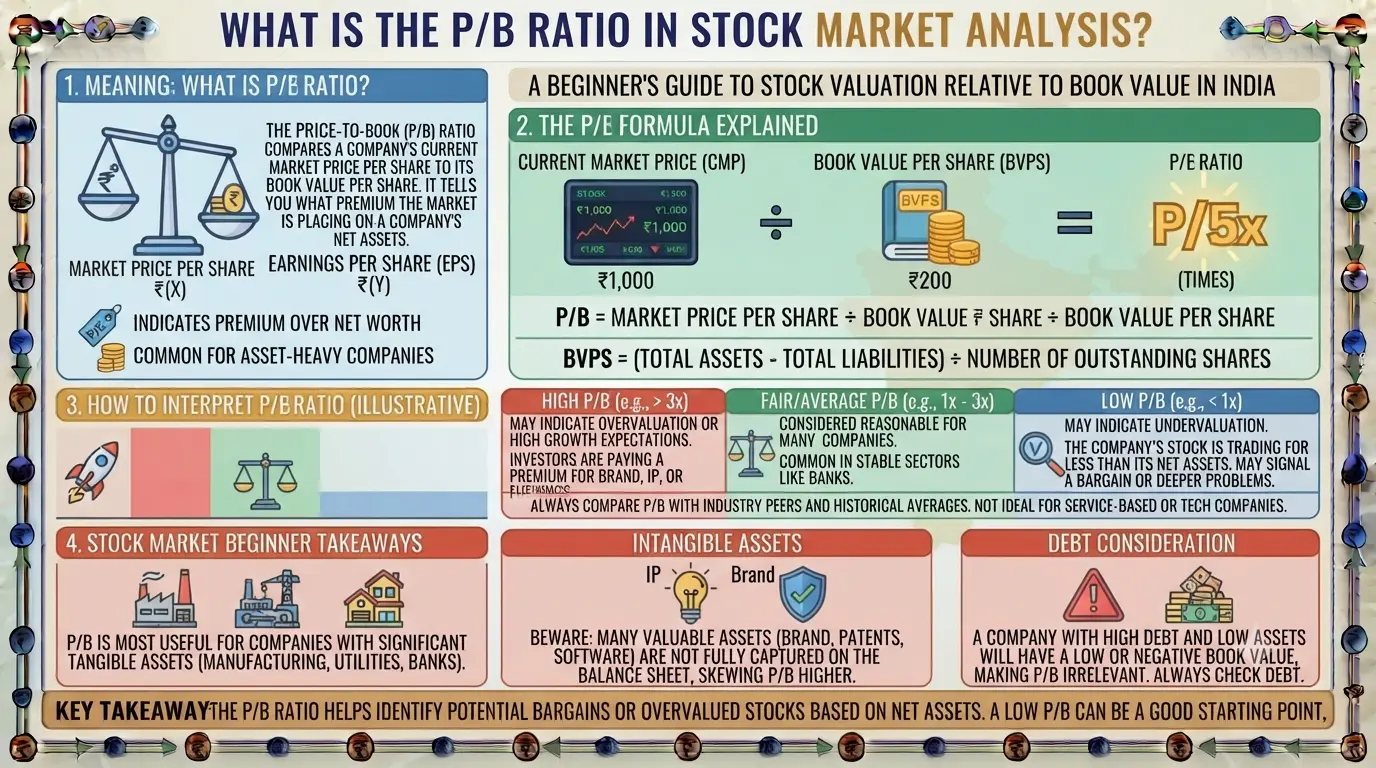
What Is the P/B Ratio in Stock Market Analysis?
The price-to-book (P/B) ratio is a stock valuation metric that compares a company's market price with its book value. It helps investors understand how much the market is willing to pay for each rupee of the company's accounting net worth.
The P/B ratio is especially relevant when analysing banks, financial institutions and businesses whose assets and liabilities are central to their operations. However, a P/B ratio below 1 does not automatically mean that a stock is undervalued, and a high P/B does not always mean that it is expensive. The company's profitability, asset quality, return on equity, growth prospects and accounting figures must also be examined.
This guide explains what the P/B ratio means, how to calculate it, how to interpret different values and how Indian investors can use it as part of fundamental analysis.
What Is the P/B Ratio?
The price-to-book ratio, also written as P/B or PB ratio, compares a company's current market price with its book value per share.
Book value represents the accounting value of shareholders' equity recorded in the company's balance sheet. In simplified terms, it is the value remaining after the company's recorded liabilities are deducted from its recorded assets. The relevant figure for ordinary shareholders should be adjusted for any preference equity or other claims that rank ahead of them.
The P/B ratio tells investors how much the market is paying for each rupee of the company's accounting net worth.
For example, a P/B ratio of 2 means that the market price of the company's equity is twice its book value. A P/B ratio of 0.8 means that the market values the equity at 80% of its recorded book value.
This comparison does not establish the actual liquidation value of a company. Assets may be recorded at historical cost, their realisable values may differ, and the company may have valuable internally developed assets that are not fully reflected in its balance sheet.
P/B Ratio Formula
The standard formula is:
P/B Ratio = Market Price per Share ÷ Book Value per Share (BVPS)
Book value per share can be calculated as:
BVPS = Book Value of Equity Attributable to Ordinary Shareholders ÷ Number of Ordinary Shares Outstanding
For a company with no preference share claims, book value of equity is generally represented by shareholders' equity in the balance sheet. Where preference shares or other senior equity claims exist, investors should use the book value attributable to ordinary shareholders rather than blindly using total equity.
How to Calculate Book Value
A simplified starting point is:
Book Value of Equity = Total Assets − Total Liabilities
This calculation should be interpreted using the company's actual balance-sheet presentation and ownership claims. For consolidated companies, investors should also distinguish total equity from equity attributable to owners of the parent.
How to Calculate the P/B Ratio: Step-by-Step Example
Consider a hypothetical Indian company called ABC Industries. The following figures are for illustration only.
| Particular | Amount |
|---|---|
| Total assets | ₹800 crore |
| Total liabilities | ₹500 crore |
| Book value of ordinary equity | ₹300 crore |
| Ordinary shares outstanding | 10 crore shares |
| Market price per share | ₹90 |
Step 1: Calculate book value of equity.
₹800 crore − ₹500 crore = ₹300 crore.
Step 2: Calculate book value per share.
BVPS = ₹300 crore ÷ 10 crore shares = ₹30 per share.
Step 3: Calculate the P/B ratio.
P/B = ₹90 ÷ ₹30 = 3 times.
ABC Industries is therefore trading at three times its book value per share. Investors are paying ₹3 in market price for every ₹1 of accounting book value per share.
This does not mean that the stock is automatically overvalued. The market may be assigning a premium because of strong profitability, expected growth, valuable business relationships or other factors. Those expectations need to be evaluated rather than assumed.
What Does a P/B Ratio of 1 Mean?
A P/B ratio of 1 means the market price per share is equal to the book value per share used in the calculation.
For example, if a company has a BVPS of ₹50 and its share trades at ₹50:
P/B = ₹50 ÷ ₹50 = 1 time.
The market is valuing the company's equity at approximately the same amount as its recorded book value. This does not necessarily mean that the stock is fairly valued. The company's assets may be overstated or understated, its future profitability may be weak, or its business may have valuable opportunities that are not fully reflected in book value.
What Does a Low P/B Ratio Mean?
A low P/B ratio means the market price is relatively low compared with the company's accounting book value. A ratio below 1 means the market is valuing the equity below its recorded book value.
This can attract value investors because it may indicate that the market price is below the accounting net worth attributable to shareholders. However, the discount may exist for valid reasons.
Possible reasons for a low P/B ratio include:
- Weak profitability or consistently low return on equity.
- Declining demand or deteriorating business prospects.
- High debt or other financial obligations.
- Poor asset quality or questionable asset valuations.
- Expected write-downs or impairment losses.
- Weak corporate governance or management concerns.
- Regulatory, legal or industry-specific risks.
- Low expected returns on future investments.
Example of a Low P/B Ratio
Suppose Company A has a book value per share of ₹100 and trades at ₹70.
P/B = ₹70 ÷ ₹100 = 0.7 times.
The market price is 30% below the recorded book value per share. This may deserve further investigation, but it does not prove that the stock is undervalued. Investors must examine why the market is applying a discount and whether the assets and liabilities are accurately represented.
What Does a High P/B Ratio Mean?
A high P/B ratio means the market is valuing the company's equity at a premium to its accounting book value.
This premium may reflect expectations of:
- Higher future profitability.
- Strong and sustainable return on equity.
- Effective use of shareholder capital.
- Competitive advantages and customer relationships.
- Growth opportunities.
- Strong management and business execution.
- Valuable assets that are not fully represented in book value.
However, a high P/B ratio can also mean that investors have priced in optimistic assumptions. If profitability weakens or expected growth fails to materialise, the valuation multiple may contract.
Example of a High P/B Ratio
Suppose Company B has a BVPS of ₹40 and trades at ₹160.
P/B = ₹160 ÷ ₹40 = 4 times.
The market values the company's equity at four times its recorded book value per share. Investors should investigate whether the company's returns, growth prospects and business quality justify that premium.
What Is a Good P/B Ratio?
There is no universal P/B ratio that makes every stock attractive. A ratio of 0.8 may deserve investigation for one bank, while the same ratio may reflect a very different business risk in another industry. A company trading at 3 times book value may be reasonably valued if it consistently generates strong returns, but it may be expensive if its profitability is weak.
Investors should compare P/B ratios using relevant benchmarks rather than applying a fixed threshold.
1. Compare With Industry Peers
Compare companies that operate in similar industries and have broadly comparable business models. For banks, compare banks with similar lending profiles, asset quality, capital strength, profitability and growth characteristics.
For non-financial companies, consider differences in asset intensity, accounting policies, business mix and the role of intangible assets.
2. Compare With Historical P/B
Review the company's P/B ratio over several years. A current ratio that is higher than its historical range may indicate that investors are paying a larger premium than before. A lower ratio may indicate a change in market expectations or a possible valuation opportunity.
Historical comparisons should account for major changes in the business, capital structure, acquisitions, asset write-downs and accounting policies. A company's historical P/B is not automatically a fair-value benchmark.
3. Compare With Sector and Market Conditions
Market-wide interest rates, economic cycles, credit conditions and investor risk appetite can affect valuation multiples. A comparison with a relevant sector index may provide context, but it should not replace company-level analysis.
Why Is the P/B Ratio Important for Banks?
The P/B ratio is particularly useful in analysing banks and some other financial institutions because their balance sheets are central to their business models. Loans, investments, deposits and other financial assets and liabilities form a large part of their operations.
For a bank, book value provides a starting point for assessing the accounting net worth attributable to shareholders. The market's valuation relative to that book value can reflect expectations about future profitability, asset quality, capital strength, management and the bank's ability to generate sustainable returns.
The Reserve Bank of India has examined the P/B ratio of Indian scheduled commercial banks and discussed its relationship with profitability, viability, financial cycles and the perceived franchise value of banks. This makes P/B an important analytical measure, but not a substitute for detailed bank analysis.
What Should Investors Check Alongside Bank P/B?
- Return on Equity (ROE): Measures profit generated relative to shareholders' equity.
- Gross Non-Performing Assets (GNPA): Indicates the proportion of gross advances classified as non-performing.
- Net Non-Performing Assets (NNPA): Shows the remaining non-performing asset exposure after relevant provisions.
- Provision Coverage: Helps assess the extent to which identified bad loans are covered by provisions.
- Capital Adequacy: Indicates the bank's capital position relative to its risk-weighted assets.
- Return on Assets (ROA): Helps assess how effectively the bank generates profit from its assets.
- Credit Growth and Deposit Growth: Provide context about the expansion and funding of the bank's business.
A bank trading below book value may have weak asset quality, low profitability or concerns about future credit losses. A bank trading above book value may have stronger profitability and better market confidence, but investors should still test whether the valuation premium is justified.
P/B Ratio vs Tangible Book Value
Traditional book value includes recognised intangible assets such as goodwill and certain acquired intangible assets. These amounts may not have the same recovery value as tangible assets if a company faces financial distress.
Some analysts therefore examine tangible book value, which removes specified intangible assets from book equity.
Tangible Book Value = Book Value of Equity − Goodwill − Other Relevant Intangible Assets
Tangible Book Value per Share = Tangible Book Value ÷ Relevant Shares Outstanding
Price-to-Tangible-Book Ratio = Market Price per Share ÷ Tangible Book Value per Share
The exact adjustments should be clearly defined and applied consistently. Tangible book value is not a guaranteed liquidation value, and it does not eliminate the need to assess asset quality and liabilities.
P/B Ratio vs P/E Ratio
The P/B ratio and P/E ratio are both used in fundamental analysis, but they compare the share price with different financial measures.
| Basis | P/B Ratio | P/E Ratio |
|---|---|---|
| Full form | Price-to-Book Ratio | Price-to-Earnings Ratio |
| Formula | Share price ÷ book value per share | Share price ÷ earnings per share |
| Main financial statement | Balance sheet | Profit and loss statement |
| What it compares | Market price with accounting equity | Market price with earnings |
| Common application | Banks and selected asset-heavy businesses | Profitable companies across many sectors |
| Important limitation | Book value may not reflect economic value or intangible assets | Earnings can be distorted by exceptional items or cyclical conditions |
Neither ratio is universally superior. P/B may be more informative when book equity is a meaningful measure of the business, while P/E may be more useful when earnings are a reliable indicator of profitability.
P/B Ratio vs P/TBV Ratio
The P/B ratio uses reported book value, which may include goodwill and other intangible assets. The price-to-tangible-book (P/TBV) ratio uses tangible book value after specified intangible assets are deducted.
P/TBV can provide additional insight when analysts want to focus on tangible net assets, particularly when evaluating certain financial institutions. However, it still depends on the quality and valuation of the underlying assets and liabilities.
When Is the P/B Ratio Less Useful?
The P/B ratio is not equally useful for every company. Its usefulness depends on how well the balance sheet captures the economic resources that generate the business's value.
1. Technology and Software Companies
Technology companies may depend heavily on software, intellectual property, research, skilled employees and internally developed products. Many internally generated intangible assets are not recognised as balance-sheet assets in the same way as acquired assets.
As a result, book value may understate important sources of economic value. A high P/B ratio in such a business should not be interpreted without examining its profitability, growth and cash generation.
2. Brand-Driven Businesses
Companies with strong brands, customer loyalty and distribution networks may have valuable competitive advantages that are not fully reflected in accounting book value.
3. Companies With Large Historical-Cost Assets
Property, plant and equipment may be recorded using historical cost less depreciation, subject to applicable accounting policies. Their current market value may differ significantly from the balance-sheet carrying value.
This can make P/B comparisons difficult between companies with different asset ages, acquisition histories or accounting choices.
4. Companies With Negative Book Value
If a company's liabilities exceed its assets, shareholders' equity may become negative. In such cases, the standard P/B ratio is not meaningful for ordinary valuation comparison.
A negative book value can indicate accumulated losses or serious financial weakness, although the reasons must be examined in the context of the company's business and balance sheet.
Factors That Can Change a Company's P/B Ratio
1. Share Price Movements
The market price is the numerator of the P/B formula. If the share price rises while book value per share remains unchanged, the P/B ratio increases. If the share price falls, the ratio decreases.
2. Profit Retention and Accumulated Reserves
When a company earns profits and retains part of them in the business, reserves and shareholders' equity may increase. This can increase book value per share, assuming other factors remain unchanged.
3. Share Buybacks
A company buying back its own shares may reduce shareholders' equity and the number of outstanding shares. The effect on book value per share depends on the repurchase price and the accounting treatment. A buyback does not automatically improve the company's underlying economics.
4. Asset Impairments and Write-Downs
If a company recognises an impairment or writes down the carrying value of an asset, shareholders' equity may decline. This can reduce book value per share and increase the P/B ratio if the share price does not change.
5. New Share Issuance
Issuing additional shares can increase the company's equity and share count. The effect on book value per share depends on the issue price, costs, use of proceeds and existing book value.
How to Use the P/B Ratio in Stock Analysis
Investors should use P/B as part of a wider valuation process rather than as a standalone buy-or-sell signal.
Step 1: Verify the Share Price and Financial Statements
Use a clearly identified market price and the latest available balance sheet. Note the reporting date and whether the financial statements are standalone or consolidated.
Step 2: Calculate Book Value per Share
Identify equity attributable to ordinary shareholders and divide it by the relevant number of outstanding ordinary shares. Check for preference shares, minority interests and other claims that may affect the figure.
Step 3: Calculate the P/B Ratio
Divide the market price per share by book value per share. Confirm that the price and book value relate to the same share class and that the share count has been adjusted for relevant corporate actions.
Step 4: Compare With Similar Companies
Compare the ratio with businesses in the same sector. For banks, compare asset quality, capital adequacy, profitability and growth as well as P/B. Avoid comparing a bank directly with a software company and treating the difference as a valuation conclusion.
Step 5: Examine ROE and Profitability
Return on equity helps explain how effectively a company uses shareholder capital to generate profit. A company with sustainable, higher ROE may justify a higher P/B multiple than a similar company with weak returns.
However, investigate why ROE is high. Excessive leverage, unusually low equity or temporary earnings can inflate the ratio without indicating superior business quality.
Step 6: Review Asset Quality and Accounting Risks
Examine whether the assets recorded in the balance sheet are likely to retain their value. For banks, this includes loan quality, provisioning and capital strength. For industrial companies, it may involve asset utilisation, impairment risk, inventory quality and receivables.
Step 7: Form a Valuation View
Combine P/B with profitability, growth, financial risks and peer comparisons. Decide whether the valuation appears relatively low, reasonable or demanding based on the available evidence and the assumptions behind it.
Practical Comparison: Two Hypothetical Companies
Consider two hypothetical Indian financial companies. These figures are for educational illustration only and do not represent actual listed companies.
| Particular | Company A | Company B |
|---|---|---|
| Share price | ₹120 | ₹80 |
| Book value per share | ₹60 | ₹80 |
| P/B ratio | 2 times | 1 time |
| Illustrative ROE | 16% | 8% |
| Asset quality | Relatively stronger | More concerns |
Company B trades at a lower P/B ratio, but its weaker assumed ROE and greater asset-quality concerns may help explain why the market assigns it a lower multiple.
Company A trades at a higher P/B ratio. Its stronger assumed profitability may support a premium, but investors must still assess whether that profitability is sustainable and whether the share price already reflects optimistic expectations.
The comparison shows why a low P/B ratio is not enough to identify an attractive stock. The quality of the book value and the returns generated from it matter.
Common Mistakes Investors Should Avoid
- Assuming P/B below 1 means undervaluation: The discount may reflect weak assets, expected losses or poor future profitability.
- Using total assets as book value: Book value of equity is not the same as total assets. Liabilities and other senior claims must be considered.
- Ignoring preference shareholders or minority interests: Use equity attributable to the relevant ordinary shareholders.
- Comparing unrelated industries: Different business models and accounting structures can make comparisons misleading.
- Ignoring ROE: A premium or discount should be examined alongside the returns generated on equity.
- Ignoring intangible assets: Book value may not capture internally generated intellectual property, brands or customer relationships.
- Treating book value as liquidation value: Recorded accounting values are not guaranteed realisable values.
- Ignoring asset quality in banks: A low bank P/B may reflect concerns about bad loans, provisioning or capital strength.
- Using outdated balance-sheet figures: Book value changes when companies report results, issue shares, retain profits or recognise losses.
A Practical P/B Ratio Checklist
Before relying on a company's P/B ratio, ask:
- Am I using the latest available balance sheet?
- Is the book value attributable to ordinary shareholders?
- Have I checked whether the figures are standalone or consolidated?
- Is book value positive and meaningful?
- How does the P/B compare with relevant industry peers?
- How does it compare with the company's historical range?
- Is the company generating a sustainable return on equity?
- Are its assets and liabilities reasonably valued?
- Does the company have material goodwill or intangible assets?
- For a bank, have I checked asset quality, provisions and capital adequacy?
- Could a buyback, new share issue or write-down have distorted book value per share?
Frequently Asked Questions About the P/B Ratio
1. What does a P/B ratio of 2 mean?
A P/B ratio of 2 means the market price of the company's equity is twice its accounting book value. Investors are paying ₹2 in market value for every ₹1 of book value per share.
2. Is a P/B ratio below 1 good?
Not necessarily. A P/B below 1 means the stock trades below its recorded book value, but the discount may reflect weak profitability, asset-quality problems, expected losses or other business risks. Investors should investigate the reason rather than treating it as an automatic bargain.
3. What is a good P/B ratio for bank stocks?
There is no single good P/B ratio for every bank. Compare banks with similar business profiles and examine ROE, asset quality, provisions, capital adequacy and growth. A bank's profitability and risk profile help explain why its market valuation may be above or below book value.
4. Why is the P/B ratio useful for banks?
Banks operate through financial assets and liabilities, so their balance sheets are central to understanding their business. P/B compares the market value of bank equity with its accounting book value. It should still be used alongside asset-quality and profitability measures.
5. Can the P/B ratio be negative?
If shareholders' equity is negative, book value per share can also be negative. A standard P/B ratio then becomes unsuitable for ordinary valuation comparisons. Investors should investigate accumulated losses, liabilities and the company's financial position.
6. What is the difference between P/B and P/TBV?
P/B compares market price with reported book value per share. P/TBV compares market price with tangible book value per share after specified intangible assets are deducted. P/TBV can offer an additional view of tangible net assets, but it is not a guaranteed measure of recoverable value.
7. Is P/B better than P/E?
Neither is universally better. P/B focuses on accounting equity, while P/E focuses on earnings. P/B is often more useful for banks and selected asset-heavy businesses, while P/E is commonly used for profitable companies whose earnings provide a meaningful valuation basis.
8. Where can Indian investors find book value and P/B information?
Investors can calculate book value using a company's published balance sheet and share count. They can also consult company annual reports, quarterly financial results, stock exchange disclosures and financial research platforms. Always check the reporting period and calculation basis before relying on a displayed P/B figure.
Conclusion
The P/B ratio helps investors compare a company's market valuation with its accounting book value. It is particularly useful for analysing banks and selected financial or asset-heavy businesses, where balance-sheet strength is an important part of the business model.
However, a low P/B does not automatically mean that a stock is undervalued, and a high P/B does not automatically mean that it is expensive. Investors should examine return on equity, asset quality, profitability, accounting values, intangible assets and the company's position relative to relevant peers.
Use the P/B ratio as one part of a broader fundamental analysis process. Understanding why the market assigns a premium or discount to book value is more useful than relying on the ratio alone.
Educational Disclaimer: This article is intended for educational and informational purposes only. It does not constitute investment advice, a recommendation to buy or sell securities, or a promise of returns. Financial ratios depend on market prices, company disclosures and accounting information, all of which can change. Investors should conduct independent research and consider their financial objectives and risk tolerance before making investment decisions.