What Is NSE and BSE? Understanding India’s Two Stock Exchanges
A clear beginner-friendly explanation of NSE and BSE — India’s two main stock exchanges — their history, differences, indices (Nifty 50 and Sensex), how they work, and what every new investor needs to know.
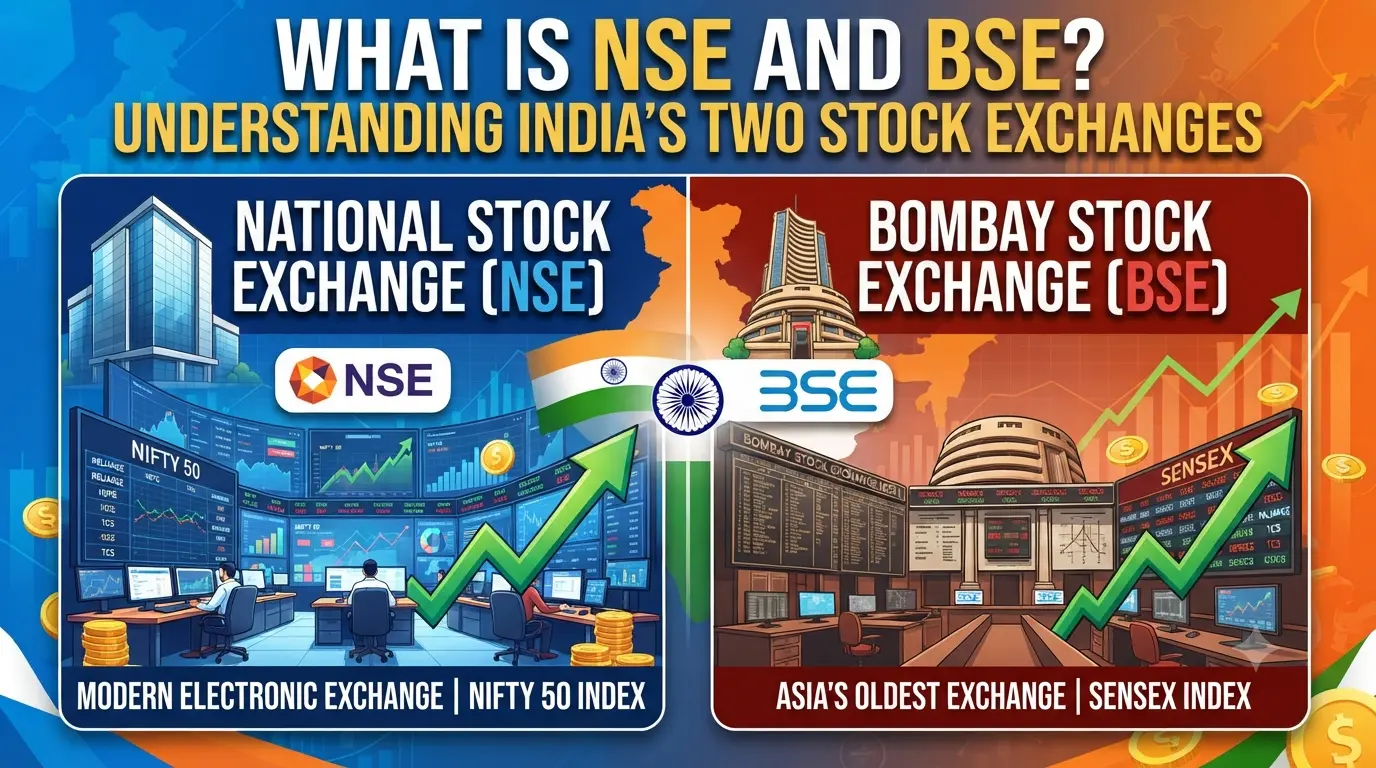
What Are NSE and BSE? Understanding India's Stock Exchanges
When Priya opened her first Demat account, her broker's app showed two options for almost every popular stock: NSE and BSE. She wondered why the same company appeared on both exchanges and whether buying its shares on one exchange would be different from buying them on the other.
This is a common question among people entering the Indian stock market. They hear NSE and BSE mentioned in financial news almost every day, but understanding what these institutions actually do is an important first step towards understanding how stock trading works.
NSE and BSE are India's two major stock exchanges. They provide organised electronic marketplaces where buyers and sellers can trade listed securities under established rules and regulatory supervision. Although they serve a similar purpose, they have different histories, benchmark indices, trading activity and market infrastructure.
Let's understand how these exchanges work, how they differ, and what beginners should know before placing their first stock market order.
What Are NSE and BSE?
NSE stands for National Stock Exchange of India, while BSE stands for BSE Limited, formerly known as Bombay Stock Exchange Limited. Both are recognised stock exchanges regulated by the Securities and Exchange Board of India (SEBI).
In simple terms, a stock exchange is an organised marketplace where investors can buy and sell securities such as equity shares, bonds and other exchange-traded financial instruments.
Think of it as a marketplace with established rules. Buyers submit orders showing how much they are willing to pay, while sellers submit orders showing the prices at which they are willing to sell. The exchange's electronic trading system matches compatible orders according to its trading rules.
There is an important distinction between raising capital and trading existing shares. When a company issues shares through an IPO, it can raise money from investors in the primary market. After those shares are listed, investors can generally buy and sell them among themselves in the secondary market through an exchange.
Therefore, NSE and BSE do more than display share prices. They provide the trading infrastructure, market surveillance, price discovery and related facilities that support India's securities markets.
A Short History of India's Two Major Stock Exchanges
How BSE Started
BSE has a much longer history than NSE. Its origins go back to 1875, when a group of stockbrokers formed the Native Share and Stock Brokers' Association in Mumbai.
Over time, the organisation developed into an important securities trading institution. It became a major part of India's financial market infrastructure and is recognised as Asia's oldest stock exchange.
For many years, traditional floor-based trading was an important part of its operations. BSE later introduced its BSE Online Trading (BOLT) system in 1995, marking its transition towards electronic trading.
Why NSE Was Established
The National Stock Exchange was incorporated in 1992 and received recognition as a stock exchange from SEBI in 1993. It began operations in 1994, introducing nationwide screen-based electronic trading.
Its establishment was an important development in the modernisation of India's securities market. Investors and trading members could access an electronic trading system rather than depending on traditional trading-floor arrangements.
NSE expanded rapidly and became a major centre for equity and derivatives trading. Its technology-driven infrastructure contributed to the development of a more accessible and efficient securities market.
Today, both exchanges operate electronic trading systems and function within India's regulated securities market framework.
How Do NSE and BSE Work for Investors?
To understand the role of an exchange, consider what happens when someone buys shares through a stockbroker's mobile application.
Step 1: An Investor Places an Order
Suppose Rahul wants to purchase 10 shares of a listed company. He opens his broker's trading application, searches for the company and enters the quantity and order price.
He can select the available exchange, such as NSE or BSE, depending on the trading facility provided by his broker.
Step 2: The Order Reaches the Exchange
The broker transmits the order to the selected exchange through its trading infrastructure. The exchange maintains an electronic order book containing available buy and sell orders.
Step 3: The Exchange Matches Buyers and Sellers
The exchange's matching engine matches compatible orders according to price-time priority and applicable trading rules.
For example, if Rahul places a buy order at ₹500 and a seller has a compatible sell order at ₹500, the system may execute the transaction.
Once the order is matched, the trade is confirmed and the relevant clearing and settlement process begins.
Step 4: Clearing and Settlement Take Place
After execution, the clearing corporation calculates the obligations of buyers, sellers and clearing members. It manages the clearing process, settlement obligations and associated risk-management mechanisms.
For the regular equity cash market, India's standard settlement cycle is T+1. This means settlement generally takes place on the next working day after the trading day, excluding applicable market and settlement holidays.
An optional T+0 settlement facility is also available for eligible securities and participating market participants under the applicable SEBI framework. It is not the universal settlement cycle for every stock or broker.
After settlement, purchased securities are credited to the investor's demat account, subject to the applicable process. India's two principal depositories, NSDL and CDSL, provide the infrastructure for holding securities in electronic form.
Step 5: The Investor Tracks the Investment
Once the transaction is completed, the investor can monitor the shares through the broker's application and demat account. The exchange continues to provide trading infrastructure and market information for subsequent transactions.
This is how a stock exchange connects investors through an organised trading and settlement system.
Practical Example: Buying the Same Stock on NSE and BSE
Suppose Priya wants to purchase 20 shares of a company listed on both NSE and BSE.
Her broker's application displays the following hypothetical market information:
| Market Information | NSE | BSE |
|---|---|---|
| Last Traded Price | ₹500.00 | ₹500.20 |
| Best Available Buy Price | ₹499.90 | ₹500.00 |
| Best Available Sell Price | ₹500.10 | ₹500.30 |
Note: These figures are hypothetical and are included only to explain how prices and order books can differ.
Although the company is the same, its shares have separate order books on the two exchanges. Differences in available buy and sell orders can therefore produce slightly different prices.
Priya should compare the available prices, bid-ask spread and quantity before placing her order. A tighter spread and sufficient available quantity can help reduce trading costs.
Market participants, including arbitrage traders, may act on price differences between exchanges. Their activity generally helps keep prices closely aligned for actively traded securities, although differences can still exist.
For a long-term investor buying a highly liquid stock, the exchange selection may have a relatively small impact. However, the actual execution price and available liquidity always matter.
Key Differences Between NSE and BSE
Although both exchanges perform similar functions, there are several differences in their history, benchmark indices and trading activity.
| Parameter | NSE | BSE |
|---|---|---|
| Full Name | National Stock Exchange of India | BSE Limited (formerly Bombay Stock Exchange Limited) |
| Year of Establishment | Incorporated in 1992 | Established in 1875 |
| Operations Started | 1994 | Long-established exchange; electronic trading introduced in 1995 |
| Headquarters | Mumbai | Mumbai |
| Benchmark Index | Nifty 50 | S&P BSE Sensex |
| Index Constituents | 50 companies | 30 companies |
| Trading Activity | Higher activity in several major market segments | Important presence across equity, debt, derivatives and SME segments |
| Derivatives Market | Major derivatives trading venue | Offers exchange-traded derivatives as well |
| SME Platform | NSE Emerge | BSE SME |
| Regulator | SEBI | SEBI |
One important point is that a larger number of listed companies does not automatically mean higher trading activity. Liquidity depends on actual market participation, order-book depth and trading activity in individual securities.
Exchange-level comparisons also depend on the segment and period being measured. Therefore, investors should avoid assuming that one exchange leads in every category.
Understanding Nifty 50 and Sensex
When you watch financial news, you will frequently hear two names: Nifty 50 and Sensex. Both are benchmark indices that help investors understand the broad movement of selected shares in the Indian stock market.
What Is Nifty 50?
Nifty 50 is a benchmark stock market index maintained by NSE Indices Limited. It tracks 50 selected companies listed on NSE, representing different sectors of the Indian economy.
The index uses free-float market capitalisation methodology. This means the calculation considers the market value of shares available for public trading rather than simply counting every share held by promoters and other strategic investors.
Investors use Nifty 50 as a benchmark for understanding market performance, comparing investment portfolios and tracking index-based products such as ETFs and index funds.
What Is Sensex?
Sensex, officially known as the S&P BSE Sensex, is the benchmark index of BSE. It tracks 30 selected companies representing important sectors of the Indian economy.
Launched in 1986, Sensex is one of India's oldest and most widely followed equity market indices. Like Nifty 50, it uses free-float market capitalisation methodology.
Both indices can move in similar directions because they include major Indian companies and reflect overlapping economic influences. However, their movements and percentage returns do not have to be identical.
| Feature | Nifty 50 | Sensex |
|---|---|---|
| Exchange Association | NSE | BSE |
| Number of Companies | 50 | 30 |
| Launch Year | 1996 | 1986 |
| Calculation Method | Free-float market capitalisation | Free-float market capitalisation |
| Purpose | Benchmark for Indian equity market performance | Benchmark for Indian equity market performance |
Important Stock Market Concepts Related to NSE and BSE
Understanding a few related terms makes it easier to follow how the exchanges function.
Listing
Listing refers to the admission of a company's securities for trading on a recognised stock exchange after meeting the applicable eligibility and regulatory requirements. A company may list its shares on one exchange or multiple exchanges.
Liquidity
Liquidity describes how easily a security can be bought or sold without significantly affecting its market price.
For example, a stock with many active buyers and sellers may have better liquidity than a stock with very few market participants.
Bid Price and Ask Price
The bid price is the highest price a buyer is currently willing to pay. The ask price, also called the offer price, is the lowest price a seller is currently willing to accept.
The difference between these prices is called the bid-ask spread. A narrower spread can indicate a more competitive order book, although investors should also consider available quantity and market conditions.
Clearing Corporation
A clearing corporation is an important market infrastructure institution responsible for clearing trades, calculating settlement obligations and managing associated risks. It also operates settlement guarantee mechanisms under applicable rules and safeguards.
Demat Account
A demat account holds securities in electronic form. NSDL and CDSL are India's two principal securities depositories. Investors generally access their demat holdings through a depository participant, such as a bank or broker.
How Should Beginners Choose Between NSE and BSE?
For most beginners, choosing between the two exchanges does not need to be complicated. The important thing is to understand the market conditions of the particular stock you want to trade.
Consider these factors before placing an order:
- Compare the available prices: Check the current bid and ask prices on both exchanges.
- Check liquidity: Look at available quantities and trading activity rather than relying only on the last traded price.
- Compare the bid-ask spread: A narrower spread may help reduce the difference between buying and selling prices.
- Check product availability: Certain securities or derivatives contracts may have different availability across exchanges.
- Understand transaction costs: Consider applicable brokerage, statutory charges and other costs shown by your broker.
For long-term investors purchasing actively traded shares, the difference between exchanges may often be small. Company fundamentals, valuation, financial goals and investment risk generally deserve much more attention than the exchange name alone.
Advantages and Limitations of Having Two Major Exchanges
Advantages
- Competition: Multiple exchanges encourage improvements in technology, trading facilities and market services.
- Market access: Investors and companies have access to more than one recognised trading platform.
- Price discovery: Independent order books contribute to the process of determining market prices.
- Product diversity: Both exchanges provide different market segments and facilities for securities trading.
- Market infrastructure: Established systems support trading, surveillance, clearing and settlement.
Limitations
- Different order books: The same security can have slightly different prices across exchanges at a particular moment.
- Liquidity differences: Some securities may have substantially more trading activity on one exchange than the other.
- Beginner confusion: New investors may not immediately understand which exchange to select.
- Operational complexity: Maintaining exchange-specific trading, surveillance and clearing infrastructure requires substantial investment and coordination.
Common Mistakes Beginners Make About NSE and BSE
1. Assuming One Exchange Is Always Better
NSE and BSE both operate under SEBI's regulatory framework. The better choice for a particular transaction depends on factors such as liquidity, available prices and product availability.
2. Expecting Identical Prices on Both Exchanges
Each exchange has a separate order book. Small price differences are normal, even when both exchanges trade the same company's shares.
3. Confusing Listed Companies With Trading Volume
A higher number of listed companies does not necessarily mean higher trading activity. A stock may be listed on an exchange but still have limited trading volume.
4. Treating Nifty 50 and Sensex as Individual Stocks
These are indices, not individual company shares. Investors can gain exposure to them through eligible index funds, ETFs and other available investment products.
5. Ignoring the Actual Execution Price
Beginners sometimes focus only on the last traded price. However, the bid-ask spread, order quantity and available liquidity can affect the price at which an order is executed.
Practical Action Plan for Beginners
If you are new to the Indian stock market, follow these steps to build a basic understanding of exchanges and trading:
- Learn the difference between NSE and BSE and understand the role each exchange performs.
- Understand how a trading account and demat account work.
- Learn the difference between a stock exchange, stockbroker and depository.
- Follow Nifty 50 and Sensex to understand broad market movements.
- Observe the bid price, ask price and available quantity before placing an order.
- Use a SEBI-registered broker and understand the applicable transaction charges.
- Refer to official NSE, BSE and SEBI educational resources for updated market information.
Learning these fundamentals will make it easier to understand how individual stocks, market indices and trading platforms fit into India's financial markets.
Frequently Asked Questions About NSE and BSE
1. Which is better, NSE or BSE?
Neither exchange is universally better. NSE has higher trading activity in several major market segments, while BSE has a longer history and a broader listing base. For an individual trade, compare liquidity, available prices and order-book depth.
2. Can the same stock trade on both NSE and BSE?
Yes. Many Indian companies list their equity shares on both exchanges. Investors can trade those securities through either exchange, subject to availability and their broker's facilities.
3. Why do share prices sometimes differ between NSE and BSE?
Each exchange maintains a separate order book with its own buy and sell orders. Differences in available demand and supply can create small temporary price variations. Arbitrage activity generally helps keep prices aligned for actively traded stocks.
4. What is the difference between Nifty 50 and Sensex?
Nifty 50 tracks 50 selected companies associated with NSE, while Sensex tracks 30 selected companies associated with BSE. Both are benchmark indices that help investors understand broad movements in the Indian equity market.
5. Do I need separate demat accounts to trade on NSE and BSE?
No. You generally need one demat account and a trading account with a broker that provides access to both exchanges. The same demat account can hold eligible securities purchased through either exchange.
6. Who regulates NSE and BSE?
The Securities and Exchange Board of India (SEBI) regulates recognised stock exchanges, securities market intermediaries and relevant market activities under the applicable Indian securities laws and regulations.
7. Which exchange is older, NSE or BSE?
BSE is older. It was established in 1875, whereas NSE was incorporated in 1992 and began operations in 1994.
8. Where can beginners find official information about NSE and BSE?
Beginners can visit the official websites of NSE at nseindia.com, BSE at bseindia.com and SEBI at sebi.gov.in. These websites provide exchange information, market updates, regulatory announcements and investor education resources.
Conclusion: Understanding the Role of NSE and BSE
NSE and BSE are two important pillars of India's securities market. BSE has a history dating back to 1875, while NSE introduced nationwide electronic trading when it began operations in 1994. Both provide organised platforms where investors can trade securities under an established regulatory framework.
Their benchmark indices, Nifty 50 and Sensex, help investors understand broader market movements. Their electronic trading systems, order books and clearing arrangements support the process of buying and selling securities.
For a beginner, the most important takeaway is that an exchange provides the marketplace, while investment decisions depend on the security being purchased, its price, the investor's financial objectives and the risks involved.
Once you understand the difference between an exchange, a broker, a demat account and a market index, the Indian stock market becomes much easier to navigate.
Educational Disclaimer: This article is intended for educational purposes only and does not constitute investment advice or a recommendation to buy or sell any security. Stock market investments are subject to market risks, including the possible loss of capital. Readers should verify current information through official sources and consider their financial circumstances before making investment decisions.