What Is Compounding? Meaning, How It Works, Formula and Examples
Understand what compounding means, how returns can generate further returns, and why time, reinvestment and consistency matter. Explore simple examples, the compound interest formula, stock market applications and the risks investors should understand.
What Is Compounding? Meaning, How It Works, Formula and Examples
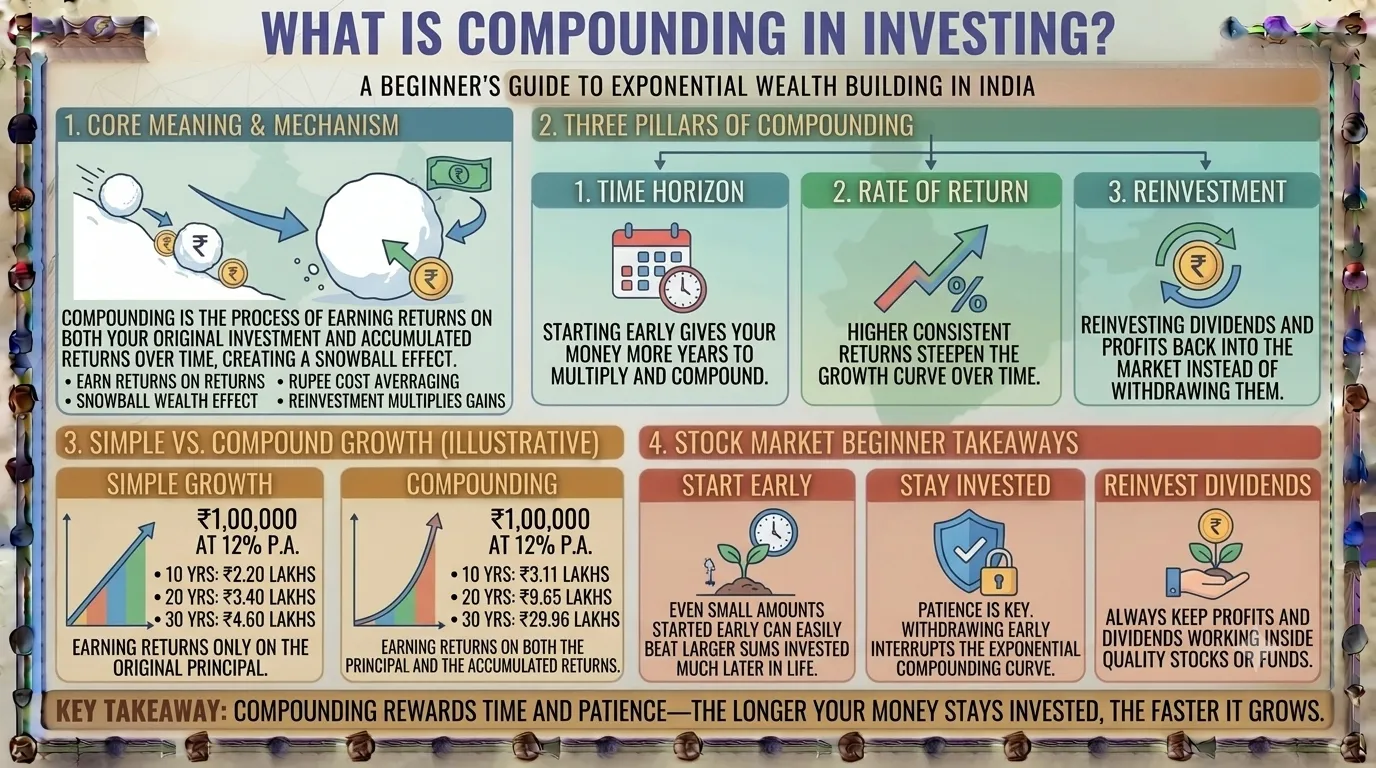
Compounding is the process in which the returns earned on an investment remain invested and generate further returns. In simple terms, you earn returns not only on your original investment but also on the gains accumulated earlier. This is why compounding is often described as “earning returns on returns”.
For example, suppose you invest ₹1,00,000 at an assumed fixed annual return of 10%, with all returns reinvested. After the first year, the amount becomes ₹1,10,000. In the second year, 10% is calculated on ₹1,10,000, not just the original ₹1,00,000. The amount becomes ₹1,21,000. Over longer periods, this expanding base can make a substantial difference.
In real investments, especially shares and equity mutual funds, returns are not fixed or guaranteed. Their value can rise and fall, and the compounding illustration should not be mistaken for a forecast.
How Does Compounding Work?
Compounding works through a repeating cycle:
- You invest an initial amount.
- The investment earns interest, income or a gain.
- You leave the earnings invested instead of withdrawing them.
- Future returns are earned on the original amount plus the accumulated gains.
- The cycle continues for as long as the investment remains invested and produces positive returns.
The key is reinvestment. If you withdraw every rupee of income as soon as it is earned, that withdrawn amount is no longer available to generate future returns in the same investment. Compounding can still occur on the balance that remains invested, but the effect is reduced.
Simple Interest vs Compound Interest
Simple interest is calculated only on the original principal. Compound interest is calculated on the principal plus previously accumulated interest.
Assume an initial investment of ₹1,00,000 earns 10% a year for five years. Under simple interest, the annual interest remains ₹10,000. Total interest is ₹50,000 and the final amount is ₹1,50,000. Under annual compounding, the amount grows to approximately ₹1,61,051. The difference is created because each year's interest becomes part of the base for the next year.
The comparison assumes the same rate is available every year, no tax or fees, no withdrawals and annual compounding. It is a mathematical illustration, not a claim that an investment will deliver a steady 10% return.
Compound Interest Formula
For a lump-sum investment with a fixed nominal annual interest rate and a defined compounding frequency, the formula is:
A = P × (1 + r/n)(n × t)
Where:
- A: Future value, including accumulated interest.
- P: Initial principal or investment amount.
- r: Annual interest rate expressed as a decimal.
- n: Number of compounding periods per year.
- t: Investment duration in years.
If ₹1,00,000 is invested at 10% per year, compounded annually for 20 years:
A = ₹1,00,000 × (1 + 0.10)20
A ≈ ₹6,72,750.
The investment grows by approximately ₹5,72,750 before taxes, fees and any other costs. The calculation assumes a constant 10% annual rate and annual compounding. It does not represent a likely or guaranteed stock-market outcome.
The formula changes when contributions are added regularly, withdrawals are made, or rates vary. A monthly SIP is a series of separate investments made at different dates; it is not the same as investing one lump sum at the start. Each instalment has a different amount of time to grow.
Why Time Matters in Compounding
Time gives accumulated returns more periods in which to generate further returns. The effect may look modest in the early years because the investment base is still small. As the base grows, the same percentage return produces a larger rupee gain.
For example, ₹1,00,000 growing at an assumed 10% annually becomes approximately ₹2,59,374 after 10 years, ₹6,72,750 after 20 years and ₹17,44,940 after 30 years. The rate is unchanged in this illustration; the longer period is what creates the larger difference.
Starting earlier can therefore matter even when the initial amount is modest. However, the decision to invest should still consider emergency savings, high-cost debt, financial goals, time horizon and risk tolerance. Starting early does not justify investing money needed for near-term expenses in volatile assets.
What Determines the Effect of Compounding?
The outcome depends on several interacting factors:
- Initial amount: A larger starting investment has a larger base on which returns can accumulate.
- Rate of return: A higher return assumption produces a higher mathematical future value, but higher expected returns generally involve greater uncertainty and risk. Do not select an investment merely because an illustration uses a high rate.
- Time invested: More compounding periods can increase the effect, provided returns remain invested.
- Reinvestment: Interest, dividends or other distributions that are reinvested can contribute to future growth. Withdrawn income cannot compound within the investment after withdrawal.
- Compounding frequency: For a fixed nominal interest rate, more frequent compounding can increase the mathematical result. Actual products specify how interest is calculated, credited and paid; read the product terms.
- Contributions and withdrawals: Additional contributions increase the capital working for you. Withdrawals reduce the amount available to generate future returns.
- Costs and taxes: Fees, expenses and taxes can reduce the amount left invested and therefore reduce future compounding.
How Does Compounding Apply to the Indian Stock Market?
Compounding is relevant to equity investing, but it does not work exactly like a bank deposit paying a fixed rate.
Compounding in Shares
An investor may benefit from a company's growth in earnings and value over time. If the market price rises, the value of the holding rises. Dividends, when paid, are cash distributions; an investor who reinvests them buys additional shares and may increase future participation in gains or losses. A company that retains profits and reinvests them productively may also grow its business value. None of this guarantees that the share price will rise.
Compounding in Mutual Funds
A mutual fund's portfolio value changes with the market value and income of its holdings, after applicable expenses. In a growth option, gains generally remain reflected in the scheme's NAV rather than being distributed to the investor as regular cash payouts. This can allow the value to accumulate, but the NAV can fall as well as rise.
In an Income Distribution cum Capital Withdrawal (IDCW) option, amounts distributed are paid out and the scheme's NAV is adjusted. A distribution should not be mistaken for extra return. Investors who want to reinvest a payout must make a separate reinvestment decision where applicable. SEBI's mutual fund disclosures explain the distinction between growth and IDCW options.
Compounding Through SIP
A Systematic Investment Plan (SIP) is a method of investing regularly in a mutual fund; it is not itself a return or a guarantee of compounding. Each instalment buys units at the applicable NAV. Earlier instalments have more time in the market than later ones. The combination of ongoing contributions and returns on the accumulated portfolio may help build a corpus over time, but market returns are uneven and not guaranteed.
Compounding in Fixed Deposits and Recurring Deposits
These products may specify an interest rate and compounding or payout terms. The actual result depends on the bank's product conditions, tenure, compounding frequency, premature withdrawal rules and applicable tax. Do not assume all deposits compound in the same way.
A Stock Market Example: Reinvestment and Total Return
Suppose you buy shares worth ₹50,000. Over a year, the share price rises by 8%, and the company also pays a dividend equal to 2% of the original value. For a simplified illustration, assume the dividend is reinvested immediately and ignore price movements after the dividend date, tax and costs. Your total value would be approximately ₹55,000, equivalent to a 10% total return for that year.
If the next year's 10% total return were earned on the full ₹55,000, the value would become ₹60,500. The second year's gain would be ₹5,500, larger than the first year's ₹5,000 because the starting value is higher. This illustrates how reinvested total returns can compound.
This example is hypothetical. Actual share returns depend on price movements, dividend timing and amount, corporate actions, taxes, costs and whether dividends are reinvested. A company can also cut or stop dividends, and its share price can decline.
The Difference Between CAGR and Compounding
Compounding describes how returns build on an accumulated amount. Compound Annual Growth Rate (CAGR) is a way to express the smoothed annual growth rate between a starting and ending value over a period.
CAGR = (Ending Value / Beginning Value)(1 / Number of Years) − 1.
For example, if an investment grows from ₹1,00,000 to ₹1,21,000 over two years, its CAGR is approximately 10% per year. CAGR does not mean the investment actually returned 10% in each year. It smooths the path into one equivalent annual rate and hides volatility along the way.
Can Compounding Work Against You?
Yes. Compounding applies to amounts owed as well as investments. If unpaid interest, fees or charges are added to a loan balance, future interest may be calculated on a larger amount. Credit-card balances and certain overdue loans can become expensive when carried forward. Read the effective annual rate, compounding terms, fees and repayment conditions before borrowing.
Investment losses also affect compounding. A 20% loss requires a 25% gain on the reduced amount just to return to the starting value. A 50% loss requires a 100% gain. This is why avoiding large permanent losses matters: a smaller capital base has less money available to participate in a recovery.
Compounding does not turn a poor investment into a good one. A business can deteriorate, a company can default, a fund can underperform, and an investor can lose capital. Time alone does not eliminate those risks.
Benefits and Limitations of Compounding
Potential Benefits
- Reinvested earnings can generate additional earnings.
- Time can make a larger contribution to the final value.
- Regular contributions can add to the amount that remains invested.
- It can support long-term goals when the underlying investment is suitable and risks are managed.
Limitations and Risks
- Returns are not fixed in market-linked investments.
- Losses can reduce the capital base and delay recovery.
- Inflation reduces the purchasing power of the final amount.
- Taxes, expense ratios, brokerage and other costs can reduce net returns.
- Withdrawals interrupt the growth of the withdrawn amount.
- A long holding period does not guarantee a positive result.
Nominal Growth vs Real Growth After Inflation
A portfolio can grow in rupee terms while buying power grows more slowly. Real return measures the return after considering inflation. A useful approximation is nominal return minus inflation, although the exact calculation is:
Real return = (1 + nominal return) / (1 + inflation rate) − 1.
For example, if an investment earns 8% and inflation is 5%, the exact real return is approximately 2.86%, before taxes and fees. This is more informative than looking only at the headline 8% return because it considers changes in purchasing power.
How Can Investors Use Compounding Sensibly?
- Define the goal and the date when the money may be needed.
- Keep an emergency reserve and manage expensive debt before taking investment risk.
- Choose products based on risk capacity, time horizon, liquidity needs and understanding—not on an attractive compounding calculator result.
- Reinvest distributions only when that choice fits the investment plan and tax circumstances.
- Review costs, taxes, asset allocation and the underlying investment periodically.
- Avoid frequent withdrawals from long-term goal investments unless the goal or circumstances change.
- Do not chase unusually high promised returns. Verify products and intermediaries and understand that market-linked returns fluctuate.
Common Mistakes to Avoid
- Treating an assumed return as guaranteed: A calculator's fixed rate is only an input, not a forecast.
- Confusing SIP with compounding: SIP is a contribution schedule; compounding is the process by which accumulated returns can generate further returns.
- Ignoring inflation: A large future rupee balance may have lower purchasing power.
- Withdrawing gains repeatedly: Withdrawn money stops compounding in that investment.
- Chasing the highest return: A high return assumption often comes with higher risk; losses can erase years of gains.
- Ignoring taxes and costs: Gross projections can overstate the amount ultimately retained.
- Believing all stocks compound automatically: A company may destroy value, and share prices can fall or remain stagnant for long periods.
Frequently Asked Questions About Compounding
What is compounding in simple words?
Compounding means earning returns on your original investment and on the returns that have accumulated earlier, provided those returns remain invested.
What is the difference between simple interest and compound interest?
Simple interest is calculated on the original principal only. Compound interest is calculated on the principal plus previously accumulated interest.
What is the formula for compound interest?
For a fixed rate compounded n times a year, A = P × (1 + r/n)(n × t), where P is principal, r is the annual rate in decimal form, n is compounding periods per year and t is years.
Does compounding work in the stock market?
It can. Reinvested dividends and gains, and growth in the value of businesses, can contribute to compounding total returns. But stock prices and dividends are uncertain, and losses are possible.
Does an SIP guarantee the benefit of compounding?
No. SIP is a way to invest regularly. It does not guarantee returns. The value of a mutual fund can rise or fall, and the result depends on the scheme, market performance, costs, time and the timing of contributions.
Is compounding better than simple interest?
At the same positive rate and over the same period, with earnings reinvested and no costs or taxes, compounding produces a higher mathematical ending value. That does not mean every investment offering compounding is better or safer.
How does inflation affect compounding?
Inflation reduces the purchasing power of the amount accumulated. Investors should consider real returns after inflation, as well as taxes and fees.
Can compounding create losses?
Compounding can magnify the effect of negative returns as well as positive ones. Debt balances can also grow when interest and charges are added to unpaid amounts.
Conclusion
Compounding is the process of allowing accumulated returns to remain invested and potentially generate further returns. Its effect depends on the amount invested, the return earned, the time available, contributions, withdrawals, costs, taxes and inflation. In the Indian stock market, compounding may arise through reinvested dividends, growth in business value and returns retained within investments, but unlike a fixed-rate illustration, market outcomes are uncertain. Understand the investment first, use realistic assumptions and treat compounding as a mathematical process—not a promise of wealth.
Educational Disclaimer: This article is for general financial education only and is not investment, tax or legal advice. Investments in securities and mutual funds are subject to market risks. Read all relevant offer documents and scheme information carefully, assess your own financial circumstances and consult a SEBI-registered investment adviser or other qualified professional where appropriate before making investment decisions.