How to Identify Quality Companies: A Practical Guide for Indian Investors
Learn how to identify quality companies using business fundamentals, financial statements, profitability ratios, cash flow, management quality, competitive advantages and valuation. This practical guide explains what Indian investors should examine before considering a stock.
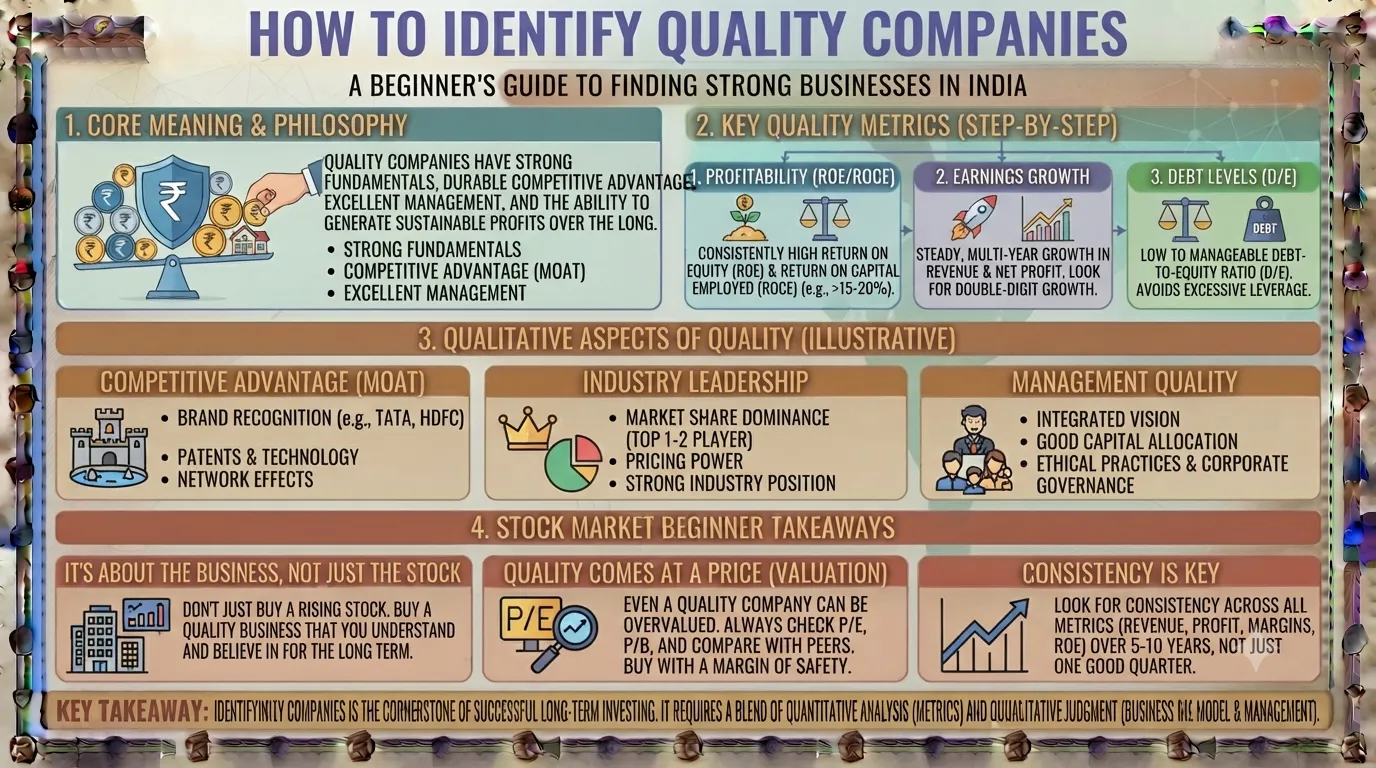
How to Identify Quality Companies: A Practical Guide for Indian Investors
Finding a stock that is rising is easy. Identifying a company with a strong business, reliable financial performance and responsible management requires much more work. A share price can rise because of market excitement, short-term news or speculation. Those movements do not necessarily mean the company itself is becoming stronger.
For long-term investors, the more important question is whether the underlying business can generate sustainable profits, protect its competitive position, manage financial risks and use capital effectively. These are the characteristics that help distinguish a quality company from a business that is simply attracting market attention.
To identify quality companies, examine six areas: business model, profitability, financial strength, cash-flow quality, management and corporate governance, and competitive advantage. Then assess whether the stock's valuation is reasonable. No single financial ratio can establish quality, and even a strong company can be a poor investment when purchased at an excessive price.
What Is a Quality Company?
A quality company is a business that can generate sustainable returns on capital, maintain a financially sound position, convert a reasonable portion of its accounting profits into cash, compete effectively and allocate resources responsibly over time.
Quality is not defined by company size, a famous brand, a high share price or one year of exceptional earnings. It is better understood as a combination of business strength, financial discipline, earnings reliability and management integrity.
There is no single universally accepted definition of a quality company. Different investment frameworks use different measures. For example, the NSE Indices white paper on the NIFTY200 Quality 30 framework discusses profitability, financial leverage and earnings growth variability as important dimensions of quality. These dimensions provide a useful starting point, but investors should also examine business durability, governance and valuation.
Why Identifying Quality Companies Matters
Buying shares means becoming a part-owner of a business. If the business performs well over time, its earnings and cash-generation ability may improve. However, if the company has weak finances, poor governance or an eroding competitive position, its stock can remain under pressure even when the broader market is rising.
Evaluating quality helps investors:
- Separate sustainable business growth from temporary earnings increases.
- Identify companies that use shareholder capital efficiently.
- Recognise excessive debt and liquidity risks.
- Understand whether reported profits are supported by cash generation.
- Assess whether management decisions protect or weaken shareholder interests.
- Avoid confusing a popular stock or a low P/E ratio with a fundamentally strong business.
Quality analysis does not eliminate investment risk. It creates a more disciplined way to understand the risks before committing capital.
1. Understand the Company's Business Model
Start by understanding what the company actually does. Do not begin with its share-price chart or a list of financial ratios. If you cannot explain how the company earns money, who pays it and why customers choose it, you may not yet understand the investment.
Questions to ask about the business
- What products or services does the company sell?
- Who are its main customers?
- Does it sell to consumers, businesses, government entities or other companies?
- What are its major sources of revenue?
- Which costs have the greatest effect on its margins?
- Does the company depend heavily on one customer, supplier, product or geography?
- Is demand recurring, seasonal, cyclical or dependent on one-time projects?
- What could cause customers to move to a competitor?
For example, a company that sells subscription-based enterprise software may receive recurring payments from customers. A construction company may depend on project awards, execution timelines, working capital and timely customer payments. Both can be good businesses, but their revenue patterns, risks and financial ratios should not be assessed in exactly the same way.
Also examine the industry's structure. A company may operate in a growing industry but still perform poorly because competition is intense, customers have bargaining power or new entrants can offer similar products at lower prices.
2. Examine Revenue and Profit Growth
A quality company should have a credible explanation for how it earns and grows revenue. Look beyond the latest quarter. Review at least five financial years where reliable data is available, and examine whether growth has been consistent, profitable and supported by business expansion.
Revenue growth
Revenue growth shows whether the company is increasing the value of products or services it sells. However, growth alone does not prove quality. Sales may rise because of acquisitions, price increases, temporary demand, aggressive credit terms or a one-off contract.
Investigate the source of growth. Is the company selling more units, entering new markets, gaining customers, increasing prices or acquiring another business? Each source has different implications for sustainability.
Operating profit and net profit
Operating profit helps show whether the core business is becoming more profitable before financing costs and certain non-operating items. Net profit reflects the amount remaining after expenses, interest, depreciation, tax and other applicable items.
Compare revenue growth with operating profit and net profit growth. If revenue rises consistently but operating profit margins decline, the company may be facing higher input costs, pricing pressure or inefficient expansion. If net profit increases mainly because of exceptional income, asset sales or tax benefits, the improvement may not be repeatable.
Check profit margins
Margins help explain how much of each rupee of sales remains at different stages of the income statement.
- Gross profit margin: Gross profit divided by revenue. It indicates how much remains after direct costs of goods or services.
- Operating profit margin: Operating profit divided by revenue. It helps assess the profitability of core operations.
- Net profit margin: Net profit divided by revenue. It shows the final profit retained from sales after relevant expenses.
Do not apply one universal margin benchmark to every company. Software, retail, banking, utilities, manufacturing and infrastructure businesses have different cost structures. Compare margins with the company's own history and relevant industry peers.
3. Measure Profitability and Capital Efficiency
A business may report rising profits while requiring increasingly large amounts of capital to generate them. Quality analysis therefore asks not only how much profit a company earns, but also how efficiently it uses the resources invested in the business.
Return on Equity (ROE)
Return on Equity measures the profit generated relative to shareholders' equity.
ROE = Net Profit ÷ Average Shareholders' Equity × 100
Suppose a hypothetical company reports annual net profit of ₹120 crore and average shareholders' equity of ₹800 crore.
ROE = ₹120 crore ÷ ₹800 crore × 100 = 15%.
This means the company generated ₹15 of profit for every ₹100 of average shareholders' equity during the period. It does not mean shareholders automatically earned a 15% stock-market return.
A high ROE can be attractive, but it can also be inflated by high debt, a small equity base, buybacks or accumulated losses. Examine the balance sheet and capital structure before treating a high ROE as evidence of quality.
Return on Capital Employed (ROCE)
ROCE evaluates how efficiently a company generates operating profit from the capital employed in the business. A commonly used formula is:
ROCE = EBIT ÷ Average Capital Employed × 100
EBIT means earnings before interest and tax. Capital employed is commonly calculated using total assets minus current liabilities, although definitions can vary across data providers and analytical methods.
ROCE is particularly useful when comparing non-financial companies with different funding structures. A company that consistently earns strong returns on capital without taking excessive financial risk may have an attractive business model.
How to interpret ROE and ROCE together
ROE and ROCE should be studied together rather than used as isolated pass-or-fail tests. If ROE is much higher than ROCE, investigate whether debt or a low equity base is magnifying the return to shareholders. Also check whether the company has made large acquisitions, operates with unusual working-capital requirements or has substantial intangible assets.
There is no universal ROE or ROCE threshold that proves a company is high quality. Compare the ratios with the company's historical performance, competitors and industry economics.
4. Analyse the Balance Sheet and Debt
The balance sheet shows what a company owns, what it owes and the shareholders' residual interest. It can reveal financial risks that may not be obvious from revenue and profit growth.
Debt-to-equity ratio
Debt-to-Equity = Total Debt ÷ Shareholders' Equity
A higher ratio can indicate greater dependence on borrowing. However, the acceptable level varies by industry and business model. Banks and non-banking financial companies use borrowed funds as a core part of their operations, so a simple debt-to-equity comparison with a manufacturing company is not meaningful.
Interest coverage ratio
Interest Coverage = EBIT ÷ Interest Expense
This ratio indicates how many times operating earnings cover interest costs. A falling ratio may suggest that debt servicing is becoming more difficult. Review the trend and the stability of earnings rather than relying on one reporting period.
Other balance-sheet checks
- Borrowings: Are total debt and net debt increasing faster than the business's ability to generate cash?
- Cash and equivalents: Is reported cash available for business use, or is some of it restricted?
- Receivables: Are customers taking longer to pay?
- Inventory: Is inventory rising faster than sales, potentially indicating slow-moving or unsold goods?
- Contingent liabilities: Are there guarantees, legal disputes or other potential obligations that could become material?
- Capital expenditure: Can the company fund expansion without taking on unsustainable debt or repeatedly issuing shares?
A strong balance sheet is not necessarily one with zero debt. Borrowing can support productive investment. The important questions are whether the debt is manageable, whether it funds economically useful activities and whether cash flows can service it through weaker business conditions.
5. Check Whether Profits Convert into Cash
Accounting profit and cash generation are related, but they are not identical. A company may recognise revenue before collecting payment from customers. It may also report profits while spending heavily on inventory, receivables or capital expenditure.
The cash flow statement helps investors understand where cash comes from and how it is used.
Operating cash flow
Cash flow from operating activities (CFO) measures cash generated or used by the company's main operations, after adjustments for non-cash items and working-capital movements.
Compare operating cash flow with net profit over several years. If profits rise while operating cash flow remains weak or repeatedly negative, investigate why. The cause could be rapid expansion and temporary working-capital needs, but it could also indicate weak collections, aggressive revenue recognition or poor earnings quality.
Free cash flow
A commonly used simplified measure is:
Free Cash Flow (FCF) = Operating Cash Flow − Capital Expenditure
FCF estimates the cash remaining after the company funds capital expenditure. It is useful for assessing financial flexibility, debt repayment capacity, dividends, buybacks and reinvestment. However, the calculation may differ depending on whether an analyst includes acquisitions, leases or other investment spending.
Negative FCF is not automatically a warning. A company may be investing heavily in a new factory or network that could support future growth. The investor must assess the expected returns, funding plan, execution risk and time required for the investment to generate cash.
6. Evaluate Management Quality and Corporate Governance
Management makes decisions about borrowing, expansion, acquisitions, dividends, related-party transactions and the use of shareholder capital. A business with attractive economics can be weakened by poor leadership or governance failures.
Review management's track record
- Has management delivered on major business commitments?
- Are explanations for weak results specific and consistent with reported data?
- Does management acknowledge mistakes and disclose risks clearly?
- Have acquisitions created value or repeatedly consumed capital without clear results?
- Does expansion remain connected to the company's core capabilities?
- Are executive incentives linked to sustainable performance and long-term value creation?
Promoter shareholding and pledging
In Indian listed companies, promoter ownership can provide insight into the ownership structure and the alignment of interests. However, high promoter shareholding does not automatically prove good governance, and low promoter ownership does not automatically indicate poor management.
Check whether promoter shareholding is changing and whether promoter shares have been pledged. A rise in pledged shares can create additional risk, particularly if the promoter faces funding pressure or the share price declines. Understand the reason, scale and trend rather than treating one figure as a complete conclusion.
The NSE's corporate filings section provides access to shareholding-pattern disclosures. Investors can use these filings to examine promoter and public shareholding over time.
Related-party transactions and auditor observations
Read the annual report's related-party transaction disclosures. Examine the nature, value and business purpose of transactions with promoters, directors, subsidiaries and connected entities. Large or unusual transactions are not automatically improper, but they deserve scrutiny when terms, approvals or commercial rationale are unclear.
Also read the statutory auditor's report and notes to accounts. Pay attention to qualified opinions, emphasis-of-matter paragraphs, changes in accounting policies, internal-control weaknesses, contingent liabilities and repeated changes in auditors or key finance personnel. A clean audit opinion is useful, but it is not a guarantee that fraud or business failure is impossible.
7. Look for a Sustainable Competitive Advantage
A competitive advantage, often called an economic moat, is a feature that helps a company defend its customers, margins or market position against competitors. A strong moat can make it harder for rivals to copy the business or take away its customers.
Common sources of competitive advantage
- Brand strength: Customers trust the brand and may be willing to pay a premium.
- Cost advantage: The company can produce or distribute at a lower cost than competitors.
- Switching costs: Customers face meaningful time, expense or operational disruption when changing providers.
- Network effects: A product or platform becomes more useful as more customers or participants use it.
- Distribution reach: A broad and efficient distribution network is difficult for new entrants to replicate.
- Technology, patents or specialised expertise: Proprietary capabilities can support differentiation, subject to the risk of becoming outdated.
- Regulatory or licensing barriers: Entry requirements can limit competition, although regulation can also create costs and uncertainty.
Do not assume that a company has a moat simply because it is a market leader today. Look for evidence: stable or improving margins, customer retention, pricing power, repeat business, market-share resilience and returns on capital that remain strong despite competition.
A moat can weaken. Technology can change, customer preferences can shift, regulations can evolve and competitors can develop better products. Reassess the advantage periodically.
8. Assess the Industry and Growth Runway
A strong company still operates within an industry. Industry conditions can influence demand, pricing, costs, regulation and the amount of capital required for expansion.
Study the following:
- Industry growth: Is demand expanding, stable or shrinking?
- Competition: Are new competitors entering, or are existing players cutting prices?
- Customer concentration: Does the company depend on a few large buyers?
- Supplier dependence: Can a supplier disruption or raw-material price increase damage margins?
- Regulation: Could policy changes affect pricing, licences, product approvals or operating costs?
- Technology: Could automation, digitisation or a new product make the current business model less relevant?
- Capital requirements: How much investment is needed to grow, and what returns might that investment generate?
Be careful with the phrase “large addressable market.” A large market does not guarantee that a company can capture it profitably. Assess the company's distribution, execution capability, customer economics and competitive position.
9. Check Valuation: A Quality Company Can Still Be an Expensive Stock
Business quality and stock valuation are two separate questions. Quality analysis asks whether the company is a strong business. Valuation analysis asks what price an investor is paying for its future cash flows and earnings.
Price-to-Earnings (P/E) ratio
P/E Ratio = Market Price per Share ÷ Earnings per Share
Suppose a hypothetical company earns ₹20 per share and its stock trades at ₹400. Its P/E ratio is 20. Investors are paying ₹20 in market price for each ₹1 of annual earnings per share.
A lower P/E does not automatically mean a stock is undervalued. It may reflect weak growth expectations, high debt, cyclical earnings or governance concerns. A higher P/E may reflect stronger growth expectations, but it can also leave little room for disappointment.
Other valuation measures
- Price-to-Book (P/B): Often relevant for financial businesses, although asset quality and accounting values must also be examined.
- EV/EBITDA: Compares enterprise value with earnings before interest, tax, depreciation and amortisation. It can help compare businesses with different financing structures, but it does not replace cash-flow analysis.
- Price-to-Sales (P/S): Can be useful when profits are temporarily low or unavailable, but revenue without a path to profitability is not enough.
- Dividend yield: Shows annual dividend relative to share price. A high yield may be unsustainable if earnings or cash flows are weak.
Compare valuation with the company's own historical range and with genuinely comparable peers. Account for differences in growth, margins, capital intensity, debt, business risk and accounting. Avoid using one fixed P/E threshold across every sector.
10. A Practical Example: Comparing Two Hypothetical Companies
The following example is fictional and is designed to demonstrate how multiple indicators work together. It is not based on actual listed-company data or an investment recommendation.
| Measure | Company A | Company B |
|---|---|---|
| Five-year revenue trend | Steady growth | Fast but uneven growth |
| Operating margin | Stable | Declining |
| ROCE | Consistently healthy | Volatile |
| Debt position | Manageable | High and increasing |
| Operating cash flow | Generally supports reported profit | Frequently below reported profit |
| Management disclosures | Clear and consistent | Several explanations require further investigation |
| Competitive position | Established customer relationships | Competes mainly on price |
| Valuation | Requires comparison with peers and history | Requires investigation despite rapid growth |
Company B has faster reported revenue growth, but that single advantage does not settle the comparison. Falling margins, rising debt and weak cash conversion may indicate that growth is expensive or difficult to sustain. Company A appears stronger on several quality dimensions in this hypothetical example, but its valuation still needs independent assessment.
The lesson is to avoid selecting a company based on one impressive metric. A quality assessment is a connected analysis of the business, financial statements, management, industry and price.
11. Where to Find Reliable Company Information in India
Use original disclosures wherever possible rather than relying entirely on social-media posts, stock tips or short summaries from financial websites.
- Company annual reports: Review the business overview, management discussion and analysis, financial statements, notes to accounts, auditor report, governance disclosures and related-party transactions.
- NSE corporate filings: Check financial results, shareholding patterns and company announcements on the NSE financial results page and NSE shareholding-pattern page.
- BSE corporate announcements: Cross-check company disclosures and filings through the BSE website.
- Investor presentations and earnings calls: Use them to understand management's explanation of business performance, but verify important claims against audited statements and exchange disclosures.
- SEBI regulations: Consult the applicable SEBI website for listing, disclosure and governance requirements.
Read consolidated financial statements when the company operates through subsidiaries, because standalone figures may not show the complete economic position of the group. Check whether the reporting period, accounting policies and units are consistent when comparing companies.
12. Common Mistakes When Identifying Quality Companies
Using one ratio as the final answer
A high ROE, low P/E or strong revenue-growth figure can be misleading without context. Use several measures and understand how they relate to one another.
Ignoring cash flow
Profit growth without adequate cash generation deserves investigation. Review receivables, inventory, working capital and capital expenditure before reaching a conclusion.
Assuming a famous brand is always a strong business
Brand recognition does not guarantee pricing power, customer loyalty, profitability or sensible valuation. Verify the economics rather than relying on reputation.
Confusing a good company with a good stock purchase
A high-quality business can be overpriced. If expectations embedded in the share price are too optimistic, even good operating performance may not produce satisfactory investment returns.
Comparing companies from unrelated industries
Capital requirements, leverage, margins and accounting characteristics vary across industries. Use relevant peers and sector-specific measures.
Ignoring governance because financial results look strong
Weak governance can create risks that are not immediately visible in headline earnings. Read auditor reports, related-party disclosures and exchange announcements.
Believing past growth will continue automatically
Historical performance is evidence, not a guarantee. Reassess competition, demand, management execution and the company's ability to reinvest at attractive returns.
13. A Practical Quality Company Checklist
Before moving a company to a serious research shortlist, use the following checklist. It is a research framework, not a mechanical buy signal.
- Business clarity: Can I explain how the company earns money and what drives demand?
- Revenue quality: Is growth supported by customers, volumes, pricing or sustainable business expansion?
- Profitability: Are operating margins and returns on capital stable or improving relative to relevant peers?
- Financial strength: Is debt manageable, and can the company meet its obligations under weaker conditions?
- Cash conversion: Does operating cash flow broadly support reported profits over time?
- Capital allocation: Are investments, acquisitions, dividends and borrowings supported by a clear economic rationale?
- Governance: Are disclosures transparent, auditor observations understood and related-party transactions reasonable?
- Competitive advantage: Is there evidence that the company can defend customers, margins or market position?
- Industry outlook: Are competition, regulation and technology likely to support or weaken the business?
- Valuation: Does the share price leave a reasonable margin for uncertainty and execution risk?
If an important question remains unanswered, record it as an unresolved risk. Do not turn missing information into a positive assumption.
Frequently Asked Questions
1. What are the main characteristics of a quality company?
A quality company generally has a clear and durable business model, sustainable profitability, efficient capital use, manageable debt, reliable cash generation, responsible management and a defensible competitive position. Its valuation must also be considered before investing.
2. Which financial ratios help identify quality companies?
Commonly used measures include ROE, ROCE, operating profit margin, net profit margin, debt-to-equity, interest coverage, operating cash flow and free cash flow. P/E, P/B and EV/EBITDA can help assess valuation. No ratio should be interpreted in isolation.
3. Is high ROE enough to identify a good company?
No. High ROE can result from strong profitability, but it can also be increased by leverage, a small equity base or buybacks. Check ROCE, debt, cash flow and the company's historical performance before drawing a conclusion.
4. How many years of financial data should investors examine?
Reviewing five years of financial statements is a useful starting point because it can reveal trends across different business conditions. A longer history may be useful for cyclical companies, while newer companies may have limited operating records. The period should be long enough to understand the business, not treated as a rigid rule.
5. How can I check whether a company has high debt?
Review borrowings, debt-to-equity, interest coverage, cash flow and repayment obligations. Compare these measures with industry peers. Banks and NBFCs require sector-specific analysis because borrowing is central to their business models.
6. Why is cash flow important when analysing a company?
Cash flow helps show whether reported earnings are translating into cash received from operations. Persistent differences between profit and operating cash flow may arise from working-capital needs or other factors, so investors should investigate the reasons rather than assume either fraud or financial strength.
7. Can a small-cap company be a quality company?
Yes. Company size does not determine business quality. A small-cap company may have strong profitability, disciplined management and a defensible niche. However, smaller companies may also face higher liquidity, funding, customer-concentration and execution risks.
8. Is a quality company always a good investment?
No. A strong company can be a poor investment if its share price is too high relative to its earnings, cash flows and future prospects. Investors must assess business quality and valuation separately.
Conclusion
Identifying quality companies requires more than searching for high-growth stocks or selecting businesses with impressive financial ratios. Investors should understand the business model, examine several years of financial performance, evaluate capital efficiency, inspect debt and cash flow, review management and governance, and determine whether the company has a durable competitive advantage.
After assessing the business, valuation must be considered separately. A strong company does not automatically represent an attractive investment at every market price. A disciplined process helps investors distinguish business strength from market popularity and identify the questions that still need answers.
The most useful company analysis is not the one that produces the fastest buy decision. It is the one that makes the business, its risks and the assumptions behind the investment case clear.
Disclaimer: This article is for educational and informational purposes only. It does not constitute investment advice or a recommendation to buy, sell or hold any security. Financial ratios and examples are analytical tools, not guarantees of future performance. Equity investments are subject to market risks, including possible loss of capital. Readers should conduct independent research and consult a SEBI-registered investment adviser where appropriate.