How to Build a Stock Portfolio: A Step-by-Step Guide for Indian Investors
Learn how to build a stock portfolio from scratch, choose stocks, allocate capital, diversify across sectors, manage risk and review your investments using practical examples for Indian investors.
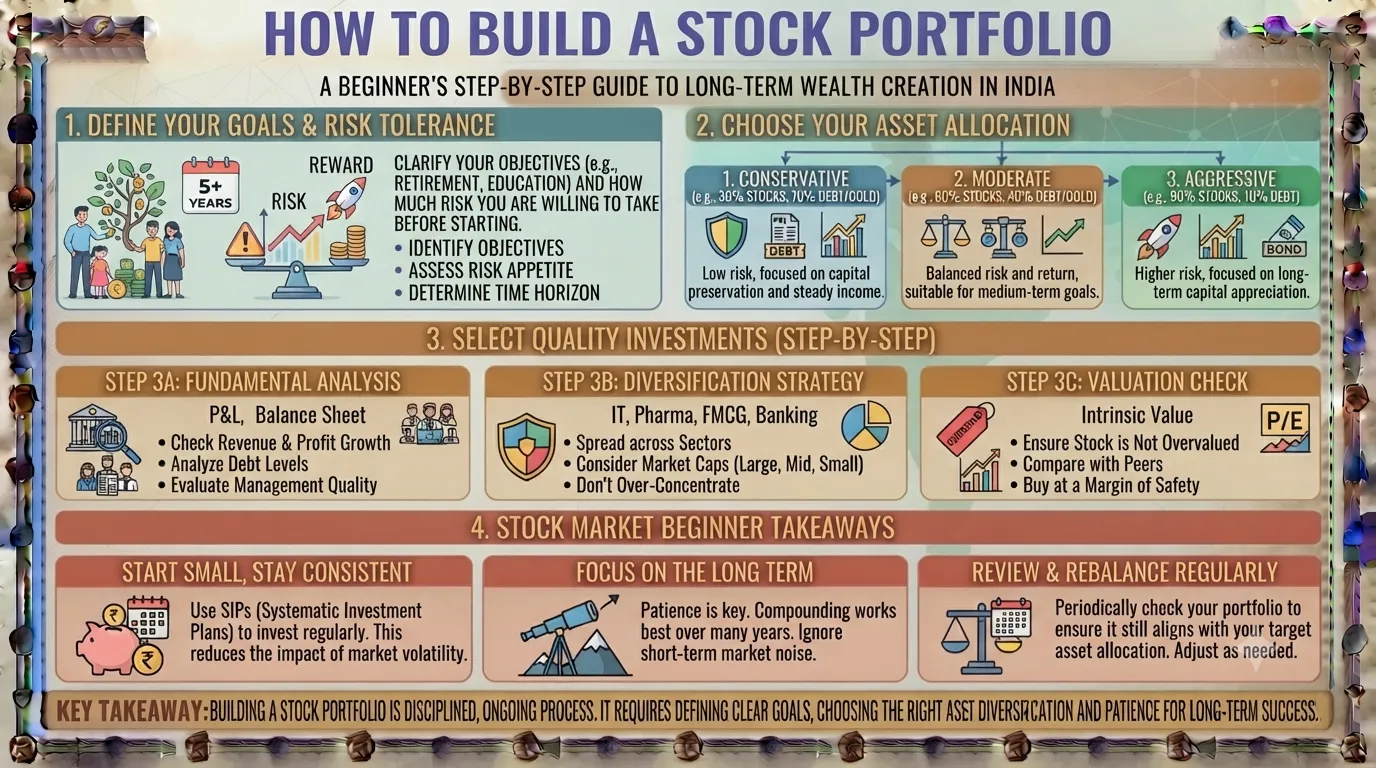
How to Build a Stock Portfolio: A Step-by-Step Guide for Indian Investors
Building a stock portfolio is not simply about finding a few popular companies and buying their shares. It is about creating a collection of investments that reflects your financial goals, investment horizon, risk capacity and understanding of the businesses you own.
A portfolio containing several well-known stocks can still be poorly constructed. For example, owning shares in five companies that depend heavily on the same economic conditions may expose you to similar risks. Similarly, buying a fundamentally strong company at an unreasonable valuation can affect your investment outcome.
For Indian investors, building a stock portfolio requires a structured approach: decide why you are investing, determine how much capital can be exposed to equity risk, research companies, diversify sensibly, control position sizes and review the portfolio periodically.
This guide explains how to build a stock portfolio step by step, with practical examples using hypothetical amounts in Indian rupees.
What Is a Stock Portfolio?
A stock portfolio is a collection of shares and other equity investments held by an investor. It may include companies from different sectors, industries and market-capitalisation categories.
For example, an investor may hold shares of companies operating in banking, information technology, healthcare, consumer goods and automobiles. Each holding represents a portion of the investor's overall portfolio.
A portfolio can be built through:
- Direct equity: Buying individual company shares through a trading and demat account.
- Equity mutual funds: Investing in professionally managed portfolios of shares.
- Index funds and ETFs: Investing in funds designed to track an index or a defined basket of securities.
- A combination of these options: Holding selected individual stocks alongside diversified funds.
A stock portfolio is different from a complete investment portfolio. A complete financial portfolio may also include debt investments, deposits, gold, real estate and other assets. The appropriate mix depends on an investor's financial circumstances and objectives.
Why Should You Build a Stock Portfolio Instead of Buying Random Stocks?
Buying shares without a plan can lead to overlapping investments, excessive exposure to one sector and decisions driven by market excitement.
A structured portfolio helps investors make decisions using a consistent framework.
1. Manage company-specific risk
Every company faces risks that can affect its financial performance. These may include weak demand, rising costs, management problems, regulatory changes, competition or excessive debt.
Holding investments across different businesses can reduce the impact of a problem affecting one company. However, diversification cannot eliminate market-wide risk.
2. Avoid excessive concentration
Suppose an investor has ₹2,00,000 invested in shares, with ₹1,20,000 concentrated in one company. If that company's share price falls sharply, the portfolio can suffer a substantial loss.
A portfolio plan helps establish position sizes before emotions influence investment decisions.
3. Align investments with financial goals
Money intended for a long-term goal may be treated differently from money required in the near future. Equity prices can fluctuate significantly, and an investor who must sell during a market decline may have to realise a loss.
The investment horizon should therefore influence how much money is allocated to shares.
4. Make monitoring more meaningful
A portfolio with a clear purpose is easier to review. Instead of checking only whether a share price has increased, investors can assess whether the company's business performance, financial condition and original investment rationale remain intact.
Step 1: Define Your Financial Goal and Investment Horizon
Before selecting any stock, identify why you are investing.
Common goals include:
- Building long-term wealth.
- Accumulating funds for retirement.
- Creating a corpus for a future financial goal.
- Participating in the long-term growth of businesses.
- Generating potential capital appreciation over an extended period.
Next, determine when you may need the money.
For example:
| Investment requirement | Possible consideration |
|---|---|
| Money needed within one year | Equity-market volatility may make direct stocks unsuitable |
| Goal in two to three years | Capital preservation and liquidity become especially important |
| Long-term goal over several years | Equity may be considered if the investor can tolerate substantial fluctuations |
| Retirement decades away | A long horizon may provide more time to manage market volatility, but does not remove investment risk |
These are general illustrations, not personal allocation recommendations.
SEBI's investor guidance identifies financial goals, investment horizon, risk appetite, liquidity, diversification and periodic review as important factors to consider before investing.
An important rule is to avoid investing money in shares simply because it is currently available. First consider essential expenses, emergency savings, high-interest debt and upcoming financial commitments.
Step 2: Understand Your Risk Capacity and Risk Tolerance
Risk capacity and risk tolerance are related, but they are not identical.
Risk capacity is the financial ability to withstand a loss without damaging important financial goals.
Risk tolerance is the level of uncertainty and price fluctuation an investor can psychologically handle.
Consider two investors:
- Investor A has stable income, sufficient emergency savings and a long investment horizon.
- Investor B needs the invested money for a major expense within the next year.
Even if both investors say they are comfortable with market volatility, their financial ability to bear losses is different.
Before building a stock portfolio, consider:
- Can you continue meeting essential expenses if your portfolio falls in value?
- Do you have enough liquidity for emergencies?
- Will you need the invested money within the next few years?
- Can you tolerate a prolonged period of poor market performance?
- Do you understand the possibility of losing a substantial part of your invested capital?
Do not confuse willingness to take risk with the ability to take risk.
Step 3: Decide How Much Capital to Allocate to Stocks
The next decision is how much of your overall investable money should be allocated to equities.
This is called asset allocation.
For example, an investor's overall financial portfolio might contain equity, debt-oriented investments, cash or deposits, and gold. The proportions should reflect the investor's goals, time horizon, risk capacity and liquidity needs.
There is no universally correct equity percentage for every investor.
A young investor is not automatically suited to putting all available money into shares. Likewise, an older investor is not automatically required to avoid equities. Financial obligations, income stability, time horizon and ability to withstand losses all matter.
Stock portfolio versus complete investment portfolio
It is important to distinguish between two decisions:
- Asset allocation: How much of your overall money should go into equities, debt, gold and other asset classes?
- Stock allocation: How should the equity portion be distributed among individual stocks, sectors, funds or indices?
An investor can have a diversified stock portfolio but still have too much exposure to equity relative to their overall financial needs.
Step 4: Choose Between Direct Stocks, Mutual Funds and ETFs
Not every investor needs to select individual stocks.
The appropriate approach depends on research ability, available time, investment knowledge and willingness to monitor holdings.
| Investment approach | How it works | Main consideration |
|---|---|---|
| Individual stocks | You select and own shares of specific companies | Requires company research and ongoing monitoring |
| Equity mutual funds | A fund manager selects and manages the underlying investments | Review the fund strategy, costs, portfolio and risks |
| Index funds | The fund aims to track a specified market index | Provides index-based exposure, subject to tracking difference and market risk |
| Equity ETFs | Exchange-traded funds provide exposure to an underlying index or basket | Consider liquidity, bid-ask spread, tracking difference and costs |
| Combined approach | Individual stocks are held alongside funds | Check for overlapping exposure and unnecessary complexity |
When direct stock investing may make sense
Direct stocks may suit investors who can:
- Read company financial statements.
- Understand how a business earns money.
- Evaluate debt and cash flow.
- Compare valuation with business prospects.
- Follow company disclosures and results.
- Monitor changes in the original investment rationale.
When funds may be more practical
Mutual funds and index funds can provide exposure to multiple securities without requiring the investor to research and purchase every underlying company individually.
However, a fund is not automatically risk-free or perfectly diversified. Investors should examine its objective, underlying holdings, concentration, costs and risk characteristics.
For a deeper comparison, read TradeSensi's guide: <a href="https://tradesensi.com/markets/stocks-vs-mutual-funds-key-differences-risks-and-benefits/">Stocks vs Mutual Funds: Key Differences, Risks and Benefits</a>.
Step 5: Create a Stock Selection Framework
Once you decide to invest directly in shares, develop a repeatable method for evaluating companies.
Do not select a stock only because it is trending, has recently increased in price or is frequently discussed on social media.
A useful stock research framework should examine the business, financial condition, management, competitive position and valuation.
1. Understand the company's business model
Start with basic questions:
- What products or services does the company sell?
- Who are its customers?
- How does it generate revenue?
- What are its major costs?
- What factors influence demand?
- Who are its competitors?
- What could weaken its competitive position?
If you cannot explain how a company makes money, you may not understand the investment well enough.
2. Examine revenue and profit trends
Review the company's financial performance over multiple reporting periods.
Look at:
- Revenue growth.
- Operating profit.
- Net profit.
- Profit margins.
- Earnings consistency.
- Changes in business segments.
A single strong quarter does not establish a sustainable growth trend. Understand whether reported growth comes from the underlying business, one-time gains, acquisitions or temporary conditions.
3. Check debt and financial obligations
Debt can help a company finance expansion, but excessive borrowing can create financial pressure.
Review:
- Total borrowings.
- Debt-to-equity ratio, where meaningful.
- Interest expense.
- Interest coverage.
- Debt repayment schedule.
- Operating cash flow.
Do not apply the same debt threshold to every industry. Banks and other financial institutions operate with different balance-sheet structures from manufacturing or technology companies.
4. Examine cash flow
Accounting profit and cash generation are not the same thing.
Operating cash flow helps investors understand whether the company's regular business activities generate cash.
Compare profit trends with operating cash flow over several periods. Investigate persistent differences rather than assuming that reported earnings automatically translate into available cash.
5. Evaluate management and corporate governance
Management decisions can significantly affect shareholder outcomes.
Review:
- Promoter and management disclosures.
- Related-party transactions.
- Auditor observations.
- Corporate announcements.
- Changes in shareholding.
- Capital allocation decisions.
- Regulatory or legal disclosures.
Investors should read official exchange filings and company reports rather than relying exclusively on summaries or social media commentary.
6. Compare valuation with business quality
A strong business is not necessarily a good investment at every price.
Common valuation measures include:
| Valuation measure | What it helps examine |
|---|---|
| Price-to-Earnings (P/E) | Share price relative to earnings per share |
| Price-to-Book (P/B) | Market value relative to accounting book value |
| EV/EBITDA | Enterprise value relative to operating earnings before specified expenses |
| Price-to-Sales (P/S) | Market value relative to revenue |
| Dividend Yield | Annual dividend relative to share price |
These measures have limitations. P/E may be less useful when earnings are negative or unusually high or low. P/B is often more relevant for certain financial businesses than for asset-light companies. EV/EBITDA can obscure capital expenditure requirements and debt-related risks.
Compare companies with relevant industry peers and examine historical valuation ranges where reliable data is available.
Never treat a low valuation multiple as proof that a stock is undervalued. The market may be pricing in genuine business problems.
Step 6: Diversify Across Companies and Sectors
Diversification means spreading investments so that the portfolio does not depend excessively on the performance of a single company, industry or economic driver.
For example, an investor who owns several banks may hold multiple companies but still have significant exposure to the same broad financial-sector risks.
A diversified portfolio may include businesses from different areas of the economy, depending on the available investment opportunities and the investor's understanding of those businesses.
Examples of sectors to study
| Sector | Business factors to understand |
|---|---|
| Banking and financial services | Credit quality, asset quality, funding costs and regulation |
| Information technology | Global demand, client spending, deal pipelines and currency exposure |
| Healthcare and pharmaceuticals | Product mix, research pipeline, regulation and pricing pressure |
| Consumer goods | Demand, distribution, input costs and brand strength |
| Automobiles | Sales volumes, competition, input costs and technology changes |
| Energy | Commodity prices, regulation, capital expenditure and energy transition |
| Infrastructure | Order book, execution, working capital and project financing |
These are research categories, not recommended sector weightings.
Avoid hidden concentration
A portfolio can appear diversified while its holdings remain exposed to similar risks.
For example:
- Several banks may be affected by the same credit cycle.
- Multiple IT companies may depend on technology spending by similar overseas customers.
- Different companies may depend on the same commodity input.
- A collection of subsidiaries or group companies may create exposure to related business risks.
Look beyond the number of stocks. Examine what drives their revenue, earnings and valuations.
Is there an ideal number of stocks?
There is no fixed number that guarantees a properly diversified portfolio.
A very small number of holdings can create substantial company-specific concentration. However, holding too many individual stocks can make research and monitoring difficult, particularly for investors with limited time.
An IIM Ahmedabad research paper examining Indian equity portfolios studied how the number of stocks affects the reduction of diversifiable risk. Its findings show why simple rules such as “10 stocks are always enough” should not be treated as universal facts.
The practical objective is to balance diversification with the ability to understand and monitor each holding. Investors who cannot research a sufficiently broad set of businesses may find diversified funds more practical than constructing a large direct-stock portfolio.
Step 7: Decide Position Sizes Before Buying
Position sizing means deciding what percentage of the portfolio should be invested in each stock.
This is one of the most important parts of portfolio construction because even a good company can experience a sharp decline.
Consider a hypothetical investor with ₹2,00,000 allocated to direct stocks.
| Stock holding | Investment amount | Portfolio weight |
|---|---|---|
| Company A | ₹20,000 | 10% |
| Company B | ₹20,000 | 10% |
| Company C | ₹15,000 | 7.5% |
| Company D | ₹15,000 | 7.5% |
| Company E | ₹10,000 | 5% |
| Other holdings or unallocated capital | ₹1,20,000 | 60% |
| Total | ₹2,00,000 | 100% |
This is only an arithmetic illustration, not a recommended portfolio structure. The unallocated portion is not automatically a recommendation to hold cash; the investor must decide whether and how it should be deployed according to their plan.
How to calculate portfolio weight
Use this formula:
Portfolio Weight (%) = (Value of a Holding ÷ Total Portfolio Value) × 100
For example, if a holding is worth ₹15,000 and the total portfolio is ₹2,00,000:
Portfolio weight = (₹15,000 ÷ ₹2,00,000) × 100 = 7.5%
The calculation should use current market value when reviewing concentration, not just the original purchase amount.
Understand the effect of a large position
Suppose a stock represents 20% of a portfolio and its price falls by 30%, while all other holdings remain unchanged.
The approximate portfolio impact would be:
20% × 30% = 6%
The overall portfolio would decline by approximately 6% from that holding's movement alone, before considering other changes, costs or taxes.
This illustrates why position size matters even when an investor has researched the company.
Step 8: Plan Your Buying Process
After selecting a company and deciding its intended portfolio weight, consider how you will purchase the shares.
Investors may use:
- A lump-sum purchase.
- Multiple purchases over time.
- Regular contributions.
- A combination based on a pre-defined investment plan.
Staggering purchases can reduce the risk of committing all planned capital at one price. However, it does not guarantee a lower average purchase price or a profit.
Do not buy merely because a share price has fallen. A price decline may create an opportunity, but it may also reflect deteriorating business fundamentals.
Before adding to a holding, ask:
- Has the company's business outlook changed?
- Has its financial position weakened?
- Is the original investment rationale still valid?
- Has the valuation become more reasonable, or has the business risk increased?
- Will adding to this position create excessive concentration?
Avoid borrowing money or using leverage simply to build a larger stock portfolio. Losses can become more damaging when investments are funded with borrowed capital.
Step 9: Maintain a Written Investment Thesis
For every direct stock holding, write down why you own it.
An investment thesis is a short explanation of the business factors that support your decision.
A useful record may contain:
| Item | What to record |
|---|---|
| Company | Name of the listed company |
| Business model | How the company earns revenue |
| Investment rationale | Why the business is being considered |
| Growth drivers | Factors that could support future business growth |
| Main risks | Factors that could weaken performance |
| Financial checks | Important revenue, profit, debt and cash-flow observations |
| Valuation | Why the current valuation is being considered reasonable or expensive |
| Review triggers | Events or changes that require reassessment |
| Portfolio weight | Current percentage of the total portfolio |
This record helps prevent emotional decisions.
For example, a stock falling 10% does not automatically mean the investment thesis has failed. Equally, a stock rising 30% does not prove that the original analysis was correct.
The business evidence matters more than the share-price movement alone.
Step 10: Monitor Your Portfolio Without Overreacting
Monitoring is necessary, but constantly reacting to every price movement can lead to unnecessary trading.
A practical review process should cover:
Company-level review
- Quarterly financial results.
- Annual reports.
- Management commentary.
- Material corporate announcements.
- Changes in debt or cash flow.
- Auditor and governance disclosures.
- Competitive developments.
Portfolio-level review
- Weight of each stock.
- Sector concentration.
- Exposure to related businesses.
- Overall equity exposure.
- Cash or liquidity needs.
- Investment-goal progress.
- Whether the portfolio still reflects your risk capacity.
A periodic review schedule can help maintain discipline. For example, an investor may examine company results when they are published and conduct a broader portfolio review at planned intervals or after a material change in personal circumstances.
The frequency should be appropriate to the investment approach. It does not require trading after every review.
Step 11: Rebalance When Your Portfolio Drifts
Rebalancing means bringing the portfolio back towards its intended allocation when changes in market values or personal circumstances create an unsuitable mix.
Consider a hypothetical portfolio initially divided equally between two holdings:
- Stock A: ₹50,000.
- Stock B: ₹50,000.
- Total: ₹1,00,000.
After a period:
- Stock A rises to ₹70,000.
- Stock B remains at ₹50,000.
- Total portfolio value becomes ₹1,20,000.
The new weights are:
- Stock A: ₹70,000 ÷ ₹1,20,000 = 58.33%.
- Stock B: ₹50,000 ÷ ₹1,20,000 = 41.67%.
The portfolio is no longer equally weighted.
This does not automatically mean Stock A should be sold. First consider whether its business outlook, valuation, risk and role in the portfolio still justify its larger weight.
Rebalancing may involve directing new contributions towards underweight holdings, reducing an oversized position or changing the overall asset allocation. Selling can create transaction costs and tax consequences, so these should be considered before acting.
Step 12: Understand Costs, Taxes and Record-Keeping
Portfolio performance should be evaluated after considering the costs of investing.
Potential costs include:
- Brokerage charges.
- Securities Transaction Tax (STT), where applicable.
- Exchange transaction charges.
- GST on applicable services.
- SEBI-related charges.
- Stamp duty.
- Depository Participant charges.
- Bid-ask spreads.
- Applicable capital-gains taxes.
The exact costs depend on the transaction, instrument, broker and applicable rules.
For Indian listed equity shares, tax treatment depends on factors such as the nature of the security, holding period, transaction conditions and the law applicable to the relevant financial year.
Do not rely on an old tax table or assume that every transaction has the same tax treatment. Check the latest Income Tax Department guidance or consult a qualified tax professional before making tax-sensitive decisions.
Maintain records of:
- Purchase and sale dates.
- Quantity and execution price.
- Brokerage and transaction costs.
- Contract notes.
- Corporate actions.
- Dividend receipts.
- Capital-gains calculations.
- Demat and broker statements.
Accurate records make portfolio review and tax reporting more reliable.
Example: How a Beginner Could Structure a Hypothetical Stock Portfolio
Suppose an investor has ₹1,00,000 that has already been set aside for long-term equity investing. The investor wants to learn direct stock research and is considering a simple portfolio.
A possible educational framework might look like this:
| Research area | Example allocation | Amount |
|---|---|---|
| Banking and financial services | 20% | ₹20,000 |
| Information technology | 15% | ₹15,000 |
| Healthcare | 15% | ₹15,000 |
| Consumer businesses | 15% | ₹15,000 |
| Automobiles and related businesses | 10% | ₹10,000 |
| Other researched opportunities | 10% | ₹10,000 |
| Unallocated capital | 15% | ₹15,000 |
| Total | 100% | ₹1,00,000 |
This is a hypothetical illustration of how an investor might organise research areas. It is not a model portfolio, a recommendation to invest in these sectors or a suggested allocation for any individual.
Actual sector weights should not be selected simply to make a table look balanced. The investor must examine the underlying companies, valuations, business risks and correlations. The unallocated amount also requires a deliberate decision based on the investment plan.
The example demonstrates an important principle: portfolio construction involves more than choosing stocks. It includes deciding how much to allocate, understanding overlapping risks and maintaining room to act according to a defined process.
Common Mistakes to Avoid When Building a Stock Portfolio
1. Buying stocks based on tips
Social media posts, anonymous messages and unverified recommendations are not substitutes for independent research. Verify important information through company disclosures and recognised sources.
2. Investing everything in one sector
A sector may perform well for a period and then face a downturn. Excessive sector concentration can expose the portfolio to common risks.
3. Confusing a famous company with a good investment
Brand recognition does not guarantee attractive valuation, strong governance or future earnings growth.
4. Ignoring valuation
A high-quality company can still deliver disappointing investment results if purchased at an excessive valuation.
5. Holding too many stocks without understanding them
A long list of holdings may create the appearance of diversification while making research and monitoring harder.
6. Selling because of short-term price movements
A price fall should trigger a review, not an automatic decision. Check whether the company's underlying business and investment rationale have changed.
7. Ignoring financial goals
A portfolio that is suitable for one investor may be unsuitable for another. Investment horizon, liquidity needs and financial obligations matter.
8. Overlooking costs and taxes
Frequent buying and selling can increase costs and may create tax consequences. Review the impact before changing holdings.
9. Treating diversification as protection against every loss
Diversification can reduce company-specific and concentration risk, but it cannot prevent losses when the broader equity market declines.
10. Failing to document investment decisions
Without a written investment rationale, investors may find it difficult to distinguish a temporary price fluctuation from a genuine deterioration in the business.
Direct Stock Portfolio vs Index Fund: Which Approach Is Easier to Maintain?
Both approaches can provide equity-market exposure, but they require different levels of involvement.
| Factor | Direct stock portfolio | Index fund |
|---|---|---|
| Security selection | Investor selects individual companies | Index methodology determines constituents |
| Research effort | Requires company-level research | Requires fund and index-level evaluation |
| Diversification | Must be constructed and monitored | Generally provides exposure to multiple index constituents |
| Control | Investor controls individual holdings | Investor chooses the fund, not individual constituent weights |
| Costs | Brokerage and transaction-related costs may apply | Fund expense ratio and applicable transaction costs may apply |
| Monitoring | Company and portfolio monitoring required | Fund tracking, costs and index composition should be reviewed |
| Main risk | Company-specific and market risk | Market and index-concentration risk, among others |
An index fund can simplify diversification, but it does not remove market risk. Some indices are also concentrated in a limited number of large companies or sectors.
A direct stock portfolio offers more control but requires more research, discipline and monitoring.
The right approach depends on the investor's ability and willingness to manage the investments.
Frequently Asked Questions
1. How many stocks should a beginner have in a portfolio?
There is no universally correct number. The appropriate number depends on portfolio size, diversification needs, research ability and monitoring capacity. Holding a few stocks can create concentration risk, while holding too many can make meaningful analysis difficult. Investors who cannot research a broad range of companies may consider diversified funds.
2. How much money is needed to build a stock portfolio in India?
There is no single minimum portfolio value for all investors. The amount needed depends on share prices, the number of holdings, transaction costs and the investor's ability to diversify sensibly. Fractional ownership is generally not available for ordinary listed Indian shares in the same way it is in some overseas markets, so the cost of buying whole shares matters.
3. Should beginners invest in large-cap, mid-cap or small-cap stocks?
These categories represent companies of different market-capitalisation sizes and can have different risk characteristics. Smaller companies may face greater liquidity, business and price-volatility risks, but large companies are not risk-free. Beginners should understand the underlying business and risk rather than selecting stocks only by market-cap category.
4. Is it better to buy individual stocks or mutual funds?
Individual stocks provide direct control over company selection but require more research and monitoring. Mutual funds pool investments and can provide diversified exposure through a professionally managed structure. The better approach depends on the investor's knowledge, available time, costs and risk preferences.
5. How often should I review my stock portfolio?
Review company information when material results or disclosures are published, and conduct broader portfolio reviews at planned intervals. Also reassess the portfolio when financial goals, income, liabilities or liquidity requirements change. Avoid making unnecessary trades simply because share prices move every day.
6. What is the difference between diversification and asset allocation?
Asset allocation determines how money is distributed across asset classes such as equity, debt and gold. Diversification spreads investments within and across those categories to reduce dependence on a single investment or risk source. They are related but not interchangeable concepts.
7. Can a diversified stock portfolio still lose money?
Yes. Diversification can reduce the impact of poor performance in an individual company or a particular segment, but it cannot eliminate broad market risk. If the overall equity market declines, many stocks may fall together.
8. Should I sell a stock when it falls by 10% or 20%?
There is no universal percentage that automatically determines whether a stock should be sold. Reassess the company's business performance, financial position, valuation, governance and original investment rationale. A price decline may reflect market volatility or a genuine deterioration in the business. The decision should follow the investment plan, not an arbitrary price movement.
Conclusion: Build a Portfolio Around a Process, Not Stock Tips
Building a stock portfolio requires more than identifying companies that appear attractive. Investors need to define their goals, understand their risk capacity, decide how much capital belongs in equities, research businesses, manage position sizes and diversify across different sources of risk.
A useful portfolio is one that the investor can understand, monitor and maintain through different market conditions. It should have a clear investment rationale, realistic expectations and a review process that responds to meaningful changes rather than daily market noise.
For Indian investors, official company disclosures, annual reports, exchange announcements and reliable investor-education resources should form the foundation of research. No stock portfolio can guarantee returns or eliminate losses, but a disciplined construction process can help investors make more informed decisions.
Financial Disclaimer: This article is for educational and informational purposes only. It does not constitute investment advice, a recommendation to buy or sell any security, or a personalised portfolio allocation. All portfolio amounts and allocations used in examples are hypothetical and are not based on live market prices. Equity investments are subject to market risks, including the possible loss of capital. Readers should conduct independent research and consider consulting a SEBI-registered investment adviser before making investment decisions.