Dividend Investing: How to Analyze Dividend Stocks
Learn how to analyse dividend stocks using dividend yield, payout ratio, cash flow, dividend growth, financial health and valuation, with practical examples for Indian investors.
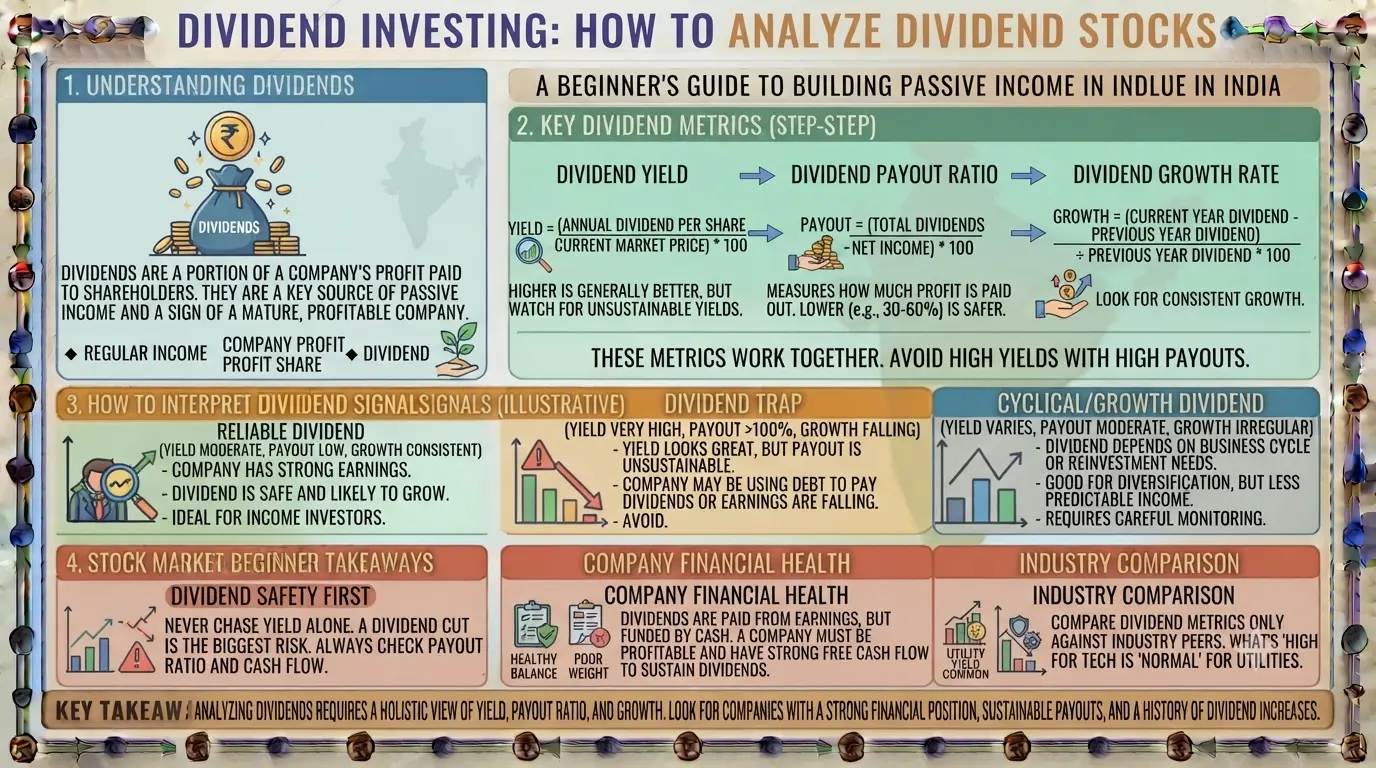
Dividend Investing: How to Analyze Dividend Stocks
Dividend investing is a strategy in which investors buy shares of companies that distribute a portion of their earnings or available profits to shareholders. These payments can provide an additional source of income, but a company paying a dividend is not automatically a good investment. The amount, consistency and financial strength behind the payment matter more than the headline yield.
For Indian investors, analysing dividend stocks requires more than checking which companies have the highest dividend yield on a stock screener. You should examine the company's earnings, payout ratio, free cash flow, debt, dividend history, business outlook and share valuation. You should also understand how dividend income is taxed.
Direct answer: To analyse a dividend stock, check whether its dividend yield is reasonable, whether earnings and free cash flow can support the payout, whether debt is manageable, whether dividends have been consistent across business cycles and whether the share price offers an attractive overall investment opportunity. No single ratio can establish dividend safety.
What Is Dividend Investing?
Dividend investing involves purchasing shares in companies that distribute cash to shareholders. A dividend is a distribution made to eligible shareholders under the company's dividend decision and applicable legal requirements. It is separate from the profit an investor may make by selling shares at a higher price.
For example, if you own 100 shares of a company and it declares a dividend of ₹6 per share, your gross dividend entitlement is ₹600, subject to eligibility and applicable tax deductions.
Companies may distribute dividends when they generate profits and have surplus cash after considering operating requirements, investment plans, debt obligations and other capital-allocation needs. Other companies may retain most of their earnings to expand operations, develop products, reduce debt or fund acquisitions.
Common types of dividends
- Interim dividend: A dividend declared during the financial year before the final annual dividend decision.
- Final dividend: A dividend proposed after the financial year, subject to the required corporate approvals.
- Special dividend: An additional, usually non-recurring distribution. It may follow an asset sale, exceptional cash generation or another unusual event.
Do not assume that an interim or special dividend will be repeated. When analysing recurring income, separate regular distributions from one-time payments.
Why Should Investors Analyse Dividend Stocks?
A dividend can be useful, but the payment alone does not reveal whether the underlying business is financially strong. A company may maintain a dividend temporarily even when earnings are weakening. It may also distribute cash while borrowing heavily or postponing necessary investment.
Dividend analysis helps investors understand:
- How much income a share currently indicates relative to its market price.
- How much of the company's earnings are distributed rather than retained.
- Whether operating cash generation can support the dividend.
- Whether debt and future investment requirements could restrict distributions.
- Whether the dividend has been maintained or increased over time.
- Whether the share price is reasonable relative to the company's financial prospects.
The objective is not to find the highest possible yield. It is to understand whether the dividend is supported by a durable business and whether the investment's potential total return justifies its risks.
How to Analyse Dividend Stocks: 8 Important Factors
1. Check the Dividend Yield
Dividend yield measures the annual dividend per share relative to the current market price. It helps investors compare the income indicated by different share prices.
Formula:
Dividend Yield = (Annual Dividend Per Share ÷ Current Market Price Per Share) × 100
Hypothetical example: Suppose a company has distributed ₹12 per share over the last 12 months and its current market price is ₹240.
- Annual dividend per share = ₹12
- Current market price = ₹240
- Dividend yield = (₹12 ÷ ₹240) × 100
- Dividend yield = 5%
The indicated trailing dividend yield is 5%. This does not mean the company will necessarily pay ₹12 again next year. Future dividends depend on business performance and the company's dividend decisions.
Important: Do not confuse a dividend percentage declared on face value with dividend yield. If a company with a face value of ₹10 declares a 100% dividend, the dividend amount is ₹10 per share. If the share trades at ₹200, the yield based on that payment is 5%, not 100%.
Why an unusually high yield can be risky
Dividend yield rises when the share price falls, even if the dividend amount remains unchanged. A sharp price decline may reflect deteriorating earnings, debt concerns, regulatory problems or expectations of a dividend reduction.
For this reason, compare current yield with the company's own historical range and similar businesses. Investigate why the yield is high before treating it as an opportunity.
2. Analyse the Dividend Payout Ratio
The dividend payout ratio shows how much of a company's earnings are distributed to shareholders as dividends. It helps investors assess how much profit the company retains for reinvestment, debt reduction and future financial needs.
Formula:
Dividend Payout Ratio = (Total Equity Dividends ÷ Net Profit Attributable to Equity Shareholders) × 100
For a per-share calculation, an equivalent approach is:
Dividend Payout Ratio = (Dividend Per Share ÷ Earnings Per Share) × 100
Hypothetical example: A company reports earnings per share of ₹40 and pays an annual dividend of ₹16 per share.
- Dividend per share = ₹16
- EPS = ₹40
- Payout ratio = (₹16 ÷ ₹40) × 100
- Payout ratio = 40%
The company distributes 40% of the earnings represented by EPS and retains the remaining 60%, subject to other adjustments and the company's financial statements.
A lower payout can provide more room to absorb a fall in earnings, invest in the business or reduce debt. A high payout may be reasonable for a mature business with stable cash generation and limited reinvestment requirements. However, a payout consistently close to or above 100% deserves closer investigation.
There is no universal payout ratio that makes every company safe. Compare businesses within similar industries and examine the company's investment needs, earnings stability and cash generation.
3. Examine Free Cash Flow and Dividend Coverage
Accounting profit and available cash are not the same thing. A company can report positive net profit while experiencing weak operating cash flow because customers have not paid, inventory has increased or working capital requirements have absorbed cash.
Dividends require cash. Therefore, investors should examine the cash flow statement rather than relying only on the income statement.
Basic free cash flow formula:
Free Cash Flow = Cash Flow from Operations − Capital Expenditure
This is a commonly used analytical measure. Companies and analysts may define capital expenditure or free cash flow differently, so use a consistent definition when comparing businesses.
Hypothetical example: A company generates ₹500 crore in cash from operations and spends ₹180 crore on capital expenditure.
- Cash flow from operations = ₹500 crore
- Capital expenditure = ₹180 crore
- Free cash flow = ₹320 crore
If the company distributes ₹120 crore in cash dividends, its free-cash-flow coverage is approximately 2.67 times (₹320 crore ÷ ₹120 crore). Its dividend payments are below the free cash flow generated during that period.
This is a useful indication, not proof of future safety. Cash flow can be affected by working capital movements, maintenance requirements, acquisitions, cyclical demand and one-off receipts.
Review several years of operating cash flow and capital expenditure. A single year of unusually strong cash generation may not represent the company's normal financial position.
4. Review Debt and Interest Obligations
Debt can reduce a company's flexibility to maintain dividends. Interest and principal repayments are contractual obligations, whereas equity dividends are generally discretionary distributions. When cash becomes tight, management may need to prioritise debt servicing and essential business investment over dividends.
Review these items:
- Total short-term and long-term borrowings.
- Interest expense and borrowing costs.
- Debt maturity schedule.
- Cash and liquid investments available to the business.
- Debt-to-equity and net debt-to-EBITDA ratios, where relevant.
- Whether the company is borrowing more while maintaining or increasing dividends.
A company with rising debt, weak cash generation and an aggressive payout may have less room to sustain distributions during a downturn. However, debt levels must be assessed in the context of the sector and business model. Banks and other financial companies require different balance-sheet measures from manufacturing companies.
5. Study Dividend History and Growth
A company's dividend history can help reveal its capital-allocation approach. Review at least five years where reliable data is available, and use a longer period when the business has experienced different economic conditions.
Look for:
- Consistency of regular dividend payments.
- Whether dividends were cut or suspended during difficult periods.
- Whether increases were supported by earnings and cash-flow growth.
- Whether recent payments included unusually large special dividends.
- Whether the company has issued new shares or completed corporate actions that affect per-share comparisons.
Dividend growth can be calculated as:
Dividend Growth Rate = [(Current Annual Dividend Per Share ÷ Previous Annual Dividend Per Share) − 1] × 100
Hypothetical example: If annual dividend per share rises from ₹10 to ₹11, the increase is 10%.
Do not assume that a history of annual increases guarantees future growth. A company may change its policy when earnings, cash requirements or business conditions change.
6. Understand the Company's Business and Industry
Dividend sustainability depends on the business that generates the cash. A stable dividend record is more meaningful when the company has a durable competitive position, predictable demand and a manageable investment cycle.
Consider the following differences:
- Consumer businesses: Examine brand strength, demand stability, pricing power and working capital.
- Utilities: Review regulation, capital expenditure, project funding and debt obligations.
- Oil, gas and mining: Consider commodity prices, production costs, reserve quality and the cyclical nature of earnings.
- Manufacturing: Examine capacity utilisation, maintenance capital expenditure, order visibility and working capital.
- Banks and financial companies: Study asset quality, capital adequacy, provisions, loan growth and regulatory capital requirements. A generic industrial-company debt-to-equity comparison is not appropriate.
A dividend policy that appears sustainable in one industry may be unsuitable in another. Compare the company with businesses that have similar economics and capital requirements.
7. Evaluate Management and Capital Allocation
Dividend decisions are part of a company's wider capital-allocation policy. Management must decide how much cash to retain, invest, use to repay debt, distribute as dividends or return through buybacks.
Read the annual report, dividend policy if published, board announcements and management commentary. Consider whether management explains the reason for the payout and whether it balances shareholder distributions with future investment needs.
Also review:
- Auditor qualifications and important notes to accounts.
- Related-party transactions.
- Promoter shareholding and pledged shares, where applicable.
- Unusual changes in reported earnings or cash flow.
- Large acquisitions, asset sales or exceptional income supporting a one-off dividend.
A high dividend should not distract investors from governance concerns or a weakening core business.
8. Check Valuation and Total Return Potential
A financially strong dividend-paying company can still be an unattractive investment if its share price is too high. Dividend yield should be considered alongside valuation and the potential for capital appreciation or loss.
Useful valuation measures may include:
- Price-to-earnings ratio: Compares share price with earnings per share.
- Price-to-book ratio: Can be useful for certain asset-heavy and financial businesses, with sector-specific interpretation.
- Free-cash-flow yield: Compares free cash flow with market capitalisation.
- Historical valuation: Compares the current valuation with the company's own past range, while accounting for changes in business quality and risk.
Investors should also assess total return, which includes dividend income and the change in share price. A dividend payment does not prevent an investor from losing capital if the stock price falls significantly.
For example, a stock that pays a 5% dividend but loses 15% of its market value has not necessarily delivered a positive overall return. Dividends are one component of investment performance, not a substitute for evaluating the underlying share.
Dividend Yield vs Dividend Payout Ratio
These two ratios answer different questions and should not be treated as interchangeable.
| Factor | Dividend Yield | Dividend Payout Ratio |
|---|---|---|
| What it measures | Annual dividend relative to market price | Share of earnings distributed as dividends |
| Main use | Assess indicated income relative to investment price | Assess how much earnings are being distributed |
| What changes it | Dividend amount and share price | Dividend amount and company earnings |
| Main limitation | Can rise because the share price falls | Can be distorted by one-off earnings or losses |
| What to check alongside it | Share-price trend, payout, cash flow and valuation | Free cash flow, debt and future investment needs |
Practical Example: Comparing Two Hypothetical Dividend Stocks
Consider two fictional companies, Company A and Company B. Both trade at ₹200 per share, but their dividend and financial profiles differ.
| Metric | Company A | Company B |
|---|---|---|
| Share price | ₹200 | ₹200 |
| Annual dividend per share | ₹8 | ₹16 |
| Dividend yield | 4% | 8% |
| EPS | ₹24 | ₹18 |
| Payout ratio | 33.3% | 88.9% |
| Cash-flow position | Positive and relatively stable | Weak and inconsistent |
| Debt trend | Manageable | Increasing |
Company B offers twice the dividend yield of Company A. However, it also distributes a much larger proportion of its earnings and has weaker cash flow and rising debt.
Company A appears to have more earnings retained after dividends and a stronger financial position in this simplified example. That does not automatically make it the better investment: investors would still need to evaluate business quality, valuation, industry risks and future prospects.
The lesson is straightforward: a higher dividend yield does not necessarily indicate a better dividend stock.
How to Find Dividend Information for Indian Companies
Investors can use official company disclosures and stock exchange announcements to verify dividend information instead of relying only on third-party stock lists.
- Visit the company's investor-relations website and locate its financial results, annual reports and dividend announcements.
- Check the company's filings on the NSE corporate filings page or the BSE corporate announcements page.
- Verify the dividend amount, whether it is interim, final or special, and the relevant corporate-action dates.
- Review the record date and ex-dividend date in the exchange announcement. Do not assume that buying a share on the record date automatically makes you eligible.
- Compare the dividend history with annual earnings, cash flow and borrowings in the company's financial statements.
SEBI's investor material explains dividend yield and highlights the importance of checking dividend announcements, record dates and ex-dates. See the SEBI Beginner's Guide for Share and Debenture Holders.
Dividend Dates Every Investor Should Understand
- Declaration date: The date on which the dividend decision is announced.
- Ex-dividend date: The date from which a buyer of the share is no longer entitled to the announced dividend under the applicable settlement rules.
- Record date: The date on which the company determines eligible shareholders based on its records.
- Payment date: The date on which the dividend is scheduled to be paid.
Always verify dates in the latest exchange announcement. Corporate-action schedules can change, and eligibility depends on the applicable settlement and record-date rules.
Dividend Taxation in India
Dividend income is taxable in the hands of shareholders under the applicable income-tax rules. For resident individual investors, the tax treatment generally depends on their applicable tax position and the nature of the dividend. A dividend is not automatically tax-free merely because it is received from a listed company.
For tax year 2026–27, the Income-tax Act, 2025 is in force. Section 92 includes dividend income under the head "Income from other sources". Section 393 provides for tax deduction at source on dividend payments by domestic companies, subject to the statutory provisions and exceptions. The current TDS table specifies a 10% rate; the Act also contains a limited exception for certain individual shareholders where the dividend is paid otherwise than in cash and the aggregate amount does not exceed ₹10,000.
TDS is a tax withholding and is not necessarily the final tax payable. Investors should reconcile tax deducted with their tax records and report dividend income as required. Rules may differ for non-residents and other categories of investors.
For current details, refer to the Income Tax Department's dividend taxation guidance and the official text of Section 393. Tax provisions should be checked again for the relevant tax year before filing a return.
Common Mistakes to Avoid in Dividend Investing
- Choosing stocks only by yield: A high yield may reflect a falling share price or an expected dividend cut.
- Ignoring cash flow: Accounting profit does not guarantee that sufficient cash is available to fund distributions.
- Assuming past dividends will continue: Companies can reduce, suspend or change their dividend policies.
- Ignoring special dividends: A one-time distribution can make a trailing yield look unusually high.
- Using the same payout benchmark for every sector: Capital requirements, regulation and business cycles differ across industries.
- Overlooking debt: High borrowing costs and repayment commitments can restrict future distributions.
- Ignoring valuation: A strong dividend-paying business can still be overpriced.
- Forgetting taxes and total return: Gross dividend yield is not the same as after-tax investment return.
- Buying only to capture an announced dividend: Share prices can adjust around ex-dividend dates, and the payment does not create a risk-free profit.
Dividend Investing vs Growth Investing
Dividend investing and growth investing differ mainly in how companies use their earnings and what investors prioritise. They are not mutually exclusive: a company can distribute dividends while continuing to grow.
| Factor | Dividend Investing | Growth Investing |
|---|---|---|
| Primary focus | Cash distributions alongside potential capital appreciation | Business expansion and potential capital appreciation |
| Use of earnings | A portion may be distributed | A larger portion may be reinvested |
| Common company profile | Often mature businesses with surplus cash | Often businesses with attractive reinvestment opportunities |
| Key analytical focus | Dividend sustainability and total return | Growth quality, reinvestment returns and valuation |
| Main risk | Dividend cuts and capital loss | Growth expectations not being achieved |
Are Dividend Stocks Safe Investments?
No equity investment is risk-free. A company can reduce or stop dividends, its earnings can decline, and its share price can fall. Even a business with a long dividend history can face new competition, regulatory changes, commodity-price shocks or financial pressure.
Dividend stocks should therefore be assessed as equity investments, not treated as guaranteed-income products. Investors should consider diversification, their time horizon, liquidity needs and ability to tolerate capital losses.
Frequently Asked Questions About Dividend Investing
1. What is a good dividend yield for a stock?
There is no universally good dividend yield. The appropriate level depends on the industry, business risk, payout ratio, cash flow, debt and valuation. Compare a company's yield with its own history and similar businesses rather than applying one fixed percentage to every stock.
2. Is a high dividend yield always better?
No. A high yield can result from a falling share price, deteriorating earnings or an unsustainable dividend. Check the payout ratio, free cash flow, debt and reason for the price decline before drawing a conclusion.
3. What is a healthy dividend payout ratio?
There is no single healthy payout ratio for all companies. A mature business with stable cash flows may sustain a higher payout than a capital-intensive or fast-growing business. Compare the ratio with sector peers and the company's investment requirements.
4. How many years of dividend history should investors analyse?
Review at least five years where data is available, and consider a longer period if the company has operated through different economic conditions. Examine dividend cuts, special payments and whether growth was supported by earnings and cash flow.
5. Can a company pay dividends when it reports a loss?
A reported accounting loss does not by itself explain every possible distribution. The legality and source of a distribution depend on applicable company law, available reserves and other requirements. Investors should investigate the company's financial statements and official disclosures rather than assume that a payment is sustainable.
6. Are dividends taxable in India?
Yes. Dividend income is generally taxable in the hands of the shareholder under applicable income-tax provisions. TDS may also apply, but the amount deducted is not necessarily the final tax liability. Check the current Income-tax Act and your own tax circumstances.
7. What is the difference between dividend yield and dividend payout ratio?
Dividend yield compares annual dividend per share with the current market price. The payout ratio compares dividends with company earnings. Yield indicates income relative to price, while payout helps assess how much of the company's earnings are being distributed.
8. Should investors buy a stock just before its ex-dividend date?
Not simply to collect the dividend. The share price may adjust around the ex-dividend date, and transaction costs, taxes and market movements can affect the outcome. A dividend payment does not create a guaranteed profit.
Conclusion
Dividend investing requires more analysis than selecting companies with the highest dividend yields. Investors should examine dividend yield, payout ratio, earnings quality, free cash flow, debt, dividend history, business stability, management decisions and valuation together.
A sustainable dividend is generally supported by a business that can generate cash, meet its financial obligations and fund necessary investment without placing undue pressure on its balance sheet. Even then, future payments are not guaranteed.
For Indian investors, official company disclosures and NSE or BSE announcements are important sources for checking dividend decisions and eligibility dates. Tax treatment should also be included when assessing the income that may actually remain after tax.
The most useful question is not simply, "Which stock offers the highest dividend?" It is, "Can this business afford to keep paying its dividend, and does its share price make sense for the risks involved?"
Disclaimer: This article is for educational and informational purposes only. It is not investment, tax or financial advice and does not recommend buying or selling any security. Equity investments are subject to market risks, including the risk of loss of capital. Dividend payments are not guaranteed and may be reduced or discontinued. Investors should conduct independent research and consult a SEBI-registered investment adviser where appropriate.