Growth Stocks vs Value Stocks: Key Differences, Examples and How to Choose
Understand the differences between growth stocks and value stocks, how investors evaluate them, the risks of each strategy, and how to assess them in the Indian stock market.
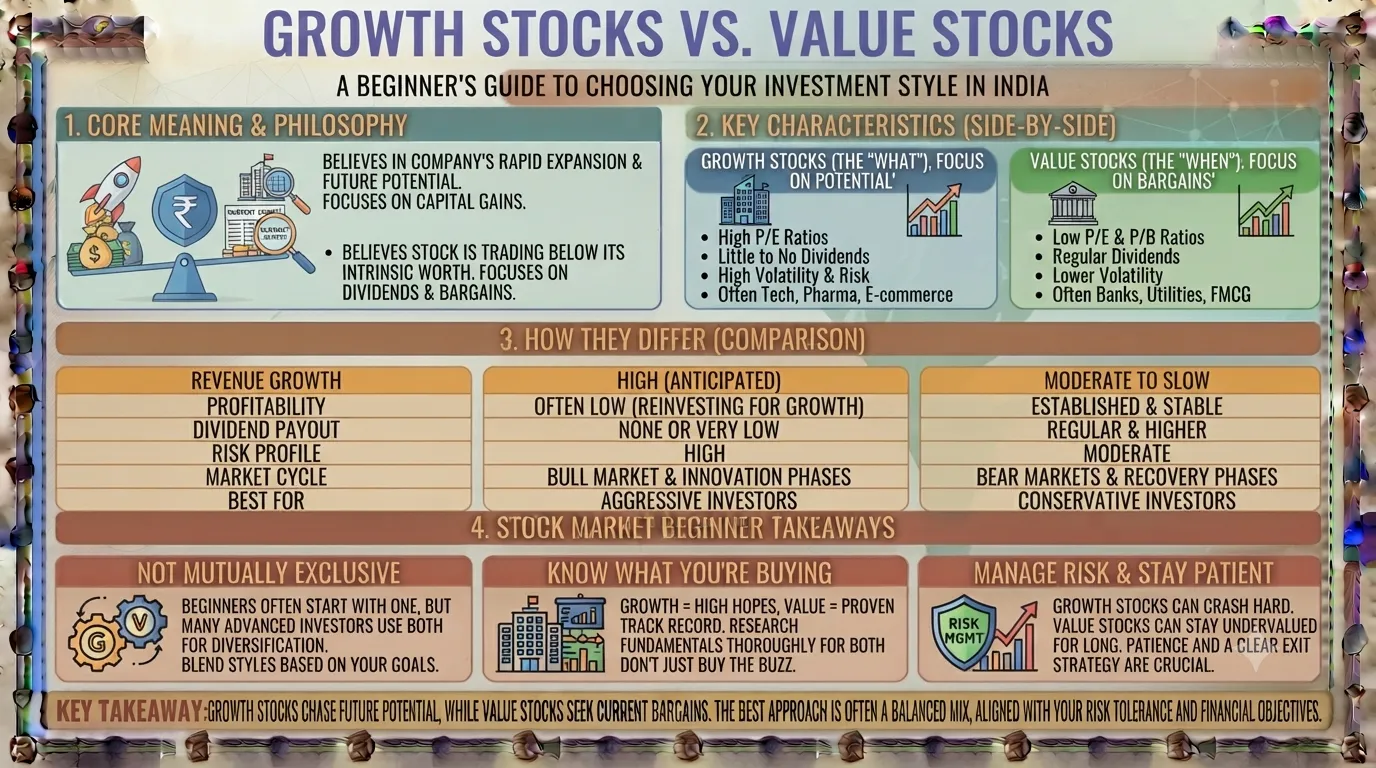
Growth Stocks vs Value Stocks: Key Differences, Examples and How to Choose
When investors compare two listed companies, one may be growing its revenue and profits rapidly while trading at a high valuation. Another may have an established business, steady cash flows and a share price that appears inexpensive compared with its earnings or assets. These businesses may represent two different investing styles: growth investing and value investing.
The debate around growth stocks vs value stocks is not simply about choosing companies that grow quickly or shares with low prices. It is about understanding what the market expects from a business, how much investors are paying for those expectations and whether the current share price offers an attractive risk-reward opportunity.
For Indian investors, this distinction is useful when analysing companies listed on the NSE and BSE, comparing sectors, evaluating mutual fund strategies and building a diversified equity portfolio. However, neither style guarantees better returns. A fast-growing company can disappoint if its valuation is excessive, while a low-priced stock can remain cheap for years if its business is deteriorating.
Growth Stocks vs Value Stocks: The Direct Answer
Growth stocks are shares of companies that investors expect to increase revenue, earnings or cash flows faster than the broader market or their industry over time. These companies often reinvest a significant portion of their profits into expansion, research, technology, capacity or new markets. Investors may be willing to pay higher valuation multiples because they expect future business growth to justify today's price.
Value stocks are shares that appear to trade below their estimated intrinsic value based on financial performance, assets, earnings or cash flows. Value investors look for a gap between what a business may reasonably be worth and what the market is currently asking them to pay. The gap may exist because of temporary negative sentiment, cyclical weakness, market neglect or company-specific concerns.
The central difference is the basis of the investment decision: growth investors place greater emphasis on future business expansion, while value investors focus on the relationship between a company's estimated worth and its current market price. Both approaches still require financial analysis, business-quality checks and valuation discipline.
What Are Growth Stocks?
A growth stock represents a company that is expected to expand its business and financial performance at a faster rate than comparable companies or the wider market. The growth may come from rising demand, new products, market-share gains, expansion into new regions, technology adoption, improved distribution or a business model that can scale.
Growth companies are not necessarily small or newly established. A large, established company can still be a growth stock if its future revenue and earnings are expected to expand meaningfully. Similarly, a small company is not automatically a growth stock simply because it has a smaller market capitalisation.
Common Characteristics of Growth Stocks
- Above-average revenue growth: Sales may be increasing faster than the industry because of rising demand, new customers or market-share gains.
- Potential for earnings expansion: Investors expect revenue growth to translate into higher operating profit and earnings over time.
- Reinvestment of cash: Management may use available cash to expand capacity, develop products, invest in technology or enter new markets instead of distributing a large dividend.
- Higher valuation expectations: The market may assign a higher P/E or price-to-sales multiple because investors expect stronger future performance.
- Exposure to changing industries: Some growth businesses operate in sectors influenced by digital adoption, healthcare innovation, financial technology, manufacturing investment or changing consumer demand.
- Greater sensitivity to expectations: If actual growth falls short of what investors have priced in, the share price may decline even when the company remains profitable.
How Growth Investing Works
Growth investors try to identify businesses that can expand their earnings power over several years. They study the company's addressable market, competitive position, customer demand, revenue growth, margins, reinvestment opportunities and ability to convert accounting profits into cash.
For example, imagine a hypothetical Indian software company that earns ₹500 crore in annual revenue. It has developed a product that is gaining customers in India and overseas. If the company can expand its customer base, retain existing clients and improve operating efficiency, its revenue and profits may grow substantially over time.
A growth investor would examine whether the market opportunity is large enough, whether competitors can copy the product, whether customer acquisition costs are sustainable and whether the company can convert expansion into profitable cash flow. Rapid sales growth alone is not sufficient evidence of a good investment.
What Are Value Stocks?
Value stocks are shares that appear undervalued compared with the estimated economic value of the underlying business. Investors following a value strategy look for companies whose share prices do not fully reflect their earnings capacity, assets, cash flows or long-term business prospects.
A company may become undervalued when investors react negatively to temporary problems, an industry enters a downturn, a business faces short-term uncertainty or market attention shifts toward more fashionable sectors. The investor's task is to determine whether the discount is excessive or whether it reflects a genuine and lasting deterioration in the business.
Common Characteristics of Value Stocks
- Relatively low valuation multiples: The share may trade at a lower P/E, price-to-book or price-to-sales ratio than comparable businesses, after accounting for differences in risk and growth.
- Established operations: Many value candidates operate in mature industries, although a company does not need to be old or large to qualify.
- Existing earnings or cash flows: Investors often examine the current earning capacity and cash generation of the business.
- Potential valuation discount: The market price may be below a reasonable estimate of intrinsic value.
- Possible dividend income: Some mature companies distribute a portion of their profits to shareholders, but dividends are not a requirement for a stock to be considered value.
- Need for a catalyst: A change in business performance, industry conditions, capital allocation or investor perception may help the market reassess the company's value.
How Value Investing Works
Value investors estimate what a business may be worth using its financial statements, earnings potential, assets, cash flows, competitive position and future risks. They then compare that estimate with the market price.
Consider a hypothetical company whose estimated intrinsic value is ₹300 per share, while its stock trades at ₹225. The difference is ₹75 per share, or 25% of the estimated intrinsic value. This apparent discount may provide a margin of safety, but only if the valuation assumptions are reasonable and the business fundamentals remain sound.
The discount is not proof that the stock is undervalued. If the company's earnings are declining permanently, its assets are overstated or its debt is unsustainable, the estimated intrinsic value may be too high. This is why value investors must distinguish a genuine bargain from a value trap.
Growth Stocks vs Value Stocks: Key Differences
The following table summarises the common differences between growth and value investing. These are broad tendencies, not rules that apply to every company. A stock's classification can change as its business, financial performance and market valuation change.
| Comparison Factor | Growth Stocks | Value Stocks |
|---|---|---|
| Primary focus | Future revenue, earnings or cash-flow expansion | Buying a business below its estimated intrinsic value |
| Business profile | May be expanding rapidly or gaining market share | May be established, temporarily out of favour or undervalued |
| Valuation | Often trades at higher multiples when strong growth is expected | Often trades at lower multiples relative to comparable businesses |
| Profit reinvestment | May reinvest a large share of available cash into expansion | May reinvest, repay debt, distribute dividends or repurchase shares |
| Dividend tendency | May have lower dividend payouts | May offer higher dividends, but this is not guaranteed |
| Investor emphasis | Growth runway, execution, market opportunity and future margins | Intrinsic value, balance-sheet strength, cash flows and margin of safety |
| Main valuation concern | Paying too much for future growth | Misjudging why the stock is cheap |
| Common risk | Growth expectations may not be achieved | The business may deteriorate or remain undervalued |
| Potential catalyst | Higher earnings, market expansion or successful new products | Business recovery, improved sentiment or recognition of intrinsic value |
| Typical holding rationale | Long-term compounding through business expansion | Potential return as market price moves closer to estimated value |
How to Identify Growth Stocks
Identifying a growth stock requires more than finding a company whose share price has risen sharply. Investors need to determine whether the underlying business is expanding and whether that expansion can continue without damaging profitability or financial stability.
1. Examine Revenue Growth
Review revenue over several financial years rather than relying on a single strong quarter. Consistent sales growth may indicate rising demand, new customer acquisition, higher volumes or successful expansion.
Compare the company's growth with its industry and competitors. A company growing at 12% in an industry growing at 5% may be gaining market share, while a company growing at 12% in an industry growing at 25% may be losing relative ground.
Revenue growth should also be examined for quality. Determine whether it comes from recurring customer demand, acquisitions, price increases, one-time contracts or a temporary industry boom.
2. Check Profit Growth and Operating Margins
Revenue growth does not automatically create shareholder value. A business may increase sales by offering heavy discounts, spending aggressively on marketing or accepting low-margin contracts.
Study operating profit, net profit and operating margins. If revenue is rising but margins are consistently falling, investigate whether the company is sacrificing profitability to expand or facing increasing competitive pressure.
3. Assess the Market Opportunity
A company can grow only if there is sufficient demand for its products or services. Study the size of its target market, the rate of industry adoption, customer behaviour, competition and the company's ability to reach new customers.
A large addressable market does not guarantee success. The company must have a realistic path to capture part of that market and generate an acceptable return on the capital it invests.
4. Evaluate Return on Capital and Cash Flow
Growth funded by large amounts of debt or repeated share issuance may not create attractive returns for existing shareholders. Examine return on capital employed (ROCE), return on equity (ROE), operating cash flow and free cash flow.
Free cash flow is commonly calculated as:
Free Cash Flow = Cash Flow from Operations − Capital Expenditure
A growing company may temporarily report low or negative free cash flow because it is investing heavily in expansion. That is not automatically a warning sign, but investors should understand the investment requirement, expected returns and funding plan.
5. Study Competitive Advantage
Long-term growth is more sustainable when a business has a defensible advantage. This may come from brand strength, distribution, switching costs, patents, technology, network effects, cost advantages or customer relationships.
Without a competitive advantage, high growth can attract new competitors, reduce pricing power and compress margins. Investors should ask what prevents another company from offering a similar product at a lower price.
How to Identify Value Stocks
Value investing begins with valuation, but it cannot end there. A low valuation multiple may indicate an opportunity, or it may reflect weak business prospects. Investors need to understand both the price and the underlying reasons for the discount.
1. Compare the P/E Ratio with Relevant Peers
The price-to-earnings ratio compares a company's share price with its earnings per share. A lower P/E may indicate that investors are paying less for each rupee of reported earnings.
However, P/E ratios should be compared with companies operating in similar industries and with comparable growth, leverage and business risks. A bank, an IT services company and a commodity producer should not be judged using one universal P/E threshold.
2. Examine Price-to-Book Value
The price-to-book (P/B) ratio compares a company's market price with its book value per share. It is often used when analysing banks and other financial businesses, where balance-sheet assets and liabilities are central to the business model.
A low P/B ratio does not automatically indicate undervaluation. It may reflect weak asset quality, low returns on equity, poor governance or concerns about the value of the company's assets.
3. Review Cash Flow and Debt
A company with low valuation multiples but high debt may face financial stress, especially when interest rates rise or operating cash flows weaken. Review the balance sheet, interest costs, debt repayment schedule and cash flow from operations.
For non-financial companies, investors may examine net debt, debt-to-equity and interest coverage. For banks and other financial institutions, use sector-appropriate measures such as asset quality, capital adequacy, liquidity and provisioning rather than applying industrial-company debt ratios mechanically.
4. Estimate Intrinsic Value
Intrinsic value is an estimate of what a business is worth based on its expected future economic benefits and the risks associated with receiving them. Investors may use discounted cash flow analysis, earnings-based valuation, asset-based valuation or comparisons with similar companies.
Every valuation method depends on assumptions. Small changes in expected growth, margins, discount rates or terminal value can produce a materially different estimate. Treat intrinsic value as a reasoned range rather than an exact figure.
5. Look for a Margin of Safety
A margin of safety is the gap between an investor's conservative estimate of intrinsic value and the price paid. It is intended to provide some protection against forecasting errors, unexpected events and business risks.
For example, if a conservative valuation suggests that a company may be worth ₹400 per share, an investor might require a purchase price meaningfully below ₹400 rather than assuming the estimate is certain. The appropriate margin depends on business quality, uncertainty and the reliability of the valuation inputs.
Financial Ratios Used to Compare Growth and Value Stocks
Financial ratios help investors organise company information, but no single ratio can classify a stock correctly or establish whether it is a good investment. Use several measures together and compare companies with relevant industry peers.
| Ratio or Measure | Formula or Meaning | Why It Matters |
|---|---|---|
| Revenue Growth | (Current Revenue − Previous Revenue) ÷ Previous Revenue × 100 | Shows the pace of business expansion. |
| EPS Growth | (Current EPS − Previous EPS) ÷ Previous EPS × 100 | Shows how earnings attributable to each share are changing. |
| Price-to-Earnings (P/E) | Market Price per Share ÷ Earnings per Share | Indicates the price investors pay for each rupee of earnings. |
| Price-to-Book (P/B) | Market Price per Share ÷ Book Value per Share | Compares market valuation with accounting book value. |
| Return on Equity (ROE) | Net Profit ÷ Average Shareholders' Equity × 100 | Measures accounting return generated on shareholders' equity. |
| Return on Capital Employed (ROCE) | EBIT ÷ Capital Employed × 100 | Assesses operating returns relative to capital used. |
| Free Cash Flow | Operating Cash Flow − Capital Expenditure | Shows cash remaining after capital expenditure. |
| Debt-to-Equity | Total Debt ÷ Shareholders' Equity | Provides a view of financial leverage for suitable non-financial businesses. |
| Dividend Yield | Annual Dividend per Share ÷ Market Price per Share × 100 | Measures dividend relative to the current share price. |
Why the P/E Ratio Needs Context
Suppose Company A trades at a P/E of 40 and Company B trades at a P/E of 15. It would be incorrect to conclude immediately that Company B is cheaper in an investment sense.
Company A may have stronger growth prospects, higher returns on capital and a more durable competitive position. Company B may be facing falling earnings, high debt or structural industry decline. The lower P/E could be justified by those risks.
Investors should also distinguish between trailing P/E, which uses reported historical earnings, and forward P/E, which uses estimated future earnings. Forward estimates can be wrong and should not be treated as confirmed financial results.
Growth Stocks vs Value Stocks: Hypothetical Indian Market Example
The following example uses fictional companies and simplified assumptions. It does not describe actual listed companies or current market valuations.
Assume two companies operate in different segments of the Indian economy:
- Company A — Growth profile: A software business expanding into new markets. It has annual earnings per share of ₹10 and trades at ₹400.
- Company B — Value profile: An established industrial business with stable operations but temporarily weak investor sentiment. It has annual earnings per share of ₹20 and trades at ₹300.
Their simplified P/E ratios are:
Company A P/E = ₹400 ÷ ₹10 = 40
Company B P/E = ₹300 ÷ ₹20 = 15
| Measure | Company A | Company B |
|---|---|---|
| Share price | ₹400 | ₹300 |
| Annual EPS | ₹10 | ₹20 |
| P/E ratio | 40 | 15 |
| Illustrative investment profile | Growth-oriented | Value-oriented |
| Key question | Can future earnings justify the valuation? | Are the earnings sustainable and is the discount justified? |
Company A's higher P/E may be reasonable if its earnings grow strongly and the business maintains attractive returns on capital. But if growth disappoints, the valuation may contract. Company B's lower P/E may offer an opportunity if its business remains healthy and the market has overestimated its problems. If its earnings decline permanently, the low P/E may be misleading.
The example demonstrates why share price and P/E alone cannot determine which stock is better. The investor must assess business quality, expected earnings, cash flows, risk and the price paid.
Are Growth Stocks Riskier Than Value Stocks?
Neither style is automatically safer. Their risks are different, and the actual risk of an individual stock depends on its business model, financial position, valuation, management, industry and market liquidity.
Risks of Growth Stocks
- Valuation risk: High expectations may already be reflected in the share price. Even good business results may not be enough if they fall short of expectations.
- Execution risk: Expansion plans may fail because of competition, poor product adoption, cost overruns or management errors.
- Funding risk: Companies that depend on external capital may face difficulties when financing becomes expensive or unavailable.
- Profitability risk: Rapid revenue growth may not translate into sustainable operating profits or free cash flow.
- Concentration risk: Investors attracted to one popular growth theme may unintentionally hold several companies exposed to the same economic or technological risk.
Risks of Value Stocks
- Value trap: The share may be cheap because the company's competitive position or earning capacity is deteriorating.
- Structural industry decline: A business may face permanent changes in technology, customer behaviour or regulation.
- Governance risk: Weak capital allocation, related-party transactions or poor disclosure can destroy shareholder value.
- Debt and asset-quality risk: A low valuation may reflect financial stress or assets that are worth less than reported.
- Long waiting period: The market may not recognise the company's value for a long time, or the expected recovery may never occur.
How Interest Rates and Economic Conditions Can Affect Growth and Value Stocks
Interest rates and economic conditions can influence how investors value future earnings, but their effects are not uniform. A company's debt structure, pricing power, industry exposure and cash-flow profile matter.
Interest Rates and Growth Valuations
Many growth valuations depend on profits expected several years into the future. When market interest rates or required returns rise, the present value of those future cash flows may fall. This can put pressure on highly valued growth shares, particularly when their expected profits are distant or uncertain.
However, a rate increase does not automatically make every growth stock fall. A company with strong current cash flows, low debt and resilient demand may respond differently from a business whose valuation depends heavily on distant forecasts.
Interest Rates and Value Businesses
Some mature businesses generate cash flows today and may be valued more heavily on current earnings, assets or dividends. Certain value-oriented sectors may therefore behave differently from long-duration growth businesses when interest-rate expectations change.
But value stocks are not immune to higher rates. Highly indebted companies may face increased financing costs, while banks and other financial businesses may be affected through funding costs, loan demand, asset quality and margins.
Economic Cycles and Sector Exposure
During an economic expansion, businesses exposed to rising demand may experience stronger sales and earnings. During a slowdown, companies with resilient demand, sound balance sheets and stable cash generation may be better positioned to withstand pressure.
It is not reliable to assume that growth stocks always outperform in bull markets or that value stocks always outperform during corrections. Performance depends on starting valuations, earnings expectations, sector composition, interest rates and the specific period being analysed.
Can a Stock Be Both a Growth Stock and a Value Stock?
Yes. Growth and value are not permanent labels attached to companies. They are investment styles that describe how investors assess a stock at a particular time.
A company may be growing its revenue and earnings while still trading below a reasonable estimate of its intrinsic value. This may be described as growth at a reasonable price (GARP). The approach seeks businesses with attractive growth prospects but avoids paying an excessive valuation for that growth.
Similarly, a company that was once considered a growth stock may become a value candidate if its share price falls substantially while its long-term business prospects remain intact. The reverse can also happen when improving fundamentals and investor expectations push a previously undervalued company to a higher valuation.
The important point is that growth and value characteristics can overlap. Investors should assess the business and its valuation rather than rely on a fixed label.
Growth Investing vs Value Investing: Which Strategy Is Better?
There is no universally superior strategy. The more suitable approach depends on the investor's understanding of businesses, ability to assess valuation, risk tolerance, investment horizon and portfolio objectives.
Growth Investing May Suit Investors Who:
- Can evaluate a company's future market opportunity and competitive position.
- Understand that high growth expectations may already be reflected in the stock price.
- Can tolerate valuation changes and periods of significant price volatility.
- Are willing to analyse reinvestment, profitability and long-term cash-flow potential.
- Can hold through uncertainty without assuming that every growth company will become successful.
Value Investing May Suit Investors Who:
- Can analyse financial statements and estimate a reasonable range of intrinsic value.
- Are comfortable investigating why a company is trading at a discount.
- Can distinguish temporary setbacks from permanent business deterioration.
- Understand balance-sheet risk, cash-flow quality and the importance of a margin of safety.
- Can remain patient when the market takes time to recognise a company's value.
These are educational descriptions, not personal investment recommendations. An investor's equity exposure should also reflect financial goals, time horizon, liquidity needs and ability to absorb losses.
Should Investors Combine Growth and Value Stocks?
Some investors use both styles to avoid relying entirely on one investment approach. A portfolio may include businesses with strong long-term growth prospects as well as companies trading at attractive valuations.
Combining styles does not automatically reduce risk. A portfolio can still be concentrated in a few sectors, companies or economic factors. For example, several apparently different growth stocks may all depend on high consumer spending, low interest rates or the same technology trend.
A disciplined approach may involve:
- Define the portfolio objective: Clarify the purpose of the investment, the time horizon and the level of loss that can be tolerated.
- Evaluate each company independently: Check business quality, management, debt, cash flow and valuation regardless of whether it appears to be growth or value.
- Diversify across businesses and sectors: Avoid building a portfolio around one popular theme or one valuation style.
- Review investment assumptions: Reassess a holding when earnings, competitive position, debt or valuation changes materially.
- Rebalance when necessary: Check whether the portfolio still reflects the intended allocation and risk level.
Investors who do not want to select individual shares may also study diversified mutual funds or index funds. However, a fund's actual holdings and investment mandate should be checked rather than assuming its name guarantees a particular growth or value exposure.
How Growth and Value Investing Are Reflected in Indian Market Indices
Indian investors can study strategy indices to understand how specific investment factors are translated into systematic stock-selection rules. These indices are useful examples of how index providers define a particular style. They are not recommendations to buy their constituents.
Nifty200 Value 30
NSE Indices describes the Nifty200 Value 30 as an index of 30 companies selected from the Nifty 200 using value scores. Its methodology considers earnings-to-price, book-value-to-price, sales-to-price and dividend yield. This shows that value classification can use several valuation measures rather than relying on the P/E ratio alone.
Read the official Nifty200 Value 30 index methodology and details for its selection framework.
Nifty200 Quality 30
The Nifty200 Quality 30 is not a growth-versus-value index. It is useful here because it demonstrates that business quality is a separate consideration from valuation style. Its selection framework considers return on equity, debt-to-equity and variability in earnings per share over the previous five years.
A company may have growth characteristics, value characteristics or a combination of both, while its quality profile needs to be evaluated separately. Review the official Nifty200 Quality 30 index information for details.
Why Index Methodology Matters
There is no single universal definition that every investor or index provider must use to classify a stock as growth or value. Different methodologies may use different combinations of valuation, earnings, sales, book value, dividends and growth measures.
Before comparing a growth fund with a value fund, read the scheme documents and benchmark methodology. Two products using similar labels may have different stock-selection rules, sector exposures and portfolio characteristics.
Common Mistakes Investors Make When Comparing Growth and Value Stocks
1. Assuming a High P/E Always Means a Growth Stock
A high P/E may reflect strong growth expectations, but it can also reflect temporary earnings weakness, accounting effects or excessive market optimism. Examine the underlying business and expected earnings before drawing a conclusion.
2. Assuming a Low P/E Means a Bargain
A low P/E may indicate undervaluation, but it may also reflect declining profits, high debt, weak governance or an industry facing structural decline. Understand why the market is assigning a lower valuation.
3. Confusing a Low Share Price with Value
A ₹50 share is not necessarily cheaper than a ₹2,000 share. The number of outstanding shares, earnings, assets, cash flows and market valuation all matter. Compare valuation ratios and business fundamentals rather than the rupee price of one share.
4. Ignoring Cash Flow
Reported profit and cash generated by the business are not always the same. Persistent gaps between net profit and operating cash flow deserve investigation. Growth investors and value investors both need to understand how earnings convert into cash.
5. Treating Sector Labels as Investment Rules
Technology is not automatically growth, and banking, utilities or manufacturing are not automatically value. Companies within the same sector can have different growth rates, financial strength, business models and valuations.
6. Ignoring the Price Paid
A high-quality company can become a poor investment if purchased at an unreasonable price. Equally, a business facing temporary challenges may offer an opportunity only when the purchase price adequately compensates for the risks.
Practical Checklist Before Investing in a Growth or Value Stock
Use the following checklist as a starting point for company research. It is not a mechanical scoring system, and a stock should not be purchased merely because it meets a certain number of points.
- Do I understand how the company earns revenue?
- Are its products or services likely to remain relevant?
- How have revenue, operating profit and earnings changed over several years?
- Are margins stable, improving or deteriorating?
- Does operating cash flow support reported profits?
- Is the balance sheet appropriate for the company's industry?
- Does management allocate capital responsibly?
- What competitive advantages does the business have?
- Is the valuation reasonable relative to its growth, risks and peers?
- If the stock appears undervalued, can I explain why the market is discounting it?
- What could invalidate my investment thesis?
- Does this investment fit the risk and diversification requirements of my portfolio?
For a more structured research process, investors should review company financial statements, exchange disclosures and relevant due-diligence information. SEBI's investor education material also explains the importance of understanding a business model, comparing competitors, reviewing financial statements and considering valuation before investing.
Frequently Asked Questions
1. What is the main difference between growth stocks and value stocks?
Growth stocks are selected because investors expect the underlying companies to expand revenue, earnings or cash flows faster than comparable businesses. Value stocks are selected because investors believe their market prices are below their estimated intrinsic value. Growth focuses more on future business expansion, while value focuses more on the relationship between price and estimated worth.
2. Are growth stocks better than value stocks?
Neither style is always better. Results depend on the price paid, business performance, market conditions, valuation assumptions and investment period. A growth stock can disappoint when expectations are too high, while a value stock can remain undervalued if its business prospects continue to weaken.
3. Do growth stocks always have high P/E ratios?
No. Growth stocks often trade at higher P/E ratios when investors expect strong future earnings expansion, but this is not a fixed rule. Some growing companies may have low or negative earnings, making the P/E ratio unsuitable. Investors should also examine revenue, margins, cash flow and valuation relative to expected growth.
4. Are value stocks safer than growth stocks?
Not necessarily. A lower valuation does not remove business, governance, debt or liquidity risks. Value stocks can be affected by permanent earnings declines or financial distress. Growth stocks may face greater sensitivity to changing expectations and valuation multiples. The risk of an individual share depends on its fundamentals and price.
5. Can a company be both a growth stock and a value stock?
Yes. A company may have strong growth prospects while trading below a reasonable estimate of intrinsic value. This can fit the idea of growth at a reasonable price, or GARP. The distinction depends on the company's business prospects and the valuation at which its shares are available.
6. Which financial ratios are useful for growth and value stocks?
Useful measures include revenue growth, earnings-per-share growth, P/E, P/B, ROE, ROCE, operating cash flow, free cash flow, debt measures and dividend yield. Their usefulness depends on the business model. For example, banks require sector-specific analysis, and negative earnings can make P/E comparisons misleading.
7. How can beginners identify value stocks in India?
Beginners can start by comparing a company's valuation with relevant peers, reviewing its financial statements, checking debt and cash flow, understanding industry conditions and estimating a reasonable range of intrinsic value. A low P/E or P/B ratio alone is not enough. Investors should also investigate governance, earnings sustainability and the reasons for the valuation discount.
8. Can investors combine growth and value stocks in one portfolio?
Yes. Investors may combine both styles to gain exposure to businesses with expansion potential and companies that appear attractively valued. The combination should still be diversified across companies and sectors and should reflect the investor's financial goals, risk tolerance and time horizon. Holding both styles does not guarantee protection from market losses.
Conclusion
Growth stocks and value stocks represent two different ways of analysing investment opportunities. Growth investors look for businesses with the potential to expand revenue, earnings and cash flows over time. Value investors look for shares trading below a reasonable estimate of the underlying business's worth.
The difference is not simply high P/E versus low P/E, or new companies versus established companies. A sound investment decision requires an understanding of the business, its financial performance, competitive position, management, cash flows, risks and valuation.
For Indian investors, strategy indices such as the Nifty200 Value 30 also demonstrate that value investing can be defined using multiple financial measures. But no index label or screening ratio can replace independent research. The most important question is whether the company's future prospects and financial strength justify the price being paid today.
Educational Disclaimer: This article is for educational and informational purposes only. It is not investment advice, a research recommendation or an offer to buy or sell any security. Equity investments are subject to market risks, including possible loss of capital. Readers should review official company disclosures, assess their financial goals and risk tolerance, and consider consulting a SEBI-registered investment adviser before making investment decisions.