Dividend Stocks vs Growth Stocks: Differences, Returns, Risks and How to Choose
Understand how dividend stocks and growth stocks differ, how dividends contribute to total returns, the risks of each approach, and how Indian investors can evaluate both strategies.
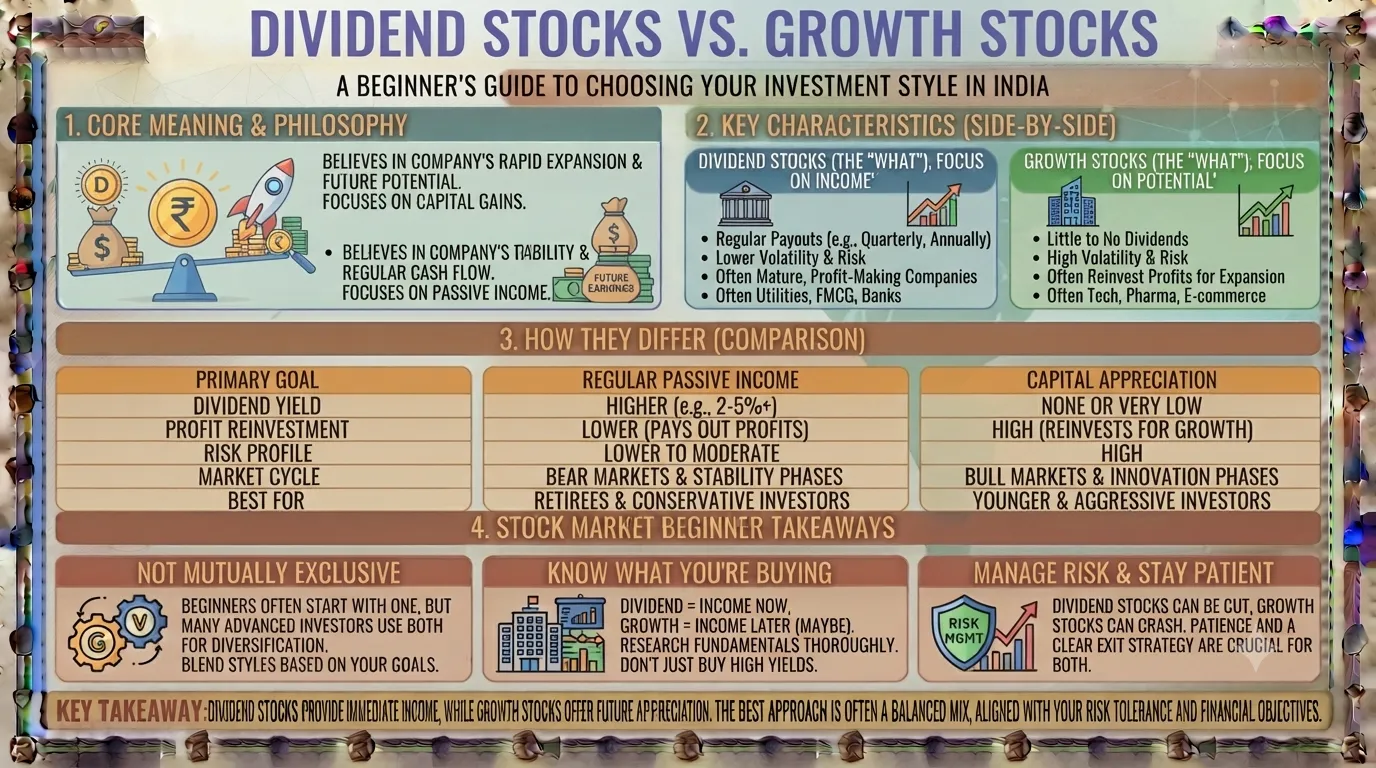
Dividend Stocks vs Growth Stocks: Differences, Returns, Risks and How to Choose
Some investors prefer shares that distribute a portion of company profits as dividends. Others prefer companies that retain earnings and reinvest them to expand their businesses. These approaches are commonly described as dividend investing and growth investing.
The choice between dividend stocks vs growth stocks is not simply a choice between regular income and higher share-price appreciation. It involves understanding how a company uses its profits, whether its dividend payments are sustainable, how quickly its business can grow, and what price investors are paying for its shares.
For Indian investors, both approaches are relevant across companies listed on the NSE and BSE. Some established businesses distribute dividends while continuing to grow. Some fast-growing companies pay small dividends. Others retain nearly all available profits because they have attractive opportunities to reinvest.
This guide explains how dividend and growth stocks work, how to evaluate them, how dividends affect total investment returns, the risks of each approach and how to compare them using practical Indian market examples.
Dividend Stocks vs Growth Stocks: The Direct Answer
Dividend stocks are shares of companies that distribute a portion of their earnings or available profits to shareholders through dividends. Investors may use these payments as income or reinvest them to buy additional shares. A dividend is not guaranteed and can be reduced, suspended or increased depending on the company's financial position and dividend policy.
Growth stocks are shares of companies that investors expect to increase revenue, earnings or cash flows faster than comparable businesses or the broader market. These companies often retain a significant portion of their profits to fund expansion, product development, technology, capacity or entry into new markets. Their potential shareholder returns may depend more heavily on future business performance and share-price appreciation.
The main difference is how investors assess the company's use of capital and the potential sources of return. Dividend investors focus on the sustainability and growth of cash distributions as well as capital appreciation. Growth investors focus more on the company's ability to reinvest capital and expand its future earning power.
These categories are not mutually exclusive. A company can pay dividends and still grow its business. A company can also stop paying dividends if its financial position or investment opportunities change.
What Are Dividend Stocks?
A dividend stock is a share of a company that distributes cash or, in certain cases, another form of dividend to eligible shareholders. Cash dividends are the most familiar form. They represent a distribution to shareholders rather than a guaranteed interest payment or fixed return.
Companies may declare interim dividends during a financial year, final dividends after the financial year, or special dividends when they decide to distribute an unusual amount of surplus cash. The timing and amount depend on the company's decisions, applicable law and its financial circumstances.
Why Do Companies Pay Dividends?
A company may pay dividends when it generates cash beyond what management believes it can reinvest productively in the business. A mature company may have an established market position, predictable demand and fewer high-return expansion opportunities than it had in its earlier stages.
Distributing part of its surplus cash can be one way to return capital to shareholders. It can also communicate management's confidence in the company's cash-generation ability, although a dividend announcement alone does not prove that the business is financially strong.
Companies may also continue paying dividends because of an established capital-allocation policy. However, the board must consider future investment requirements, debt obligations, cash reserves, profitability and other financial commitments before recommending or declaring a distribution.
Common Characteristics of Dividend Stocks
- Cash distributions: Shareholders may receive cash dividends when the company declares and pays them.
- Established operations: Many dividend-paying businesses operate in mature industries, although this is not a requirement.
- Cash-generation capacity: Sustainable dividends generally require adequate cash generation and a manageable financial position.
- Lower retention of some earnings: A company distributing a large portion of its profits retains less of those profits for reinvestment.
- Potential income growth: Some companies increase their dividend per share over time, but future increases are not assured.
- Capital appreciation or depreciation: The share price can rise or fall independently of the dividend received.
What Are Growth Stocks?
Growth stocks represent companies that investors expect to expand their revenue, earnings or cash flows faster than the market or their industry. Growth may come from new products, rising customer demand, market-share gains, expansion into new regions, technology adoption, improved distribution or operational efficiency.
Growth companies often reinvest profits into their businesses rather than distributing a large share of earnings as dividends. The purpose is to increase future earning capacity. If those investments produce attractive returns, the business may become more valuable over time.
Growth stocks are not necessarily small companies or newly listed businesses. A large, established company can still be a growth stock if it has meaningful expansion opportunities. Likewise, a small company is not automatically a growth stock simply because its revenue base is small.
Why Do Growth Companies Retain Profits?
Management may believe that reinvesting profits into the business can generate better long-term value than distributing the same cash to shareholders. For example, a company may use retained earnings to build a new manufacturing facility, expand its technology platform, develop a new product or enter an overseas market.
The decision makes economic sense only when the expected returns on those investments justify the capital employed and associated risks. Reinvestment is not automatically good. If management repeatedly invests in projects that earn less than the company's cost of capital, retaining profits can destroy shareholder value.
Common Characteristics of Growth Stocks
- Strong business expansion: Revenue, customers, production capacity or market share may be increasing.
- Potential earnings growth: Investors expect expansion to translate into higher future profits.
- Reinvestment: A substantial part of available cash may be used for capacity, technology, research or market expansion.
- Lower or no dividends: Some growth companies distribute little cash because they have attractive reinvestment opportunities.
- Valuation expectations: Investors may pay higher valuation multiples when they expect sustained future growth.
- Execution risk: Growth plans can fail because of competition, weak demand, cost overruns or poor capital allocation.
Dividend Stocks vs Growth Stocks: Key Differences
The following comparison describes common characteristics, not universal rules. A company can display features of both categories, and the actual risk of a stock depends on its business, financial position, valuation and industry.
| Comparison Factor | Dividend Stocks | Growth Stocks |
|---|---|---|
| Primary focus | Cash distributions to shareholders and potential capital appreciation | Expansion of revenue, earnings and future business value |
| Use of profits | A portion may be distributed as dividends | A larger portion may be retained for reinvestment |
| Investor return sources | Dividends and changes in share price | Primarily capital appreciation, although dividends may also be paid |
| Business stage | Often mature, established businesses | May be expanding businesses at different stages of development |
| Dividend policy | Dividend payments are an important part of the investment case | Dividend payments may be low, irregular or absent |
| Financial analysis | Dividend yield, payout ratio, cash flow, debt and dividend history | Revenue growth, earnings growth, margins, reinvestment returns and valuation |
| Potential concern | Dividend cuts, unsustainable payouts and yield traps | Overvaluation, failed expansion and slower-than-expected growth |
| Common investor objective | Cash distributions and possible long-term wealth creation | Long-term capital appreciation through business expansion |
| Important limitation | Dividends are not guaranteed and share prices can fall | Growth expectations may not materialise or may already be priced in |
How Do Investors Earn Returns from Dividend and Growth Stocks?
Understanding the sources of return is essential because a dividend payment alone does not tell an investor whether an investment has performed well.
1. Returns from Dividend Stocks
An investor holding dividend-paying shares may receive cash distributions and may also benefit from an increase in the market price of the shares. If the share price declines, however, the dividend may not compensate for the capital loss.
Total return before taxes and costs can be expressed as:
Total Return (%) = [(Ending Share Value − Initial Investment) + Dividends Received] ÷ Initial Investment × 100
This simplified formula assumes the dividends are received as cash and are not reinvested. If dividends are reinvested, the calculation must also account for the additional shares purchased and their subsequent value.
2. Returns from Growth Stocks
Growth investors generally expect a larger part of their return to come from an increase in the value of the business and its shares. If the company expands earnings and the market continues to value those earnings favourably, the share price may rise.
However, business growth does not guarantee share-price appreciation. If investors have already priced in very high expectations, the share price can fall even when revenue and profits increase. Changes in interest rates, market sentiment and valuation multiples can also affect returns.
3. Why Total Return Matters More Than Dividend Yield Alone
Consider two hypothetical investments. One generates cash dividends but experiences a decline in its share price. The other pays no dividend but increases substantially in market value. Comparing only their dividend yields would ignore a major part of the investment outcome.
Investors should evaluate the combination of capital appreciation, dividends, taxes, transaction costs and the time period involved. For mutual funds and indices, total-return measures are particularly important because price-return measures exclude reinvested distributions.
How to Calculate Dividend Yield
Dividend yield measures the annual dividend per share relative to the current market price of the share. It helps investors compare the cash distribution with the amount they would pay to buy the stock at that price.
Dividend Yield (%) = Annual Dividend per Share ÷ Current Market Price per Share × 100
Hypothetical Dividend Yield Example
Assume an Indian company has declared total dividends of ₹12 per share over the relevant twelve-month period. Its current market price is ₹240 per share.
Dividend Yield = (₹12 ÷ ₹240) × 100 = 5%
This means the historical annual dividend represents 5% of the current share price. It does not mean that the investor is guaranteed to receive 5% every year. The company may change its dividend policy, and the share price may change.
Why Dividend Yield Can Be Misleading
A high dividend yield can result from a large dividend, a falling share price or both. If a company's share price falls sharply because investors expect earnings to deteriorate, its calculated yield may rise even though the future dividend is at risk.
For this reason, investors should not rank companies only by dividend yield. They should investigate the reasons for the yield, the company's cash generation, payout ratio, debt, earnings stability and future capital requirements.
How to Evaluate Dividend Stocks
A reliable dividend investment requires more than a record of past payments. Investors need to determine whether the business can continue distributing cash without weakening its financial position or sacrificing important investment opportunities.
1. Check Dividend History
Review the company's dividend payments over several years. Look for consistency, changes in dividend per share and the reasons behind unusual increases or cuts.
A long history of dividend payments can be useful information, but it does not guarantee future distributions. Past payments may have been supported by exceptional profits, asset sales or unusually favourable industry conditions.
2. Examine the Dividend Payout Ratio
The dividend payout ratio measures the proportion of earnings distributed as dividends.
Dividend Payout Ratio (%) = Total Dividends ÷ Net Profit × 100
Alternatively, when per-share figures are used consistently:
Dividend Payout Ratio (%) = Dividend per Share ÷ Earnings per Share × 100
Suppose a hypothetical company reports earnings per share of ₹20 and declares a dividend of ₹8 per share.
Payout Ratio = (₹8 ÷ ₹20) × 100 = 40%
The company has distributed 40% of its earnings per share and retained the remaining 60%, subject to accounting and cash-flow considerations.
There is no universal payout ratio that is appropriate for every industry. A capital-intensive business may need to retain more cash for investment, while a mature business with limited expansion opportunities may be able to distribute a larger share. Investors should compare the ratio with the company's history, cash flow and business requirements.
3. Check Operating Cash Flow
Dividends are cash payments. A company reporting accounting profits but consistently weak operating cash flow may have difficulty sustaining distributions.
Compare cash flow from operations with dividends paid over several financial years. Investigate whether dividend payments are being supported by recurring operating cash generation, borrowing, asset sales or accumulated cash reserves.
4. Review Debt and Interest Obligations
A company with substantial debt may need to prioritise interest payments, debt repayment and capital expenditure before distributing cash to shareholders.
For non-financial businesses, investors may examine net debt, debt-to-equity, interest coverage and debt maturities. Banks and other financial institutions require sector-specific measures such as asset quality, capital adequacy and liquidity; industrial-company leverage ratios should not be applied mechanically to them.
5. Examine Dividend Growth
Dividend growth measures how the dividend per share changes over time. A company with a modest current yield but a sustainable record of increasing dividends may be relevant to investors seeking income that could rise over the years.
However, dividend growth should be supported by earnings and cash-flow growth. A company cannot indefinitely increase distributions faster than its underlying capacity to generate cash without eventually putting pressure on its financial position.
6. Understand Capital Allocation
Management must decide how to allocate cash between dividends, debt reduction, acquisitions, capital expenditure, research and development, and other uses. Investors should examine whether these decisions create value for shareholders.
A company that distributes too much cash may underinvest in its business. Another company may retain too much cash but fail to generate attractive returns from it. A sound dividend policy balances shareholder distributions with long-term business needs.
How to Evaluate Growth Stocks
Growth investing requires investors to assess whether a company can expand its business profitably and whether its current share price reasonably reflects those prospects.
1. Examine Revenue and Earnings Growth
Study revenue, operating profit and earnings per share over several years. Compare the company's growth with its competitors and the wider industry.
Revenue growth without corresponding improvement in margins or cash flow may indicate that expansion is expensive or unprofitable. Investors should understand whether sales are increasing through recurring customer demand, price increases, acquisitions or one-time contracts.
2. Assess Reinvestment Opportunities
A growth company should have opportunities to reinvest capital at attractive returns. These may include expanding production capacity, entering new markets, developing new products or improving technology.
Examine whether past investments have generated higher revenue, operating profit and cash flow. A company that retains profits but repeatedly fails to produce attractive returns may not deserve a growth premium.
3. Study Return on Capital
Return on capital employed (ROCE) and return on equity (ROE) can help investors understand how effectively a business uses capital. Interpret these measures with the company's debt, asset structure, accounting policies and industry in mind.
Growth funded by repeated borrowing or share issuance may not create attractive value for existing shareholders. Check whether the business can expand without taking on excessive financial risk or diluting shareholders unnecessarily.
4. Evaluate Competitive Advantage
Long-term growth is more sustainable when a company has a defensible advantage. This may come from brand strength, distribution, switching costs, patents, technology, cost advantages or customer relationships.
Without a durable advantage, competitors may copy the product, reduce prices and compress margins. Investors should ask what prevents other companies from offering a similar service or product at a lower cost.
5. Check Valuation
A good business is not automatically a good investment at every price. Compare the share price with earnings, cash flows, expected growth and relevant industry peers.
High valuation multiples can make a growth stock sensitive to changes in investor expectations. If future growth is lower than expected, the share price may decline even if the company continues to grow.
Dividend Stocks vs Growth Stocks: Hypothetical Indian Investment Example
The following examples use fictional companies and simplified assumptions. They are designed to explain the calculations and do not represent actual listed companies, current market prices or investment recommendations.
Company A: Dividend-Oriented Business
- Initial share price: ₹200
- Shares purchased: 100
- Initial investment: ₹20,000
- Annual dividend per share: ₹10
- Total annual dividend: ₹1,000
- Share price after one year: ₹210
The investor receives ₹1,000 in dividends. The shares are worth ₹21,000 at the end of the year.
Total Value = ₹21,000 + ₹1,000 = ₹22,000
Total Return = [(₹22,000 − ₹20,000) ÷ ₹20,000] × 100 = 10%
Company B: Growth-Oriented Business
- Initial share price: ₹200
- Shares purchased: 100
- Initial investment: ₹20,000
- Annual dividend: ₹0
- Share price after one year: ₹225
The shares are worth ₹22,500 at the end of the year. There is no dividend income in this example.
Total Return = [(₹22,500 − ₹20,000) ÷ ₹20,000] × 100 = 12.5%
In this hypothetical period, Company B produces the higher total return. That does not prove growth stocks always outperform dividend stocks. If Company B's share price had fallen, its return could have been negative. If Company A's share price had fallen significantly, its dividend might not have offset the capital loss.
| Measure | Company A | Company B |
|---|---|---|
| Initial investment | ₹20,000 | ₹20,000 |
| Dividend received | ₹1,000 | ₹0 |
| Ending share value | ₹21,000 | ₹22,500 |
| Total value including dividend | ₹22,000 | ₹22,500 |
| Illustrative total return | 10% | 12.5% |
The key lesson is to compare total returns rather than treating dividend income and share-price appreciation as unrelated outcomes.
Dividend Yield vs Dividend Growth: Which Matters More?
Dividend yield and dividend growth measure different things. Dividend yield focuses on the current annual dividend relative to the share price. Dividend growth focuses on how the dividend per share changes over time.
An investor who needs current cash flow may pay closer attention to the existing yield. An investor with a longer horizon may also consider whether the company's earnings and cash flow can support rising dividends in the future.
| Factor | High Dividend Yield | Dividend Growth |
|---|---|---|
| Main focus | Cash distribution relative to current share price | Increase in dividend per share over time |
| Potential advantage | Higher current cash income if maintained | Potential for rising income over time |
| Main risk | High yield may be caused by a falling share price or unsustainable payout | Future dividend increases may not materialise |
| Important checks | Cash flow, payout ratio, debt and earnings stability | Earnings growth, reinvestment returns and dividend policy |
A high current yield is not automatically superior to a lower yield with sustainable growth. Investors should consider the business's ability to maintain and increase distributions rather than chase the largest number on a stock screener.
Dividend Stocks vs Growth Stocks: Risks and Limitations
Risks of Dividend Stocks
- Dividend cuts: Companies can reduce or stop distributions when profits, cash flow or financial conditions weaken.
- Yield traps: A high dividend yield may reflect a falling share price and expectations of a future dividend reduction.
- Limited reinvestment: Distributing too much cash may leave insufficient capital for attractive business opportunities.
- Sector concentration: Dividend-oriented strategies may become concentrated in a few mature industries, such as energy, utilities or financial services.
- Tax impact: Dividend income may be taxable in the shareholder's hands, reducing the amount retained after tax.
- Capital loss: A dividend payment does not prevent the share price from declining.
Risks of Growth Stocks
- Valuation risk: A high share price may already reflect optimistic assumptions about future growth.
- Execution risk: Expansion plans may fail because of weak demand, competition, cost overruns or management mistakes.
- Funding risk: Companies dependent on external capital may face difficulties when borrowing costs rise or financing becomes unavailable.
- Profitability risk: Rapid revenue growth may not translate into sustainable profits or free cash flow.
- Volatility: Growth shares can be sensitive to changes in earnings expectations and market sentiment.
- Opportunity-cost risk: Retaining profits creates value only when management can reinvest them productively.
How Dividends Affect Share Prices: Ex-Dividend Date and Record Date
Investors should understand dividend dates before buying shares for a declared dividend. A dividend is not free money created on the payment date; it is a distribution of company value to eligible shareholders.
Declaration Date
The declaration date is when the company announces the dividend decision, subject to the applicable approval process. The announcement generally specifies the dividend amount and relevant dates.
Record Date
The record date is the date on which the company identifies shareholders eligible to receive the dividend. Investors should check the official corporate-action announcement and settlement rules to determine eligibility.
Ex-Dividend Date
The ex-dividend date is the date from which a buyer of the shares is no longer entitled to the announced dividend. In India's T+1 settlement framework, the ex-date and record-date relationship should be checked against the exchange's published corporate-action details.
When a stock begins trading ex-dividend, its price may adjust downward to reflect the cash distribution leaving the company. The actual market price movement can differ because prices also respond to demand, supply and other news.
Payment Date
The payment date is when the company distributes the dividend to eligible shareholders through the prescribed payment process.
Investors can check the company's announcements and the exchange's corporate-action information rather than relying on social-media posts or unverified dividend calendars.
Dividend Taxation in India
Dividend taxation affects the amount an investor ultimately keeps. Under the Income Tax Department's published guidance, dividend income received by a resident individual is generally taxable at the applicable income-tax slab rate, subject to the relevant provisions and exceptions. The treatment can differ according to residential status and the type of security.
Tax deducted at source (TDS), where applicable, is not necessarily the final tax liability. It is a tax collection mechanism. The investor's final liability depends on the applicable tax rules and personal tax circumstances.
Investors should check the current Income Tax Department guidance and consult a qualified tax professional for their circumstances. Tax rules can change, and the calculation should not be based on old articles or outdated TDS thresholds.
For official information, refer to the Income Tax Department's dividend income guidance.
Can a Company Be Both a Dividend Stock and a Growth Stock?
Yes. Dividend-paying and growth-oriented characteristics can exist in the same company.
A business may generate enough cash to fund expansion while also distributing a portion of its profits to shareholders. This can happen when a company has strong operating cash flow, attractive reinvestment opportunities and sufficient financial flexibility.
For example, a hypothetical consumer-products company may expand its distribution network, introduce new products and increase sales while continuing to pay a moderate dividend. Its growth potential and dividend policy are not mutually exclusive.
Similarly, a company may start paying dividends after reaching a more mature stage, or reduce dividends temporarily when it needs additional funds for expansion or financial stability.
Investors should therefore evaluate the company's capital-allocation decisions rather than assume that dividend-paying companies cannot grow or that growth companies never distribute cash.
How to Choose Between Dividend Stocks and Growth Stocks
The appropriate approach depends on the investor's financial goals, time horizon, liquidity needs, risk tolerance and ability to evaluate companies. A stock's category should not be the only factor in the decision.
Dividend Stocks May Be Relevant When:
- The investor values cash distributions from equity holdings.
- The company has sustainable operating cash flow and a manageable payout ratio.
- The investor understands that dividends can be reduced or suspended.
- The share price and valuation are reasonable relative to business fundamentals.
- The investor has considered the tax treatment of dividend income.
Growth Stocks May Be Relevant When:
- The investor is seeking long-term capital appreciation.
- The company has a credible opportunity to expand its business and earnings.
- Management has a record of allocating capital productively.
- The balance sheet can support the planned expansion.
- The current valuation does not assume unrealistic future performance.
Neither approach is automatically suitable for every investor. Someone who needs money for near-term expenses should not rely on volatile equity investments as a guaranteed source of cash. Similarly, an investor with a long horizon should not buy a growth stock without checking its valuation and business risks.
Should Investors Combine Dividend and Growth Stocks?
Some investors hold both dividend-paying and growth-oriented businesses. The intention may be to combine potential cash distributions with exposure to companies reinvesting for future expansion.
A blended portfolio does not automatically guarantee higher returns or lower risk. Its effectiveness depends on the underlying businesses, sector exposures, valuations and how much capital is allocated to each holding.
A disciplined evaluation process may include:
- Define the objective: Decide whether the portfolio is intended to support cash-flow needs, long-term wealth creation or a combination.
- Evaluate business fundamentals: Review revenue, profits, cash flow, debt, management and competitive position for every company.
- Check valuation: Avoid paying an unreasonable price simply because a company has a high dividend yield or impressive growth history.
- Review sector exposure: Multiple dividend stocks may be concentrated in similar industries, while growth holdings may share common economic risks.
- Monitor changing fundamentals: Reassess holdings when dividend policy, earnings, debt or business prospects change.
- Consider diversification: Do not rely on a small number of shares or one investment style to meet every financial objective.
Investors who prefer not to select individual companies can also study diversified mutual funds and index funds. However, they should examine the fund's mandate, holdings, costs, benchmark and risk disclosures instead of assuming that a fund's name guarantees a particular outcome.
Dividend Investing in the Indian Stock Market: The Nifty Dividend Opportunities 50
Indian investors can study strategy indices to understand how dividend-oriented stocks are selected systematically. One example is the Nifty Dividend Opportunities 50, maintained by NSE Indices.
NSE Indices describes this index as providing exposure to high-yielding companies listed on the NSE while applying stability and tradability requirements. Its methodology uses dividend yield as a selection factor, alongside eligibility criteria. This makes it a useful reference for understanding how a dividend-focused index can be constructed.
However, an index methodology is not a guarantee that every constituent will maintain its dividend or that the index will outperform a broader market benchmark. Investors should read the latest factsheet and methodology before drawing conclusions about its holdings or performance.
Review the official Nifty Dividend Opportunities 50 index page.
Price Return vs Total Return Indices
Another important distinction is between a price return index and a total return index. A price return index reflects changes in the prices of its constituent securities. A total return index also accounts for dividends and assumes their reinvestment according to the index methodology.
NSE explains that its Nifty 50 Total Returns index includes dividends, unlike the price index. This matters when comparing dividend-oriented strategies with broad-market benchmarks. Comparing a dividend strategy's total return with another index's price return would not be an equal comparison.
Read the NSE index FAQs for its explanation of price and total-return indices.
Common Mistakes Investors Should Avoid
1. Buying Only Because the Dividend Yield Is High
A high yield may reflect a falling share price or an unsustainable payout. Examine earnings, cash flow, debt and the reason behind the yield before treating it as an opportunity.
2. Assuming Dividend Income Is Guaranteed
Dividends are not fixed interest payments. A company can reduce or cancel a dividend depending on its financial position and decisions.
3. Ignoring Capital Losses
Receiving a dividend does not mean the investment has generated a positive total return. A fall in share price can exceed the cash distribution.
4. Assuming Growth Companies Never Pay Dividends
Some expanding companies distribute a portion of their earnings while reinvesting the rest. Dividend policy and growth prospects should be assessed separately.
5. Ignoring the Quality of Reinvestment
Retained profits are useful only when management can invest them productively. Growth funded by poor acquisitions, uneconomic expansion or excessive debt can weaken shareholder value.
6. Comparing Companies Without Considering Their Industries
Capital requirements, payout capacity and earnings stability differ across sectors. A bank, utility, manufacturing company and software business should not be judged using identical financial assumptions.
7. Confusing Dividend Yield with Total Return
Dividend yield measures the annual dividend relative to the share price. It does not include capital gains or losses and does not measure the full investment outcome.
Practical Checklist Before Investing
Use this checklist to organise your research before investing in a dividend-oriented or growth-oriented company:
- Do I understand how the company earns revenue?
- Are its products or services likely to remain relevant?
- How have revenue, earnings and operating cash flow changed over several years?
- Is the dividend supported by recurring cash generation?
- Is the dividend payout ratio appropriate for the company's industry and investment needs?
- Can the balance sheet support the company's debt and dividend commitments?
- Does management allocate retained profits productively?
- Does the company have a sustainable competitive advantage?
- Is the current share price reasonable relative to its financial performance and prospects?
- Have I considered dividend taxation and transaction costs?
- What could cause the investment thesis to fail?
- Does this investment fit my overall financial goals and risk tolerance?
Frequently Asked Questions
1. What is the main difference between dividend stocks and growth stocks?
Dividend stocks are shares of companies that distribute a portion of their profits or available cash to shareholders. Growth stocks are shares of companies expected to expand revenue, earnings or cash flows faster than comparable businesses. Dividend investing focuses on sustainable distributions as well as potential capital appreciation, while growth investing places greater emphasis on future business expansion.
2. Are dividend stocks better than growth stocks?
Neither category is universally better. Dividend stocks may provide cash distributions, but their share prices can fall and dividends can be reduced. Growth stocks may offer capital appreciation through business expansion, but they can be sensitive to valuation and execution risks. The more suitable approach depends on financial goals, risk tolerance, investment horizon and the price paid.
3. Do growth stocks pay dividends?
Some growth stocks pay dividends, although many reinvest a larger share of their profits into expansion. A company can distribute some earnings while using the remaining cash for new products, capacity or market expansion. Growth potential and dividend payments are not mutually exclusive.
4. How do I calculate dividend yield?
Dividend yield is calculated by dividing the annual dividend per share by the current market price per share and multiplying by 100. For example, if a company pays ₹10 per share annually and its market price is ₹200, its dividend yield is 5%. This is based on the stated dividend and current price; future payments are not guaranteed.
5. Are high-dividend stocks low-risk investments?
Not necessarily. A high dividend yield can indicate an attractive distribution, but it may also result from a falling share price or an unsustainable payout. Investors should examine cash flow, earnings, debt, dividend history and business risks rather than assuming that a high yield means low risk.
6. Is dividend income taxable in India?
For resident individual shareholders, dividend income is generally taxable at the applicable income-tax slab rate, subject to current tax provisions and exceptions. TDS, where applicable, is not necessarily the final tax liability. Investors should check current Income Tax Department guidance for their circumstances.
7. Can I build a portfolio with both dividend and growth stocks?
Yes. Investors may combine dividend-paying companies with growth-oriented businesses to gain exposure to both cash distributions and potential business expansion. However, diversification depends on the underlying companies and sector exposures, not just the labels attached to the stocks.
8. What should I check before buying a dividend stock in India?
Review dividend history, dividend yield, payout ratio, operating cash flow, debt, earnings stability, management's capital-allocation decisions and valuation. Also check the company's official dividend announcements, ex-dividend date and record date. A high historical yield alone is not sufficient to establish that a dividend is sustainable.
Conclusion
Dividend stocks and growth stocks offer different ways to participate in the performance of businesses. Dividend-oriented companies distribute part of their available profits to shareholders, while growth-oriented companies often retain more capital to expand their operations and future earning capacity.
Neither approach guarantees a better investment outcome. A dividend can be reduced, a share price can fall and a growth company can fail to generate attractive returns on reinvested profits. Investors should therefore look beyond dividend yield or revenue growth and evaluate cash flow, debt, capital allocation, business quality and valuation.
For Indian investors, the distinction between price returns and total returns is particularly important when comparing dividend-focused strategies with broad-market indices. The most useful decision is not simply whether a company pays dividends, but whether its business and capital-allocation policy can create value at the price investors are paying.
Educational Disclaimer: This article is for educational and informational purposes only. It is not investment advice, a research recommendation or an offer to buy or sell any security. Equity investments are subject to market risks, including possible loss of capital. Dividend payments are not guaranteed. Readers should review official company disclosures, assess their financial goals and risk tolerance, and consider consulting a SEBI-registered investment adviser before making investment decisions.