What Is SEBI and What Does It Do? Functions, Powers and Role Explained
Learn what SEBI is, why it regulates India's securities market, how it protects investors, what powers it has and how retail investors can use its complaint-redressal mechanisms.
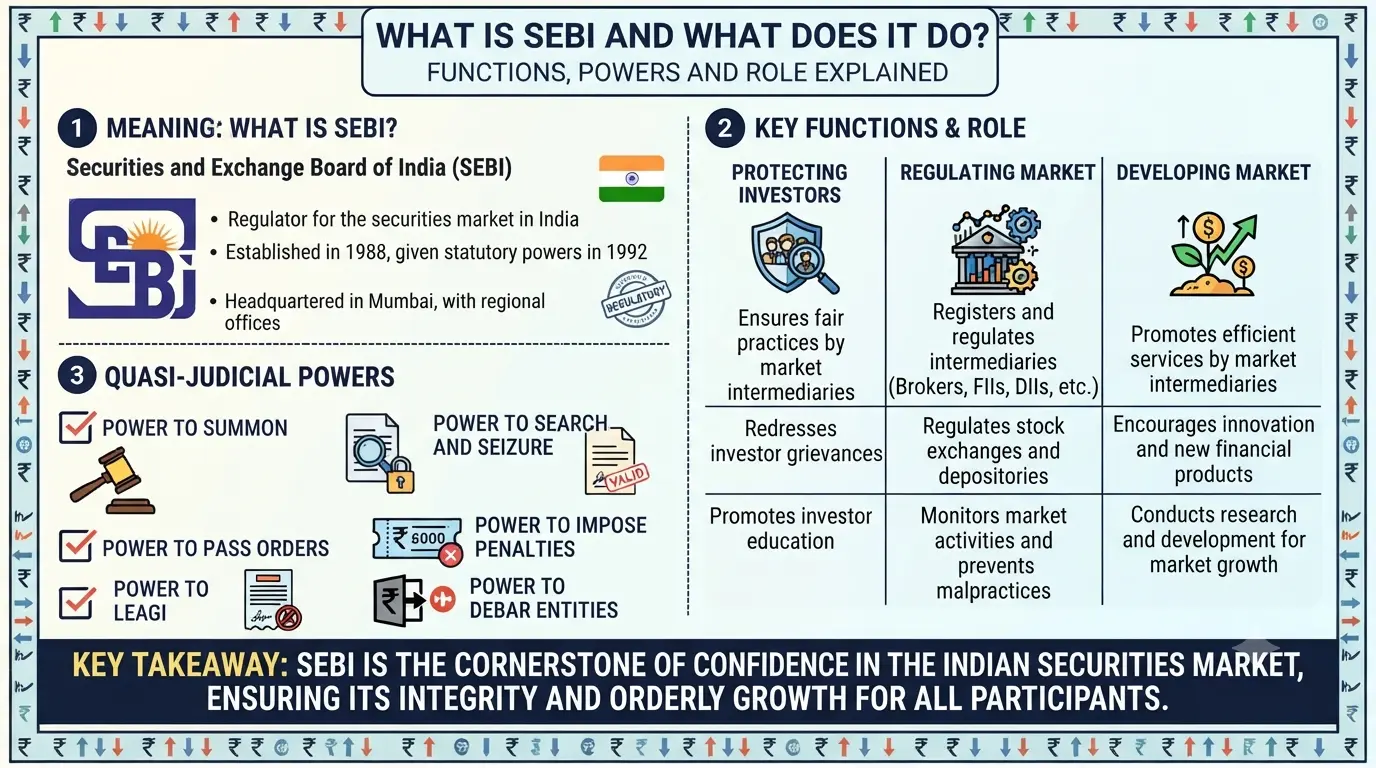
What Is SEBI and What Does It Do? Functions, Powers and Role Explained
When someone opens a Demat account, buys shares through a broker or invests in a mutual fund, several organisations are involved behind the scenes. The stock exchange provides the marketplace, the broker helps execute transactions, and the depository maintains securities in electronic form. But who sets the rules that these participants must follow?
In India's securities market, that responsibility primarily belongs to the Securities and Exchange Board of India, better known as SEBI. Its role goes beyond monitoring share prices. It regulates market participants, works to prevent unfair practices, establishes disclosure requirements and provides mechanisms through which investors can raise certain complaints.
What Is SEBI?
SEBI stands for the Securities and Exchange Board of India. It is the statutory regulator of India's securities market. Its central responsibility is to protect investors' interests, promote the development of the securities market and regulate how the market operates.
SEBI works under the Securities and Exchange Board of India Act, 1992. It oversees important market institutions and intermediaries, including stock exchanges, stockbrokers, mutual funds, investment advisers, depositories and other regulated participants.
In practical terms, SEBI establishes the regulatory framework within which investors, listed companies and financial intermediaries participate in India's securities market. It does not decide which shares an individual should buy, nor does it guarantee that an investment will make money.
When Was SEBI Established?
SEBI was first constituted as a non-statutory body on 12 April 1988 through a Government of India resolution. It later received statutory status under the Securities and Exchange Board of India Act, 1992. The Act came into force on 30 January 1992.
The change was important because a statutory regulator has powers and responsibilities defined by legislation. SEBI's authority is not simply based on an administrative instruction; it is supported by the legal framework governing India's securities market.
The preamble of the SEBI Act sets out three connected objectives: protecting investors, developing the securities market and regulating that market. These objectives form the foundation of the regulator's work.
Why Does the Indian Stock Market Need SEBI?
A stock market brings together people and organisations with very different levels of information, resources and experience. A retail investor may be buying a share using personal savings, while a listed company has access to financial statements, management information and professional advisers. Brokers, institutions and other intermediaries also operate within this system.
Without common rules, participants could misuse confidential information, mislead investors, manipulate trading activity or fail to disclose important information. Investors would find it difficult to judge whether they were dealing with legitimate market participants.
Consider a simple example. A company is preparing to announce a major financial development. If a small group of insiders trades using that information before it becomes public, ordinary investors may be placed at an unfair disadvantage. Rules against insider trading are intended to prevent this kind of misuse of unpublished price-sensitive information.
SEBI's role is to establish and enforce rules that support fair participation, transparency and confidence in the securities market. Regulation cannot remove every risk, but it creates standards that market participants are expected to follow.
What Does SEBI Do? Its Major Functions
SEBI's responsibilities are often grouped into three broad categories: protective, regulatory and developmental functions. These categories help explain its work, although several activities contribute to more than one objective.
1. Protects the Interests of Investors
Investor protection is one of SEBI's central responsibilities. It works to reduce unfair practices and improve the information available to people participating in the securities market.
Examples of investor-protection measures include:
- Prohibiting insider trading and fraudulent or unfair trade practices.
- Requiring regulated entities to follow applicable investor-service and grievance-handling requirements.
- Establishing disclosure and transparency requirements for listed companies and market intermediaries.
- Promoting investor education and awareness about market risks.
- Providing complaint-redressal and dispute-resolution mechanisms for eligible securities-market grievances.
Suppose an investor notices an unauthorised transaction in a trading account. The investor should first contact the concerned broker and preserve relevant records. Depending on the nature of the issue and the response received, the investor may be able to escalate the complaint through the prescribed market grievance mechanisms.
2. Regulates Stock Exchanges and Market Infrastructure
Stock exchanges such as the National Stock Exchange (NSE) and BSE provide organised platforms where securities are traded. They are not operated by SEBI. They function within a regulatory framework overseen by SEBI.
SEBI regulates recognised stock exchanges and other market infrastructure institutions. Its oversight supports orderly trading, appropriate systems and compliance with applicable market rules.
The broader market infrastructure also includes depositories and clearing corporations. Depositories such as NSDL and CDSL maintain securities in electronic form through their systems and participants. SEBI's regulatory framework covers these important parts of the securities-market ecosystem.
3. Registers and Regulates Market Intermediaries
Investors usually access the securities market through intermediaries. A stockbroker, for example, provides a platform and facilities for placing buy and sell orders. Other intermediaries support public issues, investment management, record-keeping and research.
SEBI registers and regulates various intermediaries under the applicable laws and regulations. These include:
- Stockbrokers and depository participants.
- Merchant bankers and underwriters.
- Investment advisers and research analysts.
- Portfolio managers.
- Registrars and share transfer agents.
- Mutual funds and asset management companies.
- Credit rating agencies and other specified market participants.
Registration is not a promise that a participant will always deliver good service or that an investment product will perform well. It means the entity is subject to the relevant regulatory requirements and oversight.
4. Regulates IPOs and Securities-Related Disclosures
When a company plans to raise money from the public through an initial public offering (IPO), investors need access to relevant information about the business, its financial position, risks and the proposed issue.
SEBI's framework sets requirements for public issues and offer documents. It also establishes disclosure obligations that help investors examine the information provided by issuers.
This does not mean SEBI certifies an IPO as a good investment. Regulatory observations or compliance with disclosure requirements should not be interpreted as a recommendation to subscribe. Investors still need to examine the company's business model, financial performance, valuation, risks and objectives.
5. Monitors and Acts Against Market Manipulation
Market manipulation can create misleading prices or trading activity. Examples may include artificial volume generation, deceptive trading practices and coordinated attempts to mislead market participants.
SEBI has powers to call for information, inspect records, conduct inquiries and investigate suspected violations. Depending on the facts and applicable law, it may issue directions or take enforcement action against persons or entities involved in wrongdoing.
Insider trading is another important area. People who possess unpublished price-sensitive information cannot lawfully misuse it to gain an unfair trading advantage. SEBI's regulatory framework includes restrictions intended to prevent such conduct.
6. Regulates Mutual Funds and Other Investment Products
Mutual funds collect money from investors and invest it according to the objectives and rules of their schemes. Investors need information about a scheme's investment strategy, risks, expenses and portfolio.
SEBI regulates mutual funds and asset management companies under the applicable framework. This includes requirements relating to disclosures, operations, governance and investor-related processes.
Similar regulatory oversight applies to other specified securities-market products and structures, including Alternative Investment Funds and collective investment schemes.
7. Promotes Investor Education and Market Development
Regulation is not limited to enforcement. A well-functioning market also needs informed participants, reliable infrastructure and processes that can support wider participation.
SEBI undertakes investor-awareness initiatives and supports the development of the securities market. Its work includes improving regulatory frameworks, encouraging better market practices and promoting financial literacy.
For a beginner, investor education can be particularly useful. Understanding risk, reading scheme documents, checking intermediary registration and recognising unrealistic return promises can help reduce avoidable mistakes.
What Powers Does SEBI Have?
SEBI's functions are supported by powers granted under the SEBI Act and other applicable legislation. Its role is commonly described through three types of authority.
Quasi-Legislative Powers
These relate to framing regulations and establishing rules for securities-market participants. For example, SEBI issues regulations governing mutual funds, stockbrokers, investment advisers, research analysts and other regulated entities.
Quasi-Executive Powers
These relate to implementing and enforcing the regulatory framework. SEBI can inspect records, call for information, conduct investigations and take appropriate action when it identifies possible violations.
Quasi-Judicial Powers
These relate to adjudication and orders in matters within SEBI's legal authority. Depending on the case and the applicable procedure, SEBI can impose penalties or issue directions against entities and individuals found to have violated securities laws.
These powers are subject to the law and applicable procedures. A person affected by certain SEBI orders may have a right to appeal before the Securities Appellate Tribunal (SAT), subject to the relevant legal provisions.
How Does SEBI Protect a Retail Investor? A Practical Example
Imagine that an investor receives a message in a WhatsApp group claiming that a particular stock will double in a few weeks. The group administrator says the information is confidential and asks members to pay for a premium recommendation.
The investor should not assume that the claim is genuine simply because the message uses market terminology or displays screenshots of previous profits. A sensible first step is to check whether the person or organisation is authorised or registered for the activity they claim to provide.
If the activity involves a regulated securities-market service, the relevant SEBI rules may apply. SEBI's framework includes requirements for specified investment advisers and research analysts, as well as restrictions on fraudulent and unfair trade practices.
The investor should preserve messages, payment records, names, account details and other evidence. If there is a securities-market grievance against a listed company or regulated intermediary, the investor can follow the appropriate complaint route. Suspected cybercrime or payment fraud may also require reporting to the relevant law-enforcement or cybercrime authority; not every online scam is exclusively a SEBI matter.
How Can Investors File a Complaint with SEBI?
SEBI provides a complaint-facilitation system called SCORES, which stands for SEBI Complaints Redress System. It allows investors to lodge and track eligible grievances involving listed companies, SEBI-registered intermediaries and relevant market infrastructure institutions.
Investors should generally approach the concerned company or intermediary first and give it an opportunity to address the issue. If the response is unsatisfactory, the investor may escalate the grievance through SCORES, subject to the platform's eligibility conditions.
Basic Steps to Raise a Securities-Market Complaint
- Contact the concerned entity: Raise the issue with the broker, listed company, depository participant or other relevant entity through its official grievance channel.
- Keep supporting evidence: Save contract notes, account statements, transaction records, emails, complaint references and other relevant documents.
- Use SCORES if required: Visit the official SCORES portal and submit an eligible complaint with the required details.
- Track the complaint: Use the registration reference to follow the status and review the response.
- Explore further resolution options: Depending on the type of dispute and applicable process, an eligible investor may be able to use the securities-market Online Dispute Resolution mechanism.
SCORES is a facilitative grievance-redressal platform; it should not be treated as an automatic guarantee of compensation or recovery. Investors should check the current official instructions and eligibility requirements before filing.
The securities-market SMART ODR framework provides an online route for eligible disputes. The process can include pre-conciliation, conciliation and, where required, arbitration. Investors must follow the prescribed steps, including taking up the grievance with the concerned intermediary before invoking ODR where that is a prerequisite.
SEBI vs NSE vs BSE vs RBI: What Is the Difference?
These organisations are often mentioned together in market news, but they do not perform the same job.
| Organisation | Main role | Simple explanation |
|---|---|---|
| SEBI | Securities-market regulator | Sets and enforces the regulatory framework for India's securities market. |
| NSE | Stock exchange | Provides a platform for trading eligible securities and related market products. |
| BSE | Stock exchange | Provides another organised marketplace for securities trading. |
| RBI | Central bank | Handles monetary policy, currency and banking-system responsibilities, along with other functions under its laws. |
A useful way to remember the distinction is this: NSE and BSE operate marketplaces, while SEBI regulates the securities-market framework within which those exchanges function. RBI has a different mandate as India's central bank, although financial-market responsibilities can intersect across regulators.
What SEBI Does Not Do
Understanding the limits of regulation is just as important as knowing its functions. Some investors expect SEBI to prevent every loss or resolve every financial dispute. That is not its role.
- SEBI does not guarantee returns: A share, mutual fund or other market-linked investment can lose value even when all relevant rules are followed.
- SEBI does not select stocks for investors: It does not tell retail investors which company to buy or when to sell.
- SEBI does not operate NSE or BSE: It regulates the securities-market framework and recognised exchanges; it is not the exchange operator.
- SEBI does not approve an investment as profitable: Compliance with IPO disclosure requirements is not a recommendation to invest.
- SEBI is not the regulator for every financial product: Banking, insurance and pension activities have their own regulatory frameworks, including the RBI, IRDAI and PFRDA within their respective jurisdictions.
- SEBI cannot automatically recover every investor loss: The availability of remedies depends on the facts, the entity involved, the legal framework and the outcome of the relevant process.
Regulation can improve market fairness and accountability. It cannot remove business risk, market volatility or the possibility of an investment decision turning out badly.
Common Mistakes Beginners Make About SEBI
- Assuming SEBI guarantees safety: Regulatory oversight does not remove market risk or guarantee profits.
- Believing every SEBI-registered product is suitable: Registration and regulatory compliance do not establish that a product matches an investor's financial goals or risk tolerance.
- Confusing SEBI with stock exchanges: SEBI regulates the securities market; exchanges provide trading platforms.
- Ignoring registration checks: Investors should verify the status of relevant intermediaries through official sources rather than relying on social-media claims or logos.
- Expecting SEBI to resolve every dispute immediately: Investors must follow the prescribed complaint process and provide accurate supporting information.
- Sharing sensitive information with supposed market experts: Never disclose passwords, OTPs, account credentials or other confidential information to people claiming to offer investment assistance.
How Retail Investors Can Use SEBI's Framework More Effectively
Investors do not need to study every regulation to participate more carefully in the market. A few practical habits can make a meaningful difference.
- Check whether the broker, adviser or other relevant intermediary is registered or recognised for the service it provides.
- Read the risk factors, scheme documents, offer documents and fee disclosures before investing.
- Keep contract notes, statements, emails and complaint references in an organised place.
- Use official websites to verify regulatory announcements and investor-protection guidance.
- Be cautious of guaranteed-return claims, urgent payment requests and unverified trading groups.
- Understand the correct complaint channel before escalating a problem.
SEBI's investor charter also explains investor rights and responsibilities. It encourages fair treatment, timely grievance redressal, careful review of documents and awareness of fees and risks.
Frequently Asked Questions About SEBI
1. What is the full form of SEBI?
SEBI stands for the Securities and Exchange Board of India. It is the statutory regulator responsible for protecting investors' interests and regulating and developing India's securities market.
2. When was SEBI established in India?
SEBI was constituted as a non-statutory body on 12 April 1988. It became a statutory body under the SEBI Act, 1992, which came into force on 30 January 1992.
3. What are the three main functions of SEBI?
SEBI's functions are commonly grouped into protective, regulatory and developmental categories. These cover investor protection, regulation of market participants and infrastructure, enforcement against unfair practices, investor education and securities-market development.
4. Does SEBI regulate NSE and BSE?
Yes. SEBI regulates recognised stock exchanges such as NSE and BSE under the applicable securities laws. However, SEBI does not operate these exchanges. NSE and BSE provide the trading marketplaces.
5. Does SEBI guarantee that investors will not lose money?
No. SEBI works to support fair and transparent markets, but it does not guarantee investment returns or prevent ordinary market losses. Share prices and mutual fund values can fall because of business, economic and market-related risks.
6. How can I complain to SEBI?
Investors should generally raise the issue with the concerned listed company or intermediary first. If the grievance is not resolved satisfactorily, an eligible complaint can be escalated through SEBI's SCORES platform at scores.gov.in, following the official filing requirements.
7. Is SEBI the same as RBI?
No. SEBI regulates India's securities market, while RBI is the country's central bank and is responsible for monetary policy and important banking and financial-system functions. They have different mandates and legal responsibilities.
8. Does SEBI regulate mutual funds in India?
Yes. Mutual funds and asset management companies operate under SEBI's regulatory framework. The framework covers areas such as scheme disclosures, operations, governance and investor-related requirements.
Conclusion
SEBI plays a central role in India's securities market. It regulates exchanges and market intermediaries, establishes rules for investment products, monitors market conduct and provides mechanisms for eligible investor grievances. These responsibilities help create a more transparent and accountable environment for market participation.
For individual investors, the most useful takeaway is that regulation and investment safety are not the same thing. SEBI can act against violations of securities laws, but it cannot guarantee that a share or mutual fund will generate a profit. Investors still need to understand the risks, verify the people and organisations they deal with, read relevant documents and make decisions carefully.
Educational Disclaimer
This article is intended for general educational and informational purposes only. It is not investment advice, a recommendation to buy or sell securities, or a substitute for professional financial, legal or tax advice. Market investments are subject to risk, including possible loss of capital. Verify current regulations and complaint procedures through official SEBI sources before taking action.